September 27, 2026 · Travel Diary
First, think of Beijing as a map with a sense of direction
Beijing’s map can easily create an illusion of distance for first-time visitors: attractions are neatly arranged, making it seem as though you could easily walk the entire route along a straight line. But once you’re actually out on the streets, the palace walls, intersections, and entrances to various buildings break this line into many segments. The Central Axis is a useful framework for understanding the city, but it doesn’t have to be a mission you must complete in a single day.
This pre-trip guide focuses on the stretch between Jingshan Hill and the Bell and Drum Towers, beginning with an elevated vantage point before returning to ground level. Beijing’s Central Axis, inscribed on the World Heritage List in 2024, connects palaces, gardens, ritual buildings, and public spaces. The symmetrical rooftops visitors see are not merely isolated scenic views, but rather an order cultivated by the city over time; once you understand this, walking through the nearby hutongs will make the shifts in scale particularly clear.
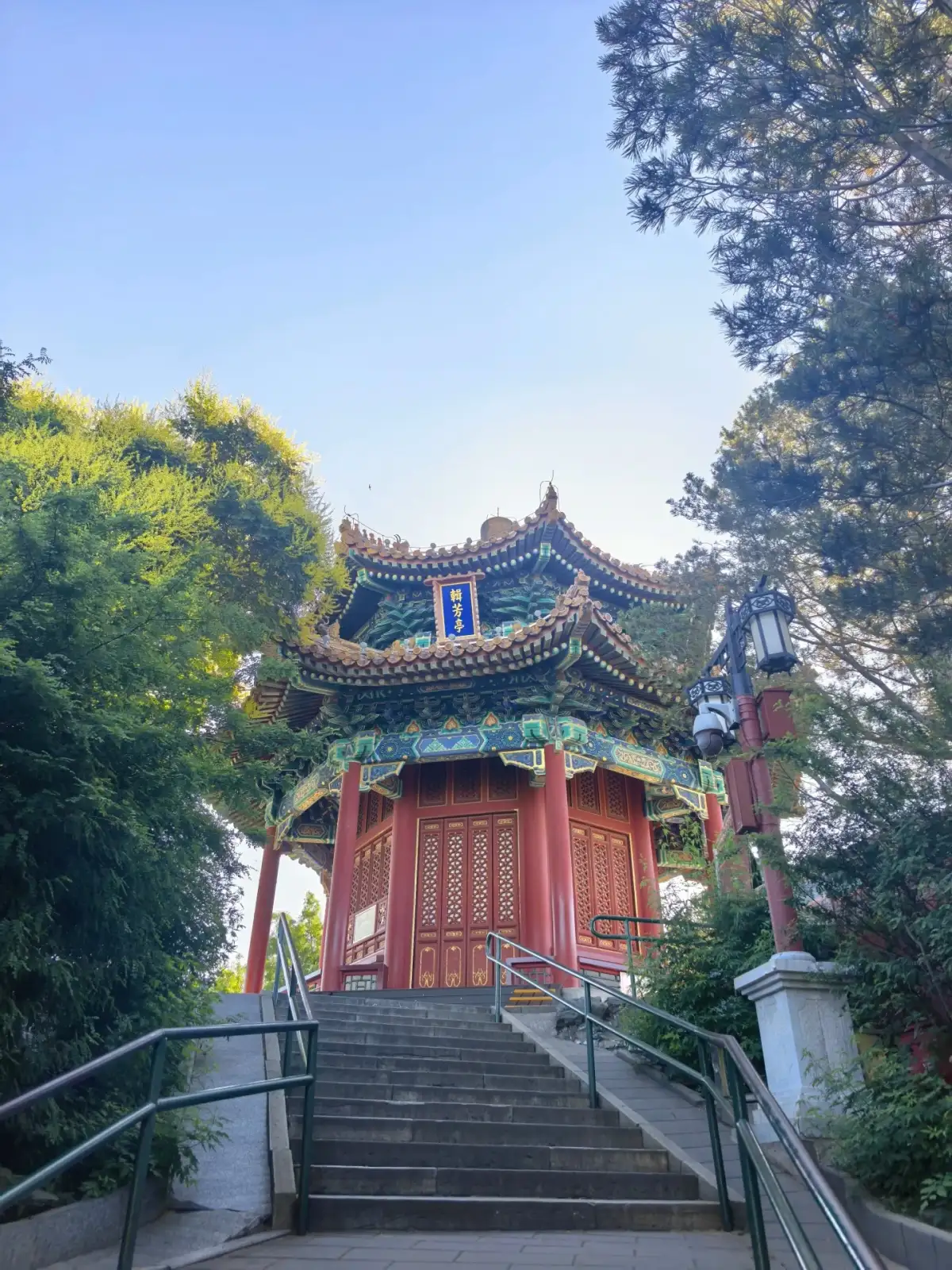
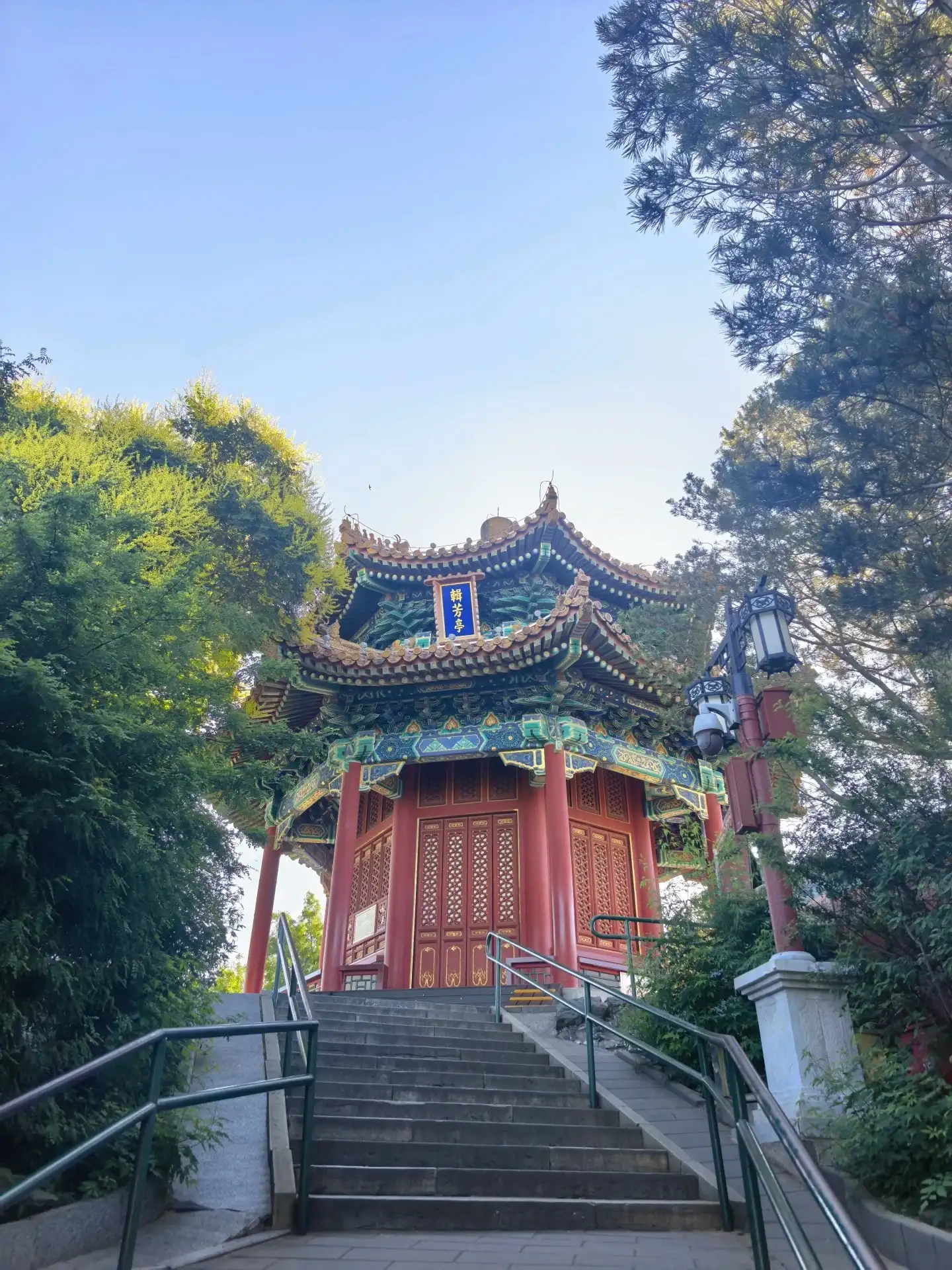
Pavilions and stone steps amidst the green trees of Jingshan Park.
In front of the Wanchun Pavilion, first identify the distance of the rooftops
The appeal of Jingshan lies not only in capturing the entire Forbidden City in a single shot. Looking south, the nearby palace walls, the continuous row of yellow rooftops, and the city skyline in the distance create layers upon layers of depth. The central structure emphasizes the axial line, while the rooftops on either side unfold through a interplay of repetition and variation. Don’t zoom in with your phone just yet—take a moment to discern where the roofs are densely clustered and where they’re more sparse. This will give you a better sense of the Forbidden City’s structure than immediately searching for the “perfect” photo.
Turn your gaze northward, and the scene shifts from the palace complex to the city blocks and the Bell and Drum Towers. With a single turn, you can sense how the spaces traversed by the same line differ. On cloudy days, the contours are often soft, while on sunny days you can see the sheen and shadows on the rooftops; whether the distant view is clear depends on actual visibility, so don’t expect every day to yield a crystal-clear photo.
As you walk down the hill, the red walls begin to stretch out before you
As you descend from the vantage point back to ground level, the visual focus shifts. From above, you see the complete layout; from the street, however, you might see only a wall stretching far into the distance, a section of eaves, or the shadow of a tree at a corner. The roads on both sides of Jingshan East Street and West Street facilitate this transition: the architecture can no longer be captured in a single photograph; instead, one must walk along the streets to fully appreciate its length.
After leaving the park, you can continue your stroll toward Di’anmen, following the actual exit and intersection layouts. Don’t keep backtracking just to maintain a straight line on the map. Beijing’s orderly layout doesn’t mean you can cut straight through every spot; if you’re willing to take a slight detour, you’ll actually be more likely to spot the small gates, street trees, and rooftop edges that are often overlooked from higher vantage points.
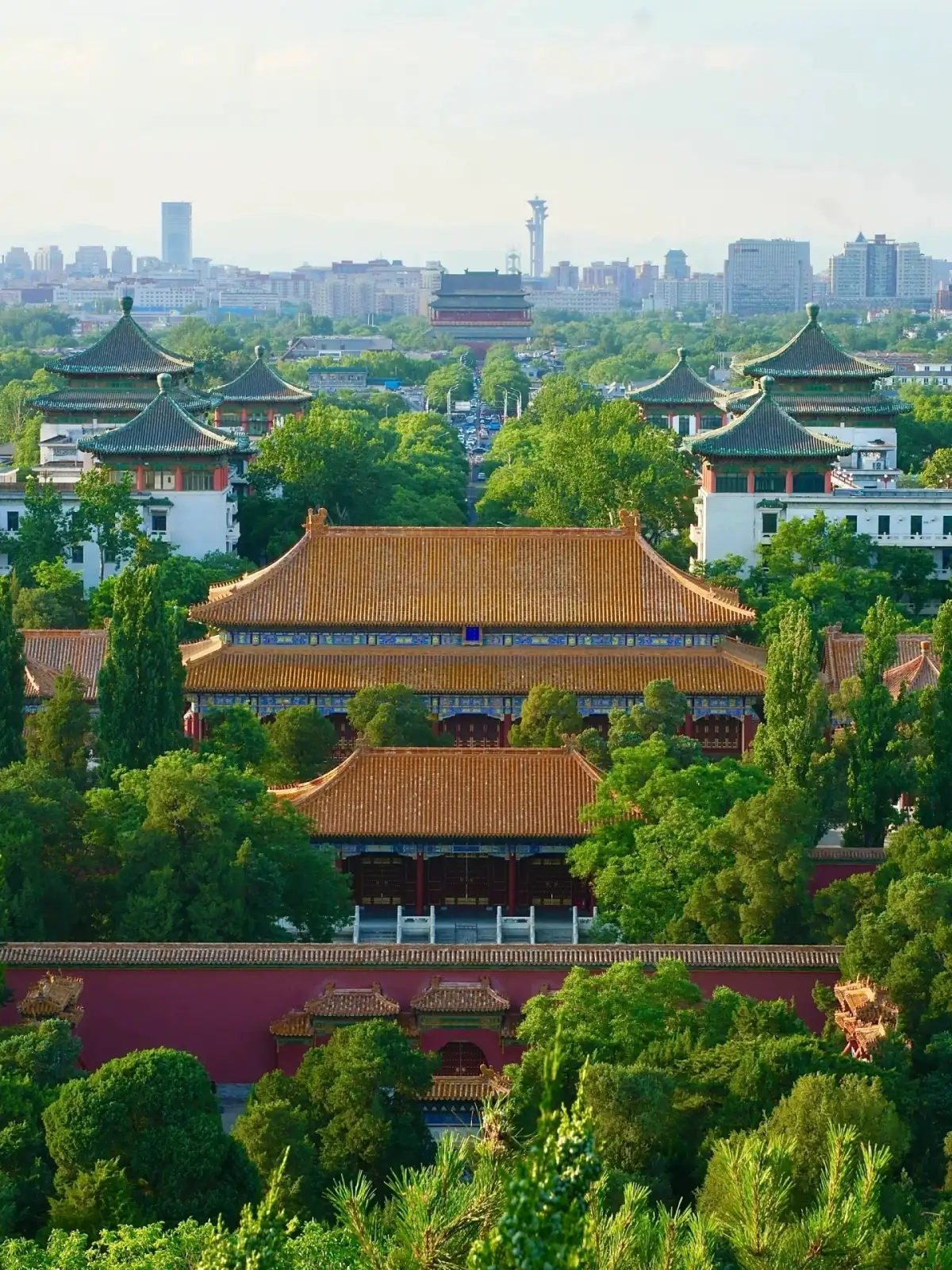
Overlapping palace rooftops and the distant cityscape on the north side of Jingshan Hill.
Near Di’anmen, lower your gaze a bit
Once you reach the Di’anmen area, the sounds of the street will reenter your experience. Vehicles on the road, bicycle parking areas, and storefronts all serve as reminders that this is still a living, active part of the city. The Central Axis does not shut daily life out: as you turn from the main roads into the alleys open to traffic, building heights decrease, and courtyard gates and walls come closer to human scale.
Exploring the hutongs can begin with three small details: how far the doors are set back into the walls, how the eaves connect, and whether the alley widens or narrows after a turn. These details are more concrete than vague generalizations like “the flavor of old Beijing.” Hutongs contain both residences and commercial spaces; simply identify the public passageways and the boundaries of the courtyards. There’s no need to treat every door as a tourist attraction, let alone invent stories about the residents based on a single photo of a gatehouse.
The five mountain pavilions and the Shouhuang Hall form the second visual thread in the bird’s-eye view
Five pavilions are arranged horizontally along the ridge of Jingshan Hill, with the Wanchun Pavilion at the center. Standing at one of them and looking toward an adjacent pavilion, the horizontally unfolding mountain landscape intersects with the north-south central axis: one line stretches the city into the distance, while the other unfolds the mountaintop before your eyes. The Jifang Pavilion in the photograph belongs to this group of mountain pavilions. When viewing it, one can simultaneously observe the extension of the eaves and the interplay between the rocks and stone steps—thus, the pavilion is more than just a decorative element within the frame.
When looking north, the Shouhuang Hall complex appears closer than the Bell and Drum Towers. Its courtyard walls and grouped roofs clearly define the foreground, while the distant city blocks gradually taper off. By identifying the elements from near to far, you’ll understand why a photo of the central axis has depth: it’s not about having as many buildings as possible, but rather about the spacing between courtyards, streets, and landmarks. Beijing municipal records also list the Guande Hall and Qiwang Tower among Jingshan Park’s key structures, meaning the park offers more than just the summit as a vantage point. If time permits, set aside a separate walk to explore the park’s buildings; the overall impression gained from the mountaintop will come into its true scale as you walk alongside the courtyard walls.
In front of the Bell and Drum Towers, discern the two distinct volumes
As you approach the Bell and Drum Towers from the surrounding streets, the scale of the architecture expands once more. Compared to the contiguous rooftops seen from Jingshan Hill, these two towering structures serve more as distinct spatial landmarks. Start by standing at a vantage point where you can take in both the street and the towers simultaneously, observing how the weight is distributed among the plinth, the tower body, and the upper roof, before deciding whether to enter for a tour.
The reason this spot is worth lingering at is that it allows you to recognize the silhouettes you saw from afar. What were just small structures on the horizon moments ago now have details, shadows, and entrances. If you choose to climb the tower or visit the exhibition that day, be sure to set aside ample time for the informational signs and interior spaces—it’s perfectly fine to skip one distant attraction. Please refer to on-site and official information regarding which areas are open to the public.
End this walk with a simple meal
The route from Jingshan Hill to the Bell and Drum Towers can serve as the main thread for a half-day exploration of Beijing; the actual time required depends on whether you climb the towers, visit the Chen Family Mansion, and make stops along the way. When it comes to lunch, there’s no need to feel pressured to “try every dish in Beijing”: just pick a place with seating near Di’anmen or the Drum Tower. A bowl of noodles or a hot meal is enough to let the images accumulated throughout the morning settle in. If you’d like to try zha jiang mian (noodles with fried sauce), pay attention to how the noodles, sauce, and toppings are mixed together before taking a bite—make your sense of taste part of the observation as well.
Before leaving, reflect once more on the two perspectives—south-facing and north-facing—from Jingshan Hill. You’ll discover that what’s most worth taking away isn’t the number of landmarks, but a sense of direction. The next time you encounter similar rooftops, wide intersections, or secluded courtyard gates on the streets of Beijing, they will no longer be mere backdrops; instead, you’ll be able to place them within the spatial relationships of this city.
Further Reading and Reference Sources
Beijing · Destination Overview
Compiled by the Dongxing Travel Editorial Department based on publicly available travel notes and the references listed in the article, for pre-trip reading; accompanying images are sourced from the noted travel notes.