September 25, 2026 · Travel Diary
My first impression of the desert was that it became difficult to gauge scale.
When viewing Mingsha Mountain from a distance on flat ground, the sand slopes appear continuous and smooth, making it easy to underestimate their height and distance. Only when you get truly close do the fine sand beneath your feet, the marks on the slope, and the shadows on the ridges provide a sense of scale. The simple lines in the photo become a landscape that requires time to explore up close once you’re there.
Mingsha Mountain and Crescent Lake are located south of Dunhuang City, and their most striking visual relationship is the sand dunes encircling the spring. This place is neither a substitute for a desolate, uninhabited wilderness nor does it need to be marketed as a perilous expedition; simply observing the juxtaposition of sand dunes and oases along the open tourist trail reveals a unique facet of Dunhuang. You can start your journey from lower ground, first getting a sense of the positions of the dunes and the spring, and then deciding whether to climb higher.
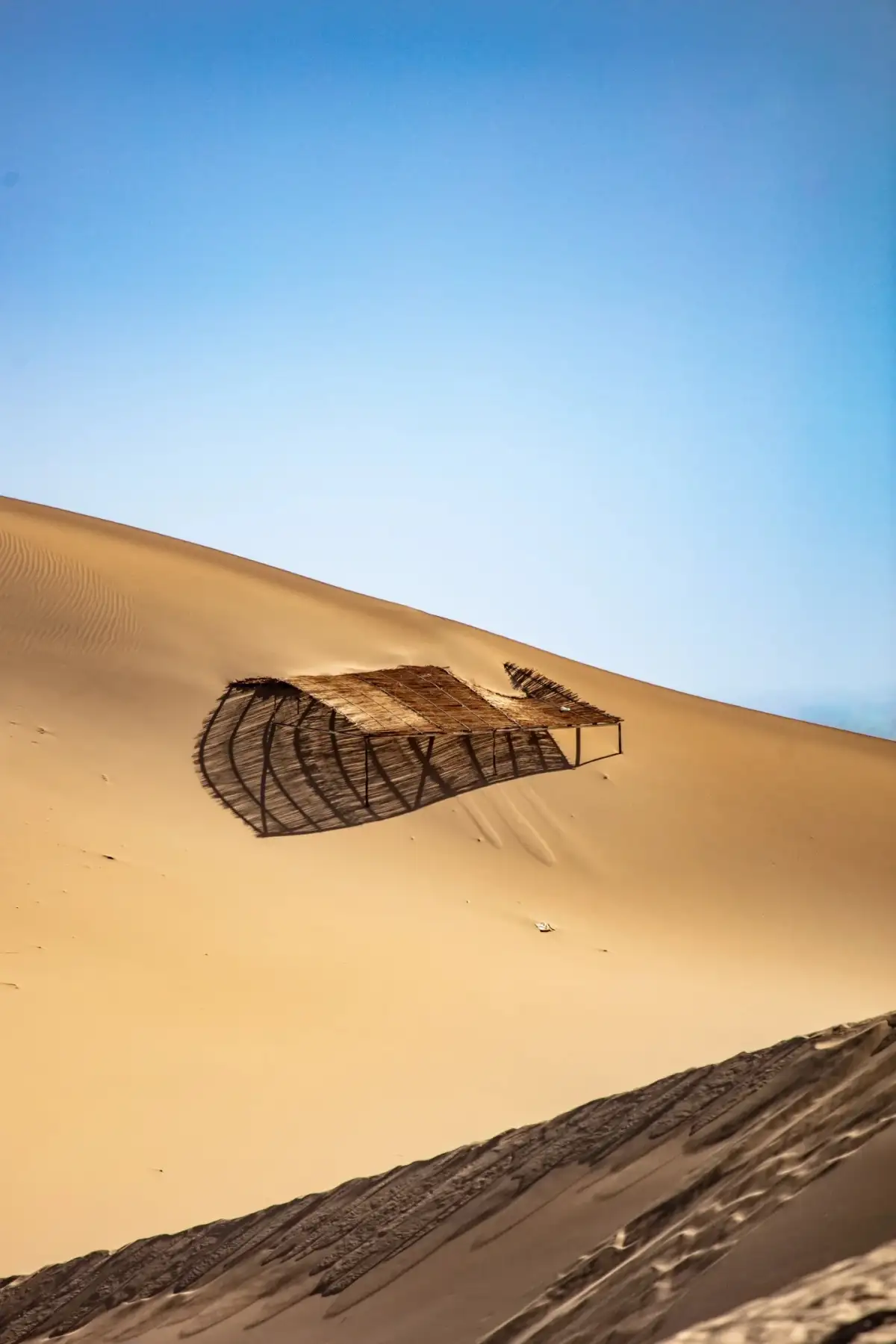
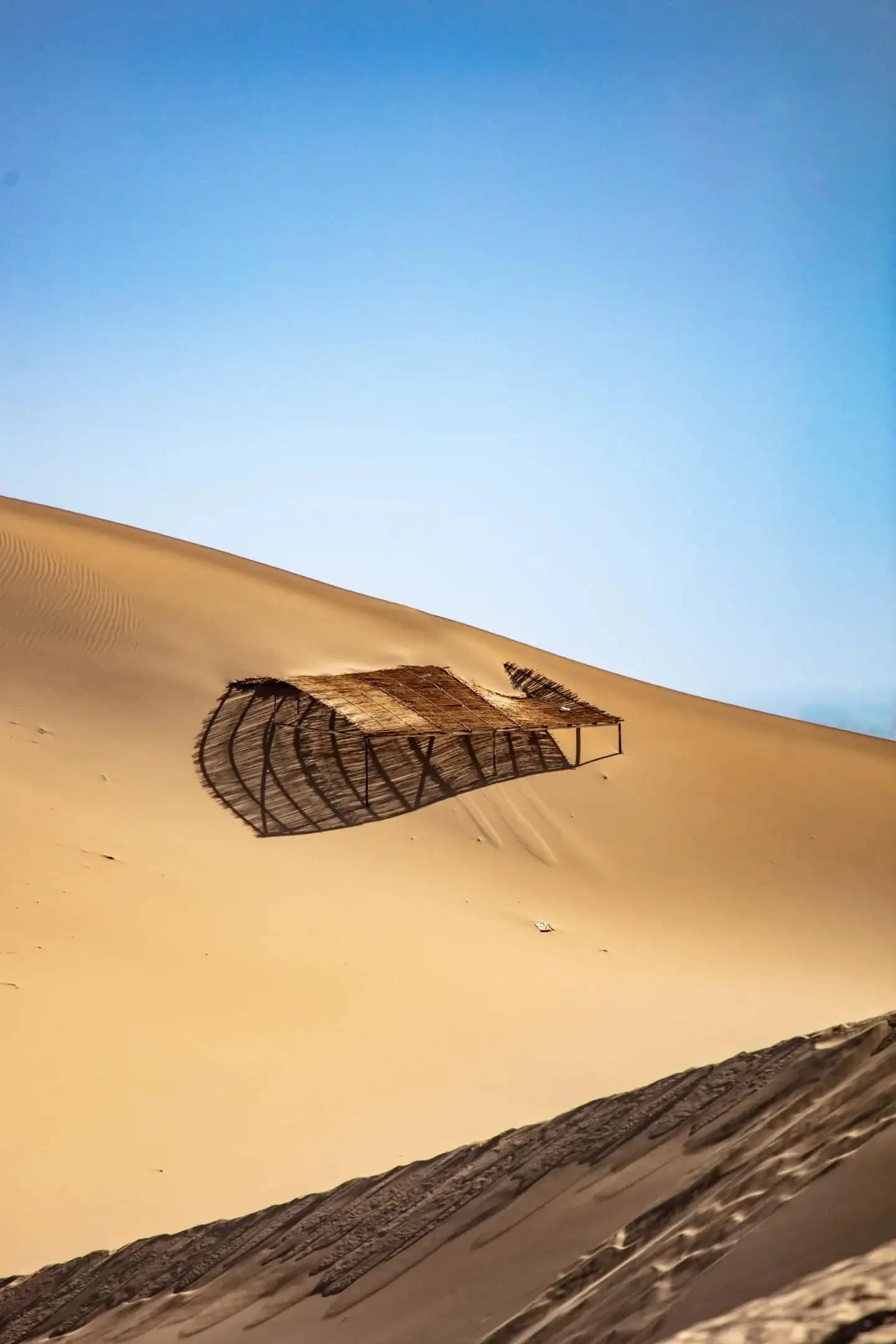
shade structures and their shadows on the slopes of Mingsha Mountain. the Road
Start with Crescent Lake and look for the beginning and end of the arc.
The spring’s name comes from its crescent shape, but when standing close by, you may not be able to see the entire arc at a glance. A ground-level perspective is better for observing how the water, the plants along the shore, and the architecture interplay: the water’s surface reflects the sky, the vegetation forms a soft edge, and the sand dunes loom in the background as broad swaths of color.
Don’t rush to replicate the bird’s-eye view seen in photographs. The foreground has its own elements, and the background has its own structure. First, memorize the relative positions along the spring’s banks; then, if you climb to an accessible viewpoint, look for the complete outline—you’ll discover how this small body of water anchors the vast expanse of sandy hues around it. It doesn’t need to be very large; the contrast with its surroundings is already distinct enough.
sand ridges that split the light into two distinct areas
the sand dunes of Mingsha Mountain are ideal for practicing light observation. The side facing the sun is brighter, while the backlit side is covered in deep shadows, with the boundary running along the ridge. As the angle of the sun changes, this boundary shifts, and the same sand slope can transform from gentle to undulating.
In photography, you can choose between two distances: a wide shot that captures several continuous sand ridges to emphasize rhythm; or a close-up that focuses on the texture of the fine sand and surface color variations to emphasize tactile quality. Footprints, tracks left by sliding, and wind ripples are distinct from one another; you can faithfully include them in the frame. The desert does not need to be edited to appear completely pristine to reveal its form; nor is it necessary to leave the open area in search of a trackless sand dune.
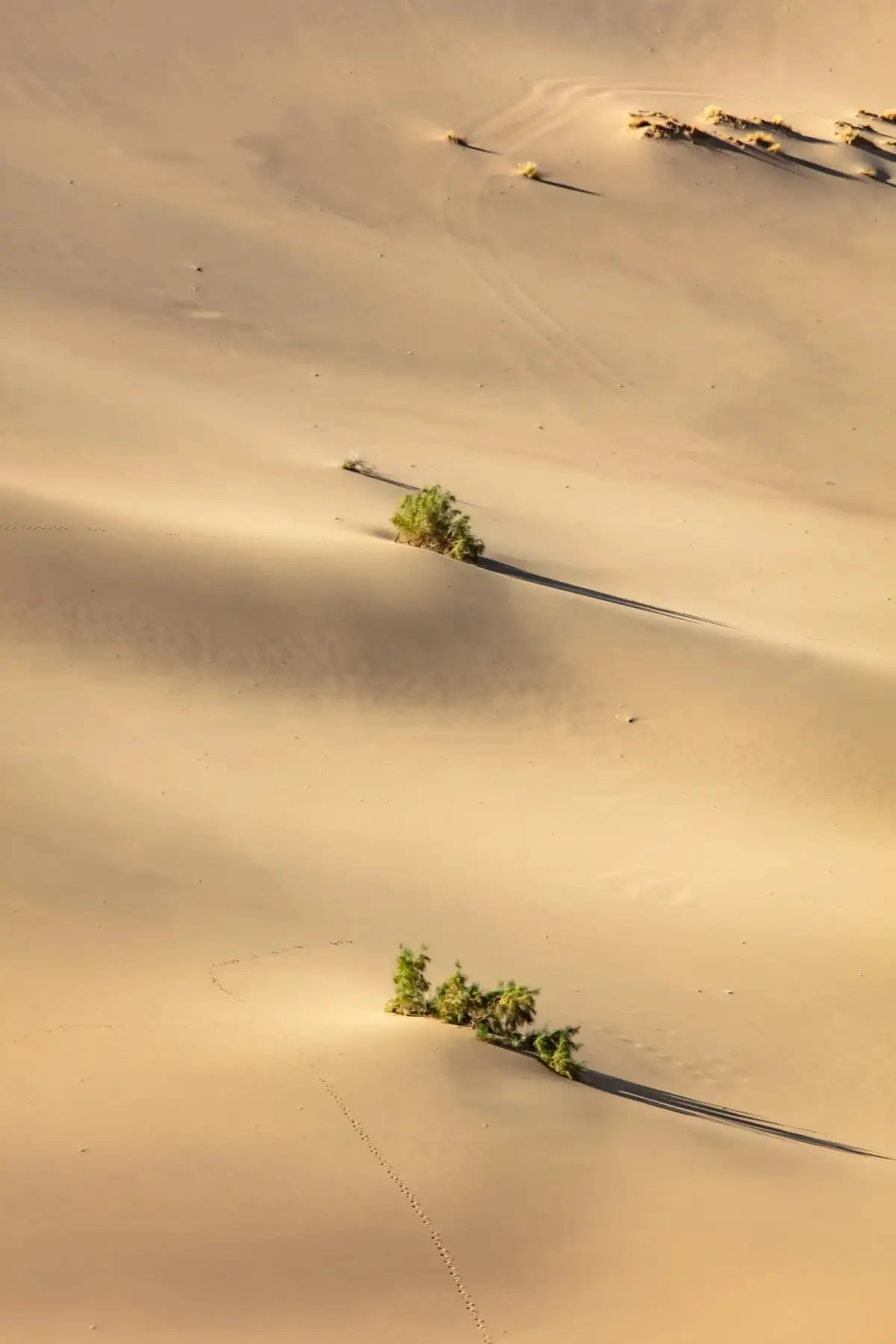
the fine sand slopes and sparse vegetation of Mingsha Mountain. the Road
The point of climbing higher is to connect the sand dunes with the city.
If you plan to climb, base your decision on your stamina and the actual open trails. The feel of each step on sand is different from that on stone steps; a short slope that looks gentle in a photo may be more strenuous to walk than you expect. Set your goal as a spot where you can appreciate the terrain, rather than insisting on reaching the highest point in the photo.
As the elevation increases, the relationship between Crescent Lake, the surrounding greenery, and the city in the distance gradually unfolds. The desert doesn’t suddenly appear at the edge of the world; it lies right next to the city of Dunhuang, the roads, and the oasis. Seeing these connections captures the true essence of this place better than completely erasing the city from the photograph. Stopping to look back is also a way to confirm exactly where you’ve arrived.
low-lying plants that give the sand dunes a different sense of scale.
If a small cluster of plants appears in a photo of the sand dunes, the scale of the landscape changes instantly. Slopes whose elevation was previously hard to gauge now have leaves and branches as points of reference; the sandy landscape also appears more expansive thanks to that touch of green. The accompanying image shows the sand slopes and sparse vegetation of Singing Sand Mountain; the spring area can be observed upon arrival by following the on-site walking route. When examining the image, look out through the shadows around the plants to discern how the slope unfolds from near to far.
a wooden sunshade structure in another photo, casting regular straight lines across the continuous sandy surface. Where natural slopes meet man-made boundaries, the actual use of the scenic area enters the frame. Singing Sand Mountain is not merely a collection of isolated sand ridges; walking paths, green spaces, and structures by the spring also contribute to the landscape before us. By taking both close-up and distant shots of the same spot, one can see how human scale is magnified or minimized by the dunes. Such details are best savored during the early morning or late evening, though they do not depend on any fixed moment: when direct light is present, one observes the shadows; when it is absent, one appreciates the materials and colors. They transform the memory of the desert from a vast adjective back into recognizable objects and locations.
It’s worth waiting for dusk, but there’s no need to script the sky.
Evening is often considered the best time to visit Singing Sand Mountain, as the lower angle of the sun illuminates the slope’s texture more clearly. Whether the sky is golden, grayish, or veiled in thin clouds on any given day depends on the actual weather. Sunset times also vary by season, so be sure to check the scenic area’s official updates before setting out to plan your wait and return trip with plenty of time to spare.
If the sunset isn’t ideal, observe the changes in the sand dunes themselves: the illuminated areas gradually shrink, shadows slowly merge into expanses, and the outlines of the spring’s edge and the buildings come into sharper relief. As dusk approaches, the scenery doesn’t end immediately; it’s just that the focus shifts from color to form. As for performances, choral concerts, or light shows, these are subject to operational scheduling and should not be treated as a fixed commitment for any given day in this article.
Back in Dunhuang, let a meal welcome the night after the hues of the sand.
After finishing your tour of the scenic area, returning to the city for dinner helps bridge the two worlds of the sand dunes and the city. The Shazhou Night Market is a good place to start your search for dinner, or you can choose a casual restaurant near your lodging. Noodles and hot soups are best enjoyed slowly; if you want to try local Dunhuang cuisine, take a close look at the ingredients and preparation methods first to decide if they suit your taste.
When reviewing the photos from that day, try arranging them in the order of the ground-level view of the spring, details of the sand ridges, and the panoramic view from atop the dune. This sequence showcases variations in distance, rather than merely a progression of increasingly intense colors. Perhaps the most memorable aspect of this stretch in Dunhuang is the interplay of two lines: the sharp edges carved by the wind across the sand dunes, and the gentle curves left by the water between the sand dunes. Only when viewed together do they complete the landscape.
Further Reading and References
Compiled by the Eastbound Travel Editorial Department based on publicly available travel notes and the references listed in the text, for pre-trip reading; accompanying images are sourced from the noted references.
Ministry of Culture and Tourism: Jiuquan City Mingsha Mountain and Crescent Lake Scenic Area
Notice from the Mingsha Mountain and Crescent Lake Scenic Area