September 9, 2026 · Travel Diary
Before entering the courtyard, let’s first pinpoint its historical location
The Pseudo-Manchukuo Imperial Palace Museum is built on the site of the imperial palace used during the period when Puyi served as the puppet emperor of the puppet state of Manchukuo; it is a historic site for understanding Japan’s invasion of Northeast China and its colonial rule. This site cannot be simply described as a continuation of the Qing imperial palace, nor is it appropriate to summarize it merely as “the home of the last emperor,” because behind his personal life lies a broader context of power and war.
Before entering the buildings, it’s helpful to read the general introduction to establish a basic understanding of the temporal and spatial relationships. Keeping the biographies of historical figures, the functions of the buildings, and the history of invasion separate—and then connecting them during the tour—will provide a clearer understanding than searching for specific rooms based on scenes from TV shows or movies.
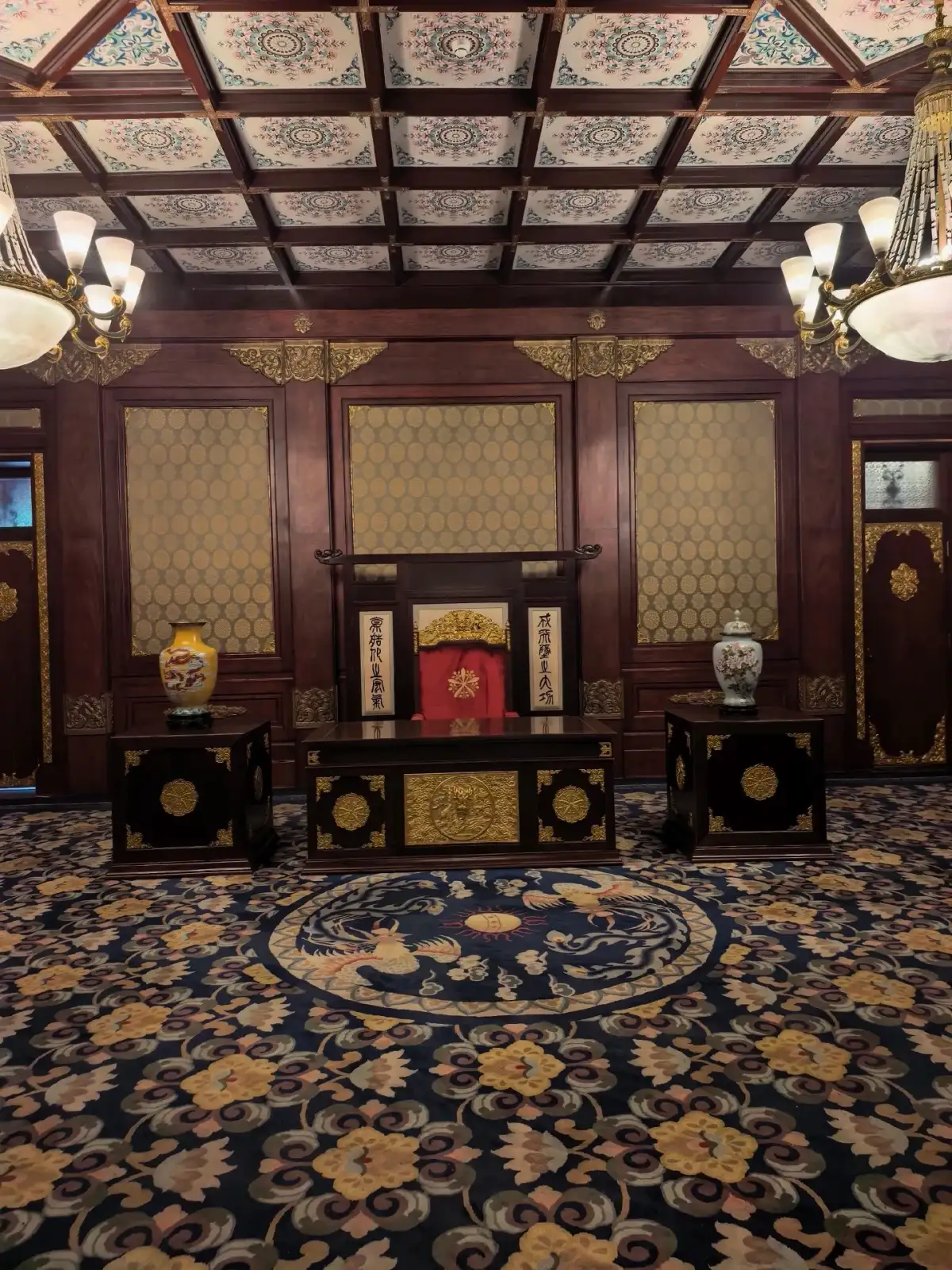
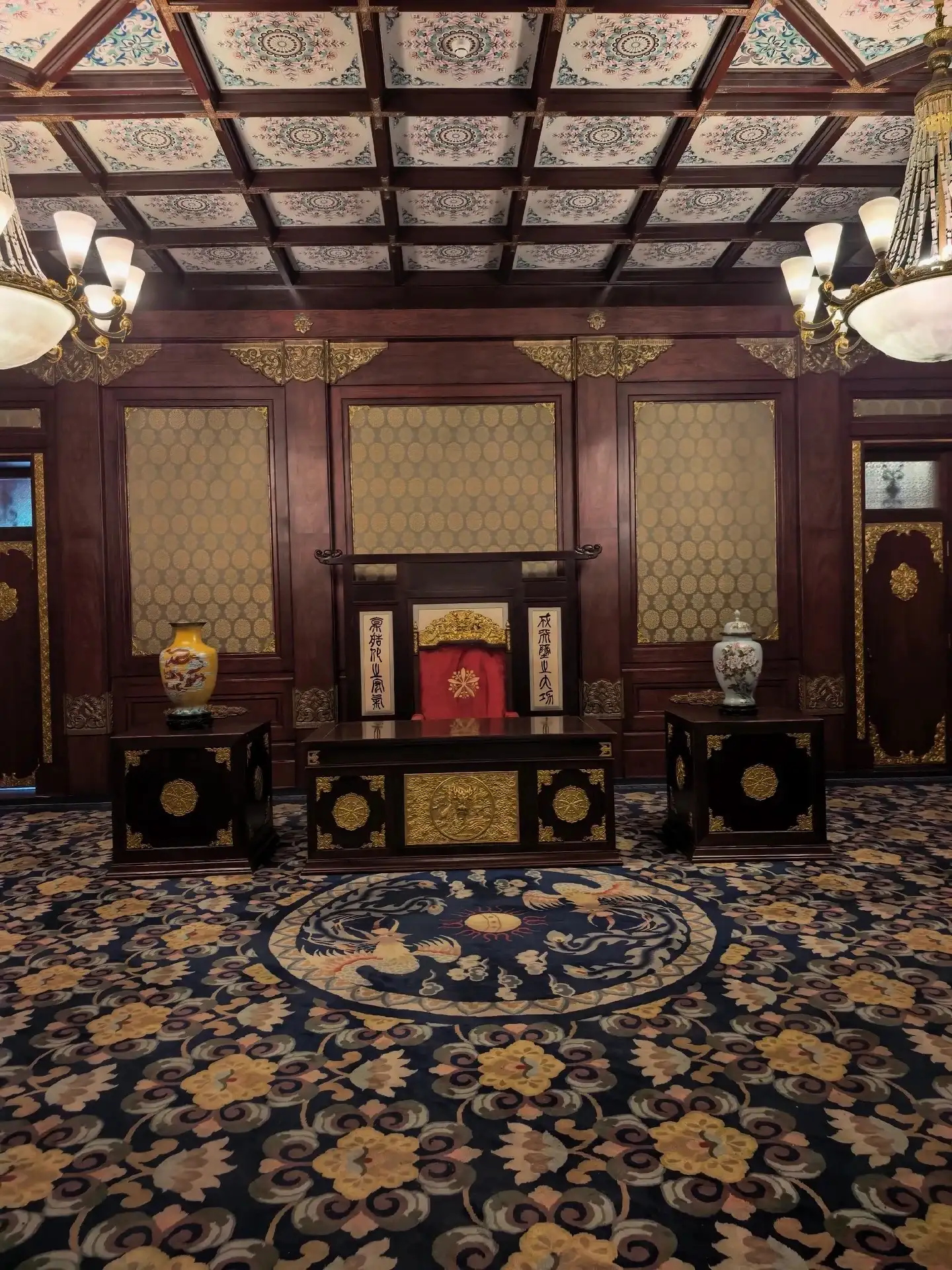
Interior furnishings, ceiling designs, and carpet patterns at the Pseudo-Manchukuo Imperial Palace Museum.
The buildings, constructed in succession, reveal the site’s developmental process
When viewed together—Qinmin Lou, Jixi Lou, and Tongde Hall—it becomes clear that the historic site was not a neatly planned imperial palace complex completed in a single phase. The first two were converted from existing government office buildings, while the Tongde Hall was built later. Their differing scales and interior layouts must therefore be understood separately; one should not simply apply the image of a symmetrically laid-out complex—such as the Forbidden City in Beijing—based solely on the name “Imperial Palace.”
During your visit, you might keep a simple record: each time you enter a major building, note three pieces of information—its original purpose, the date it was repurposed, and its current exhibition theme. When encountering a restored room, add the question: “What was the basis for the restoration?” In this way, several spaces with different exteriors will gradually come together to form a chronological narrative of the historic site, rather than leaving you with only a vague impression of red carpets and chandeliers after you leave.
This comparison also helps identify mislabeling in online sources. Unless explicitly stated, an interior photograph should describe only the visible furnishings and space, without arbitrarily labeling it as a specific figure’s bedroom or the site of a particular event. Accurate names are not superfluous details, but rather the foundation upon which historical visits can be further verified.
Qinmin Building: The Gap Between Name and Actual Authority
According to records from the Jilin Provincial Gazetteer, Qinmin Lou was originally the office building of the Jilin-Heilongjiang Monopoly Transport Bureau and was later converted into a space for Puyi to conduct related governmental affairs. This historical background is significant: the complex before us was not built from the outset as a complete architectural ensemble following the traditional palace system, but rather was created through the renovation and expansion of existing structures.
During your visit, observe how the entrances, staircases, corridors, and rooms connect, and then read about the specific functions of each room. A building name imbued with traditional political connotations does not in itself prove that this site held independent state power. Only by placing these names within the context of the puppet regime of the “Manchukuo” can we ensure that the architecture is not obscured by the facade created by decoration and ritual.
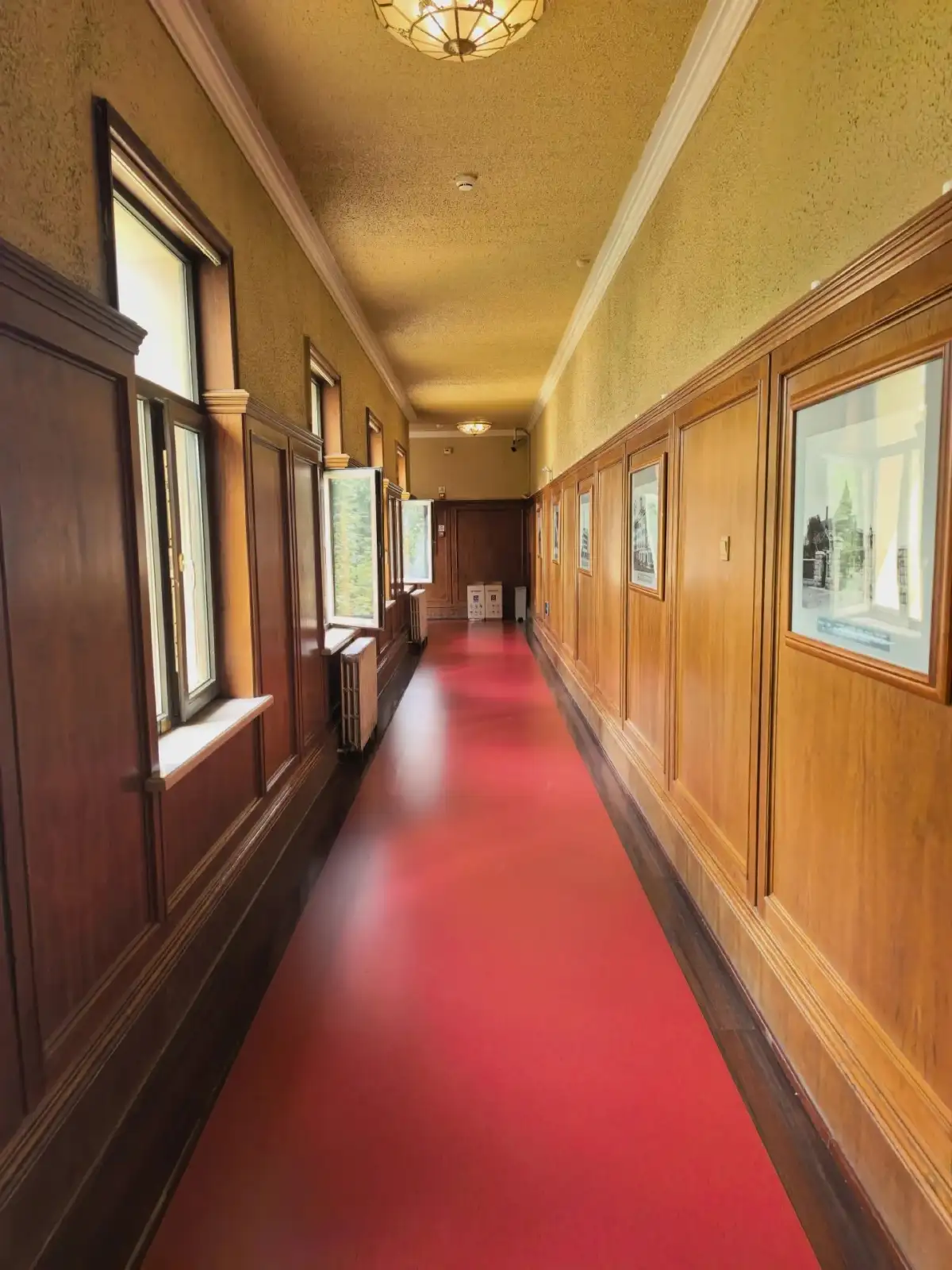
Window-side corridors and wooden wainscoting at the Pseudo-Manchukuo Imperial Palace Museum.
Jixi Tower: Living Spaces Shaped by the Times
Jixi Tower is associated with daily life. Compared to spaces used for ceremonies or receptions, the bedrooms, reception rooms, and connecting corridors allow visitors to more intuitively grasp the scale of private life. However, when viewing the furniture and furnishings, one should first pay attention to how the exhibit labels describe them: original objects, reconstructed displays, and supplementary exhibits are not the same kind of evidence.
It is unwise to draw conclusions about a resident’s emotional state at a specific moment based solely on a single bed or a curtain. While a room can suggest how it was used, insights into human psychology still require support from historical records. Maintaining this restraint actually makes the visit more impactful, as the complexity of real history does not need to be supplemented by imagined dialogue or dramatized scenes.
Tongde Hall: The Political Significance Behind Its Magnificent Form
Built in the late 1930s, the Tongde Hall served multiple purposes, including political activities, daily life, and entertainment. According to official local annals, its name carries the political implication of “one virtue, one heart” in relation to the Japanese invaders. With this knowledge in mind, when viewing its grand interior, chandeliers, and decorations, one’s appreciation will go beyond the superficial aspects of opulence or nostalgia.
At a vantage point where one can linger, observe the differences in scale between the main hall and the flanking rooms, and see how the decorations emphasize the hierarchical status of certain spaces. Architectural forms can be appreciated and studied, but they must also be understood in conjunction with the political functions they serve. These two perspectives are not mutually exclusive; on the contrary, a close examination of the architectural elements helps reveal how power is manifested through space.
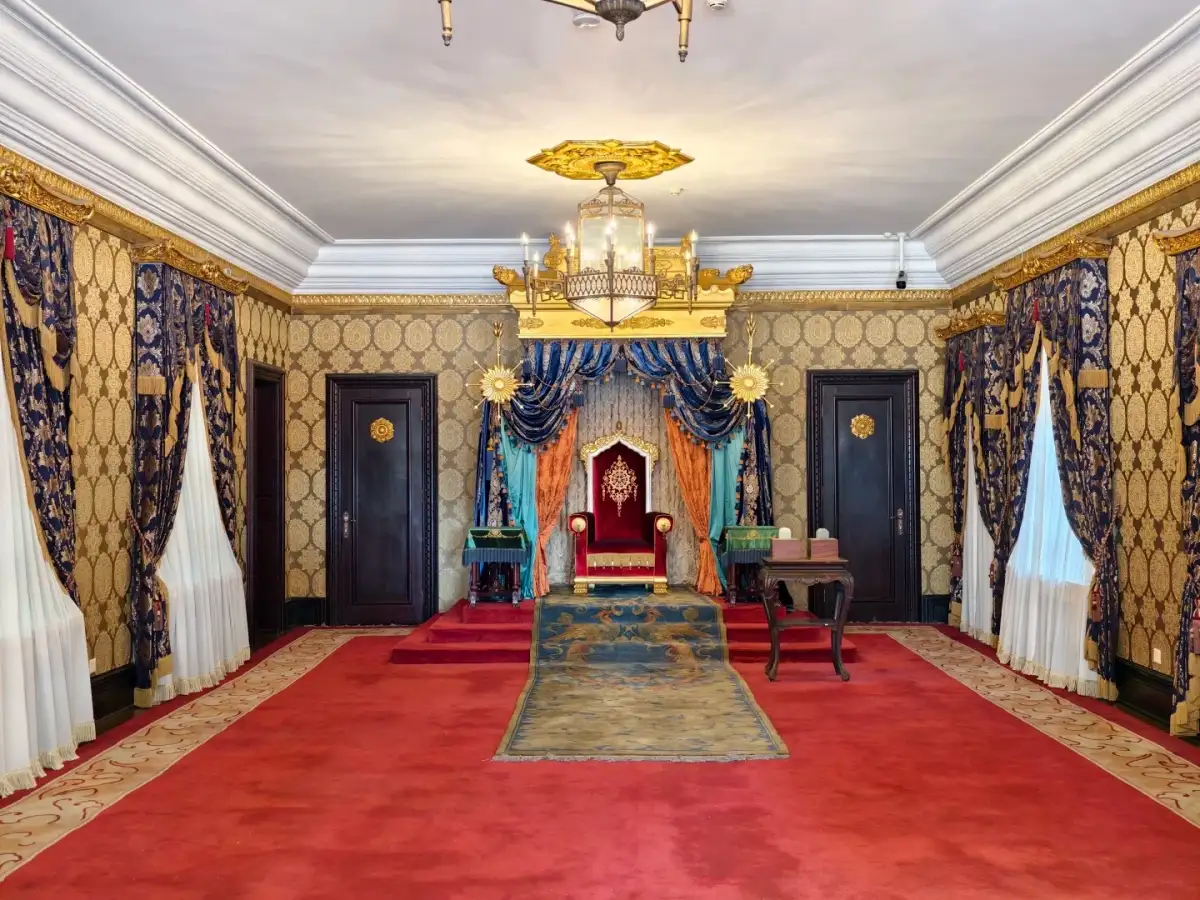
Curtains, chandeliers, and chairs from the interior furnishings of the Pseudo-Manchukuo Imperial Palace Museum.
Corridors and natural light streaming through windows serve as evidence of the connections between rooms
Tour photos often isolate a single room, but when actually walking through the site, corridors connect the various spaces. The spacing of doors, the layout of corners, and the orientation of windows all influence how people move through the architecture. Rather than merely photographing the most opulent halls, one might also observe these ordinary connecting elements, as they reveal how the building was actually used.
Light streaming in through the windows and falling on the floor, wainscoting, and furniture is a phenomenon that can still be directly observed today. When describing these details, one can be precise and concise—there is no need to interpret a single beam of light as a symbol of a particular person’s fate. This is where the value of architectural interpretation lies: first, observe the physical structure clearly; then determine which historical interpretations are well-founded and which are merely the viewer’s own associations.
Don’t end your tour in the most beautiful room
If one focuses solely on the imperial palace spaces, it is easy to reduce this period of history to the lives of a select few. When visiting, visitors should also plan their itinerary based on the day’s opening schedule, setting aside time to explore exhibits related to the history of Japanese aggression and general historical materials, thereby placing the architecture back within the broader context of Northeast China’s experience under colonial rule. Specific exhibition titles and areas open to the public are subject to change; please refer to the museum’s current information for details.
Upon leaving, visitors can take away a set of clear distinctions: the historic site versus the restored furnishings; personal experiences versus social history; and architectural form versus actual power. These insights are far more valuable than simply remembering how luxurious a particular piece of furniture was. Changchun’s urban history requires patient study, and the Puppet Manchukuo Imperial Palace offers precisely such a place—one that demands visitors bring both their eyes and their judgment to bear.
Further Reading and References
Compiled by the Dongxing Travel Editorial Department based on publicly available travel journals and the references listed in the article, for pre-trip reading; accompanying images are sourced from the noted travel journals.
Jilin Provincial Local Chronicles: The Pseudo-Manchukuo Imperial Palace Museum
Jilin Culture and Tourism: Conservation and Restoration Project for Jixi Tower and Tongde Hall