September 30, 2026 · Travel Diary
Look at the river and mountains first, then at the Buddha statues
The primary framework of Longmen is the mountains and the river. The grottoes unfold along the rock face, with the Yi River flowing between the two mountains. As visitors move along the walkway, the grottoes, the river’s surface, and the opposite bank alternately come into view. If you focus solely on the most famous giant Buddha on your phone, it’s easy to miss how this long scroll unfolds before you.
The Longmen Grottoes are a World Cultural Heritage site, with their principal sculptural art spanning periods from the Northern Wei to the Tang Dynasty. Knowledge of the historical periods provides context, but on your first visit, there’s no need to treat yourself like you’re taking an exam. First, remember that this is not a single hall but a cluster of grottoes built over time; this understanding will serve as a starting point for comprehending the variations in size, style, and state of preservation that you’ll encounter later.
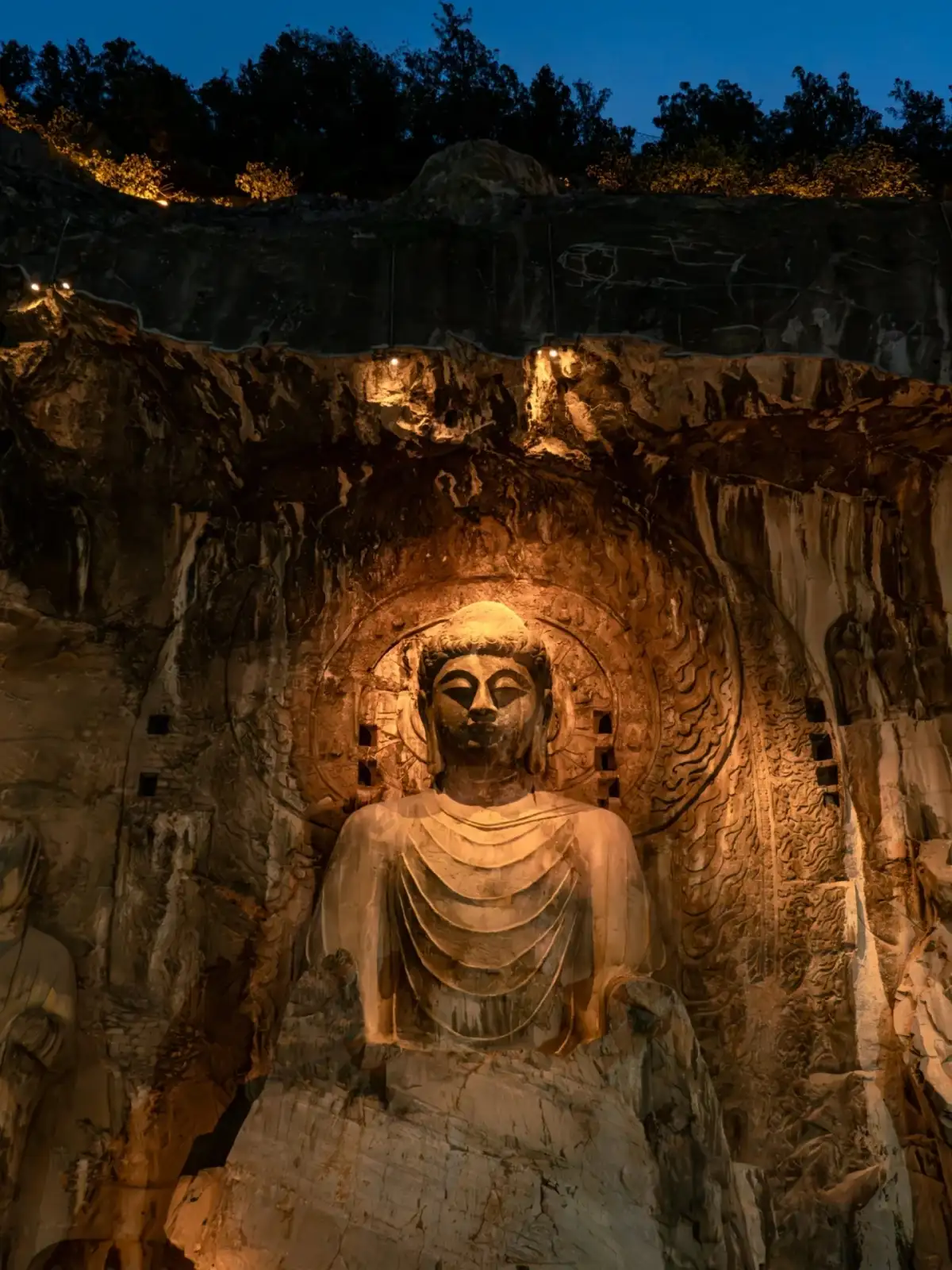
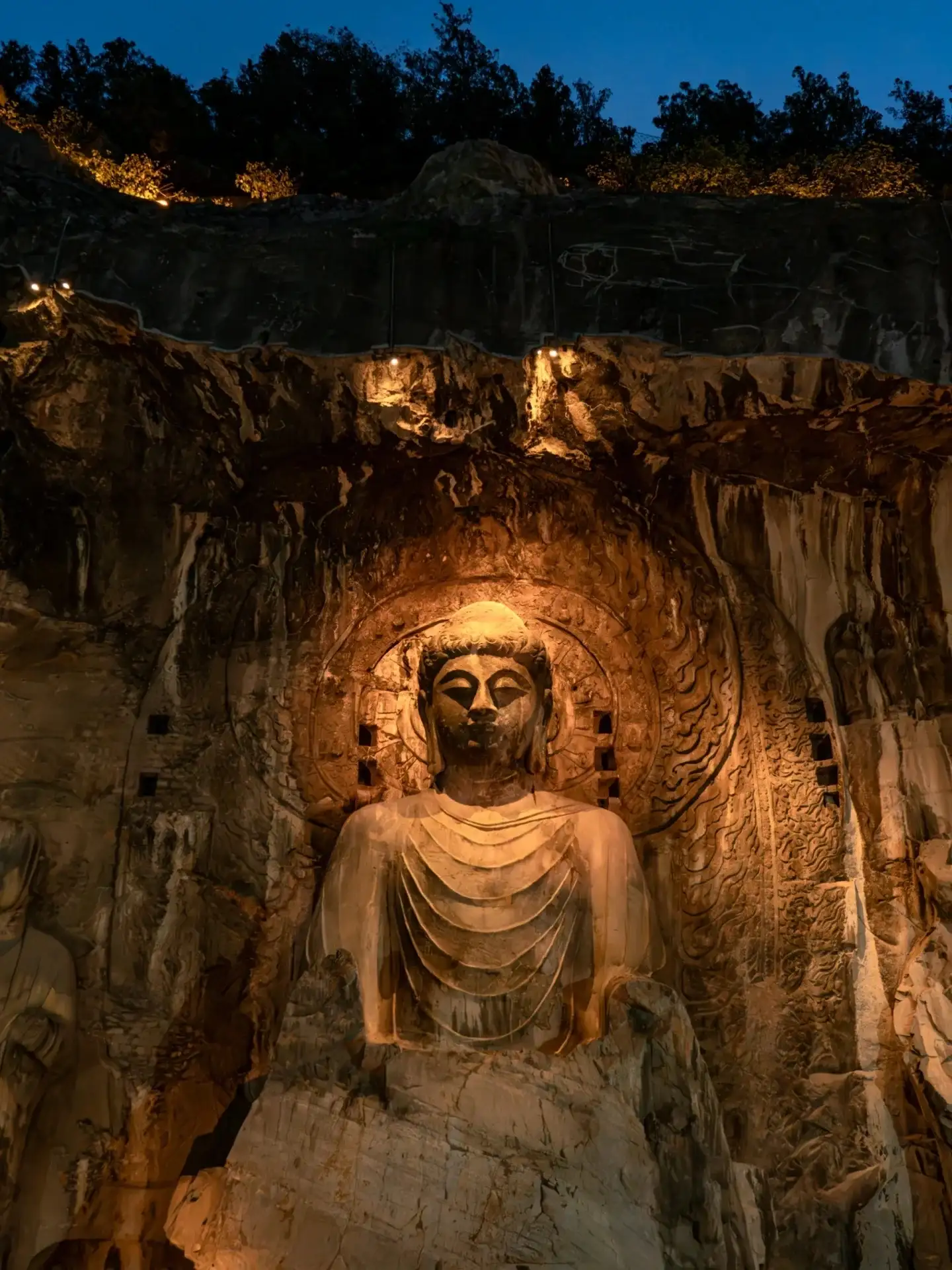
The Lushan Great Buddha illuminated at the Longmen Grottoes.
Small Grottoes Teach the Eye to Slow Down
When approaching a cave, it’s often impossible to take in the entire interior at a single glance. The main statue catches your eye first, followed by the sides, the ceiling, and the walls. You can follow a simple sequence: first, identify the overall layout; next, observe the figures’ postures; and finally, examine the drapery and decorations. This sequence helps prevent the feeling of “having seen so much but being unable to distinguish the differences.”
Names such as Binyang Cave and Lotus Cave can serve as starting points for pre-visit reading; during the actual tour, follow the designated route. Each cave has its own unique characteristics; it is not appropriate to summarize them all with a single phrase like “solemn and awe-inspiring.” Even if you are unfamiliar with Buddhist imagery, you can still honestly observe how the stone has been carved to convey a sense of weight and lightness: the volume of the shoulders, the folds of the robes, and the space between the arms and the body are all visible details.
In front of Fengxian Temple, start by examining the relationships among a group of sculptures
Upon arriving at Fengxian Temple, the Great Buddha of Vairocana naturally becomes the focal point. But once you’re close, try broadening your gaze slightly to see how the statues on either side work together with the main figure to form a cohesive whole. The poses, expressions, and proportions of the different figures create a layered composition; the sense of stability conveyed by the Great Buddha is also closely tied to the arrangement of the surrounding figures.
When viewing the faces, set aside the anthropomorphic interpretations found online and observe how the eyebrows, eyes, corners of the mouth, and facial contours are rendered. Certain expressions may evoke personal associations for visitors, but these associations are not equivalent to verifiable historical facts. Keeping “what it looks like” separate from “what the historical records say” preserves the freedom of observation and prevents stories from overshadowing the stone carvings themselves.
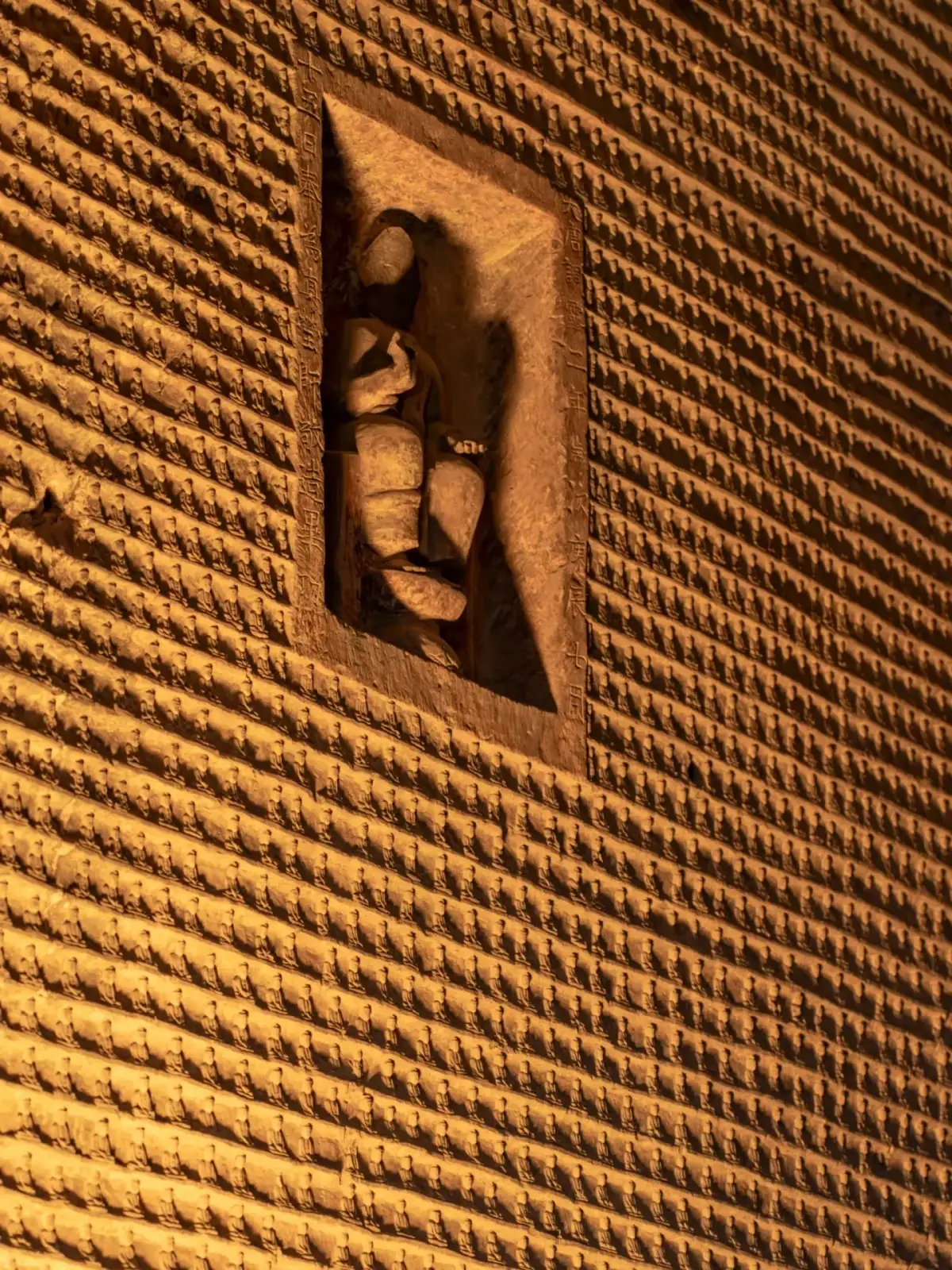
Small sculptures densely arranged on the walls of the Longmen Grottoes.
What’s Missing Isn’t Something to Skip Over
On the rock walls of Longmen, some images are intact, while others are worn, fragmented, or difficult to make out. These conditions are also part of the viewing experience. When viewing the stone carvings, in addition to appreciating the intricate details, pay attention to how the rock surface has cracked, which patterns remain clear, and which are now reduced to mere outlines.
They remind us that cultural heritage is not a perfect artifact delivered directly from antiquity to the present, but rather something that has undergone a long process of change. If the on-site exhibition explains issues related to restoration, conservation, or loss, take a moment to read these explanations. When you then look back at a well-preserved statue, you’ll gain a deeper, more concrete understanding—rather than merely marveling at its immense size.
The ceiling of Lianhua Cave and the “Ten Thousand Buddhas” wall offer two distinct rhythms when viewed from below
The ceiling of the Lotus Cave, featured in the illustrations for this article, unfolds a lotus flower above the viewer. It is not a standalone decoration hanging in the room; rather, the petals, together with the surrounding stone surface, form the very roof of the cave. As your gaze moves outward from the center, you can observe the layering of the petals and the shadows at their junctions; photographs help capture the patterns, while looking up at the site allows you to sense the actual distance between the artwork and your body.
Another photograph of the Ten Thousand Buddhas Wall depicts a dense array of small statues. While each individual figure occupies a limited space, their arrangement creates a sense of continuous rhythm—a stark contrast to the impression established by the massive statues at Fengxian Temple, which rely on their vast scale. When these two photos are juxtaposed with the image of the Great Buddha, Longmen reveals three distinct scales: the ceiling patterns, the clusters of small figures, and the expansive colossal statues. Since these are not three different angles of the same cave, travel notes should record their respective locations and names. It is precisely this process of moving from one place to another that transforms the cluster of grottoes stretching along the Yi River from a mere unified label into an ever-changing space and sculptural experience.
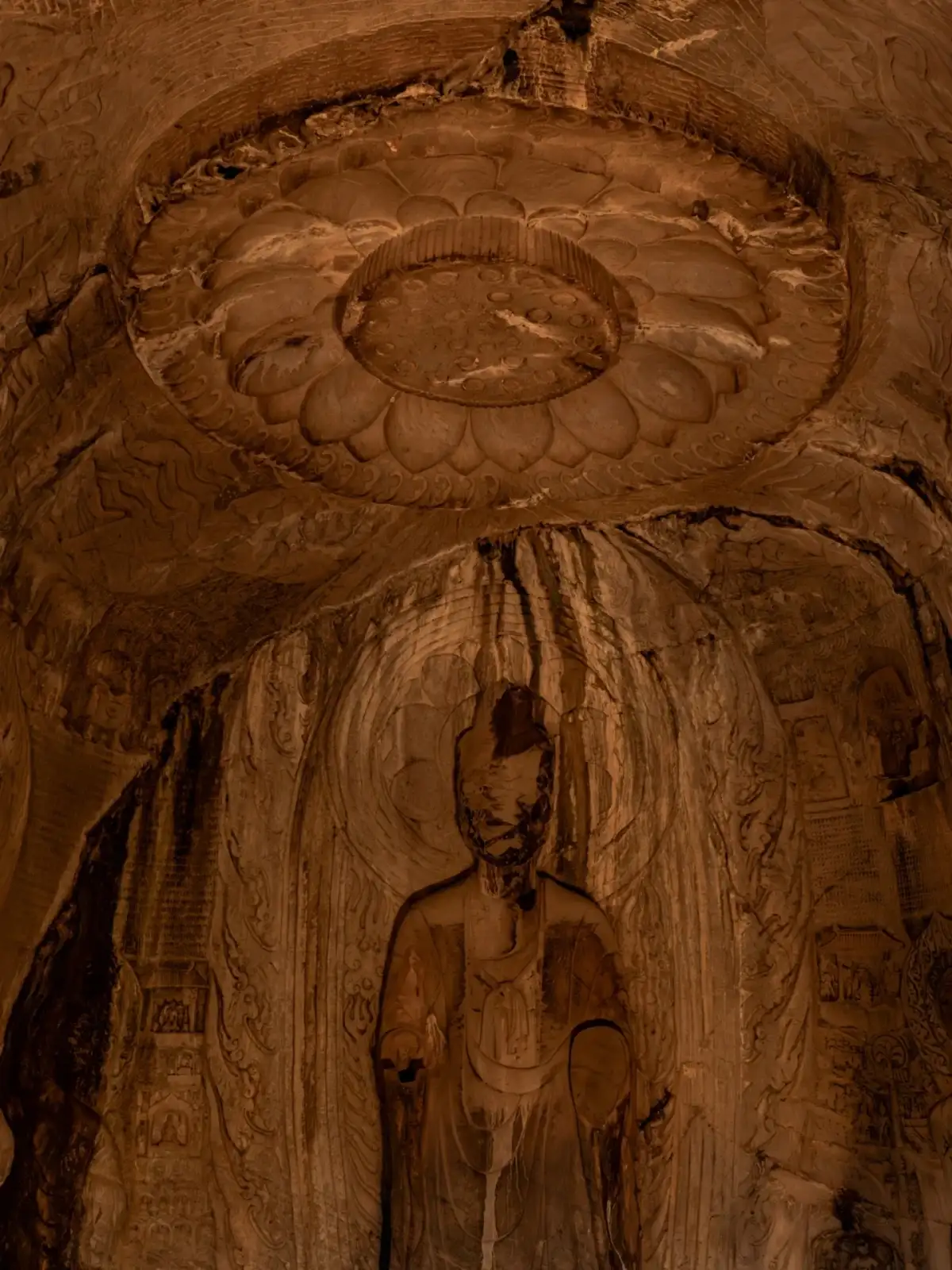
Lotus carvings and statues on the ceiling of the Longmen Grottoes.
Between the large Buddha and the smaller statues, you can also take another look at the drapery
The folds in the robes of the main statue at Fengxian Temple are broad and distinct, while the details of the smaller figures on the walls require closer, more focused observation. By connecting the two, one can appreciate how the same sculptural language adapts to different scales: the colossal statue establishes volume through large-scale transitions, while the smaller figures condense their poses onto a limited stone surface.
These differences are particularly worth noting in your visit journal. You can jot down the clearest drapery folds in one spot and then compare them to the arrangement on another wall; even a few simple sentences are sufficient. Photos supplement your memory, while written notes help clarify exactly what you saw. After viewing the lotus flowers on the ceiling, return your gaze to the small figures on the wall—shifting your perspective from looking up to looking straight ahead. This simple change in vantage point transforms the interior of the cave from a vague, dim space into something more distinct.
Walk to the riverbank and, after a close look, take a moment to gaze into the distance
After a close-up viewing, the river’s surface offers your eyes a welcome respite. Looking back from the designated viewing spot along that day’s tour route, the caves blend back into the mountainside, and the sculptures that once required you to look up now become part of the long rock face. These two perspectives complement each other: up close, you appreciate the carvings; from a distance, you appreciate the site selection and spatial design.
Nighttime opening hours and lighting arrangements are not fixed; if you plan to visit specifically to see the night views, be sure to check the latest official announcements. Natural daylight and nighttime lighting each have their own distinct characteristics, so don’t assume that photos taken at a specific time represent what the site looks like at all times. On your first visit, simply take the time to thoroughly explore the main grottoes—that alone is enough to make for a fulfilling visit.
Further Reading and References
Longmen Grottoes · Destination Overview
Compiled by the Dongxing Travel Editorial Department based on publicly available travel journals and the references listed in the text, for pre-trip reading; accompanying images are sourced from the noted travel journals.