September 10, 2026 · Travel Diary
First, find a slightly elevated spot to frame the sea and the city.
What people remember most about Qingdao’s Old Town are the red tiles and the sea, but when you’re actually there, your body often senses the sloping streets before it even registers the colors. Two locations that appear close together on a map may be separated by a continuous uphill stretch and several turns. Rather than overloading your route with too many details, it’s better to first choose a suitable vantage point to get a sense of the relationship between the coast, the hills, and the neighborhoods.
Signal Hill or Little Fish Hill can serve as different gateways to exploring the Old Town; there’s no need to visit both in a single day. From these high vantage points, you can observe how the rooftops stack along the terrain and identify the directions from which the sea comes into view. Once you’ve found a stable spot, observe first, then take photos—when you later walk through the streets, you’ll be able to recognize exactly where you are.
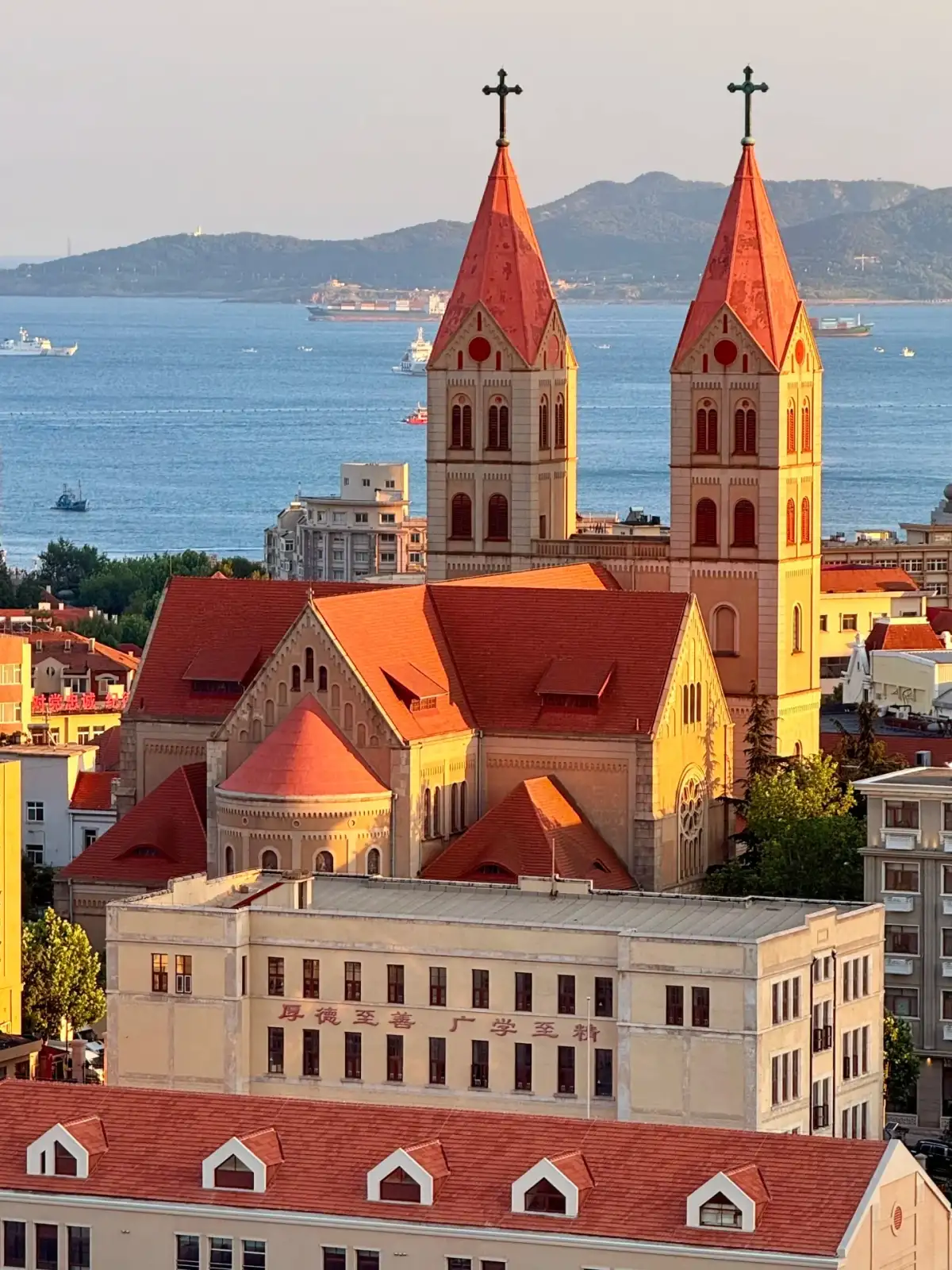
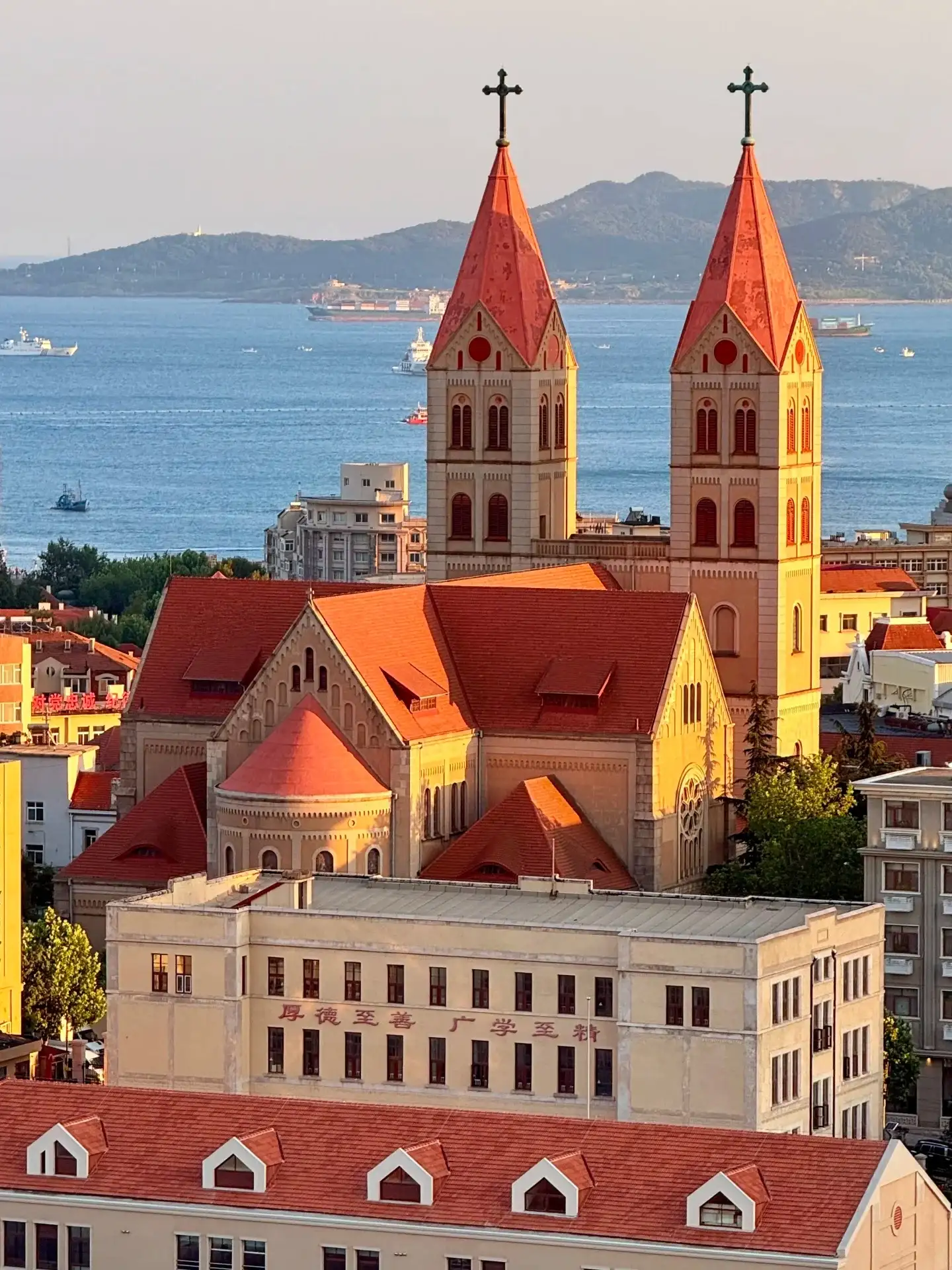
The twin towers of St. Michael’s Church in Qingdao and the sea.
The richness of the red tiles lies in their varying heights and orientations
Viewed from above, the red rooftops do not form a uniform, flat layer. Different slopes, ridge orientations, and the way trees block the light create variations in shade among similar colors. Some roofs are illuminated by the sun, while others lie in shadow, giving the city a sense of depth. The relatively flat sea in the distance provides a striking contrast to this dense undulation.
Don’t just point your camera at the most striking buildings. Choose a small section of an ordinary neighborhood and observe how windows, roofs, and courtyards come together to create a neighborhood-scale atmosphere—this, too, reveals Qingdao’s unique character. Not all buildings in a city belong to the same era or style. When you come across a specific building while walking, check the plaque on site—there’s no need to automatically classify every red-tiled house as belonging to the same historical category.
Longshan Road and the surrounding streets—shift your perspective from a bird’s-eye view to a close-up
As you turn from Signal Hill onto Longshan Road and the surrounding streets, your view shifts from expansive rooftops to building facades, doors, and windows. When the Qingdao Municipal Government describes exploring the Old Town, it also highlights the connection between Longshan Road and the surrounding historic buildings. For first-time visitors, this area is ideal for observing how the sloping terrain influences building entrances, the height of courtyard walls, and views around corners.
As you walk along the road, pay attention to a few ordinary details: does the sea come into view in the distance as you go downhill? Which wall is illuminated after a turn? How do the tree canopies shade the upper parts of the buildings? The city’s narrative unfolds within these recurring variations. Don’t step into the traffic lane just to recreate photos of popular intersections—public pedestrian spaces already offer plenty of vantage points.
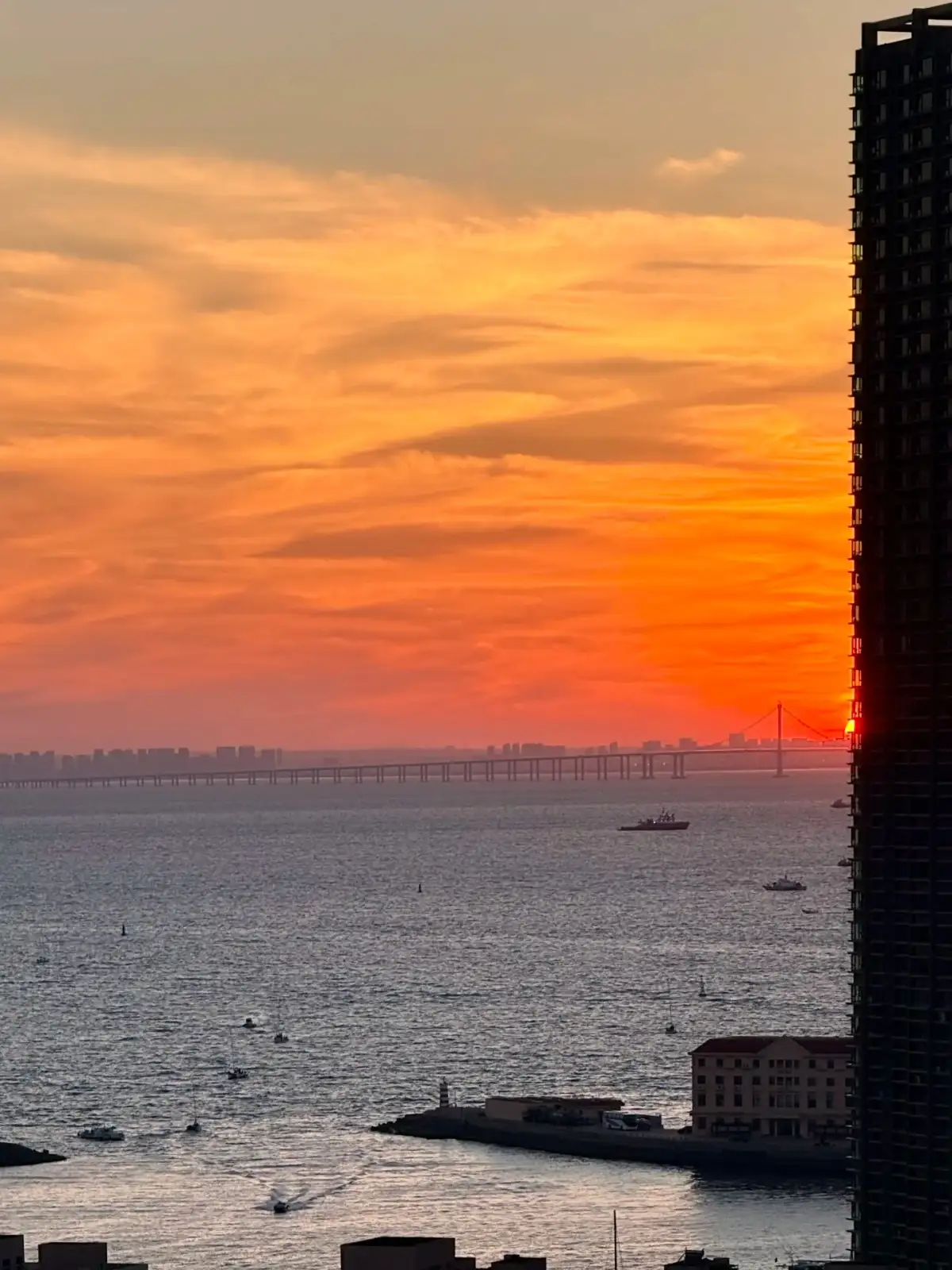
The sea off Qingdao and the clouds at sunset.
The spires of the churches—which help with navigation—are also worth a closer look
Churches in the Old Town easily serve as visual landmarks, but Catholic and Protestant churches are distinct architectural styles and should not be conflated in photo captions. If you plan to visit the area around St. Michael’s Church, start by observing the proportions created by its twin towers against the surrounding streets, then move closer to examine the entrance and facades.
When taking photos, you don’t always have to fill the frame with the building; leaving part of the street or neighboring roofs in the shot actually helps reveal why it stands out in the city. Whether to go inside for a tour depends on the day’s opening hours and etiquette requirements. As historical heritage, religious spaces, and urban landmarks, buildings can hold multiple meanings simultaneously, and travel narratives need not reduce them to mere backdrops.
The red pavilion on Signal Hill serves as another urban landmark
The three red, mushroom-shaped buildings atop Signal Hill are explicitly listed as landmarks in the Qingdao Municipal Government’s tourist guide. Their silhouettes differ from the pointed roofs of the Old Town below: the rounded tops are light and eye-catching, while the surrounding trees partially obscure their bases. Spotting this red landmark from afar allows you to pinpoint the hill among the dense cluster of rooftops and recall the direction of the slope you’ve just walked up.
Viewing from the mountain isn’t limited to a single observation deck. As you move along the walking paths, tree branches frame the panorama into segments; some spots offer better views of the sea, while others bring the church spires and neighboring blocks into view simultaneously. Consequently, the city doesn’t unfold all at once like a flat map, but rather reveals itself gradually as you round each corner. Longshan Road, the area around the Former Governor’s Mansion Museum, and Signal Hill can form a relatively concentrated exploration zone; specific stops can be chosen based on personal interest. If you continue toward the Zhejiang Road Catholic Church area, you’ll embark on another neighborhood stroll, where you’ll need to factor in the slopes and transitions between areas. Keeping these two areas distinct from one another better captures the city’s actual sense of distance than cramming all the buildings into a single, continuous “check-in” map.
Head toward the coast, and let the city’s density gradually give way to openness
When walking through the Old Town, you can choose the boardwalk area or the direction of Xiao Qingdao and Qinyu Road for the seaside sections, but you should decide based on your location that day—don’t treat the entire coastline as a short stroll. As you approach the water’s edge, the relationship between building density and your field of view changes: street corners gradually open up, the sky expands, and your pace naturally slows.
The coast offers more than just sunsets. On cloudy days, you can admire the gray-blue hues of the water and the coastal rocks; on sunny days, observe the ripples and reflections; and when the wind is strong, you can feel the contrast between the open sea and the sheltered alleys. Whether the twilight brings vivid colors depends on the conditions of the day—there’s no need to ignore the real sea right before your eyes just to wait for a certain kind of sky.
to the seaside—capture this stretch of the slope as well
When it comes to dining in Qingdao, seafood naturally comes to mind, but a meal doesn’t have to be about expense or quantity. Choose a restaurant with a clear menu, check the preparation methods, portion sizes, and daily specials, order a few dishes that suit your taste, and pair them with a staple food. If you just want a light meal, a simple bowl of noodles or a home-style dish in the Old Town is a perfect way to round out the day.
On your way back, take one last look up at the rooftops at the end of the slope—you’ll already be able to recognize the city you saw from above during the day. This stretch of Qingdao is perfect for capturing three types of scenes: a distant view of the rooftops and the sea; a close-up of doors, windows, and street trees; and a shot of the seaside with plenty of negative space. These images connect the different scales experienced on the same day and transform the Old Town from a vividly colored slogan into a place you can recall through your own footsteps.
Further Reading and References
Qingdao · Destination Overview
Compiled by the East Travel Editorial Department based on publicly available travel notes and the references listed in the text, for pre-trip reading; accompanying images are sourced from the noted references.
Qingdao Municipal Government: Signal Hill
Qingdao Municipal Government: A Stroll Along Longshan Road in Qingdao’s Old Town