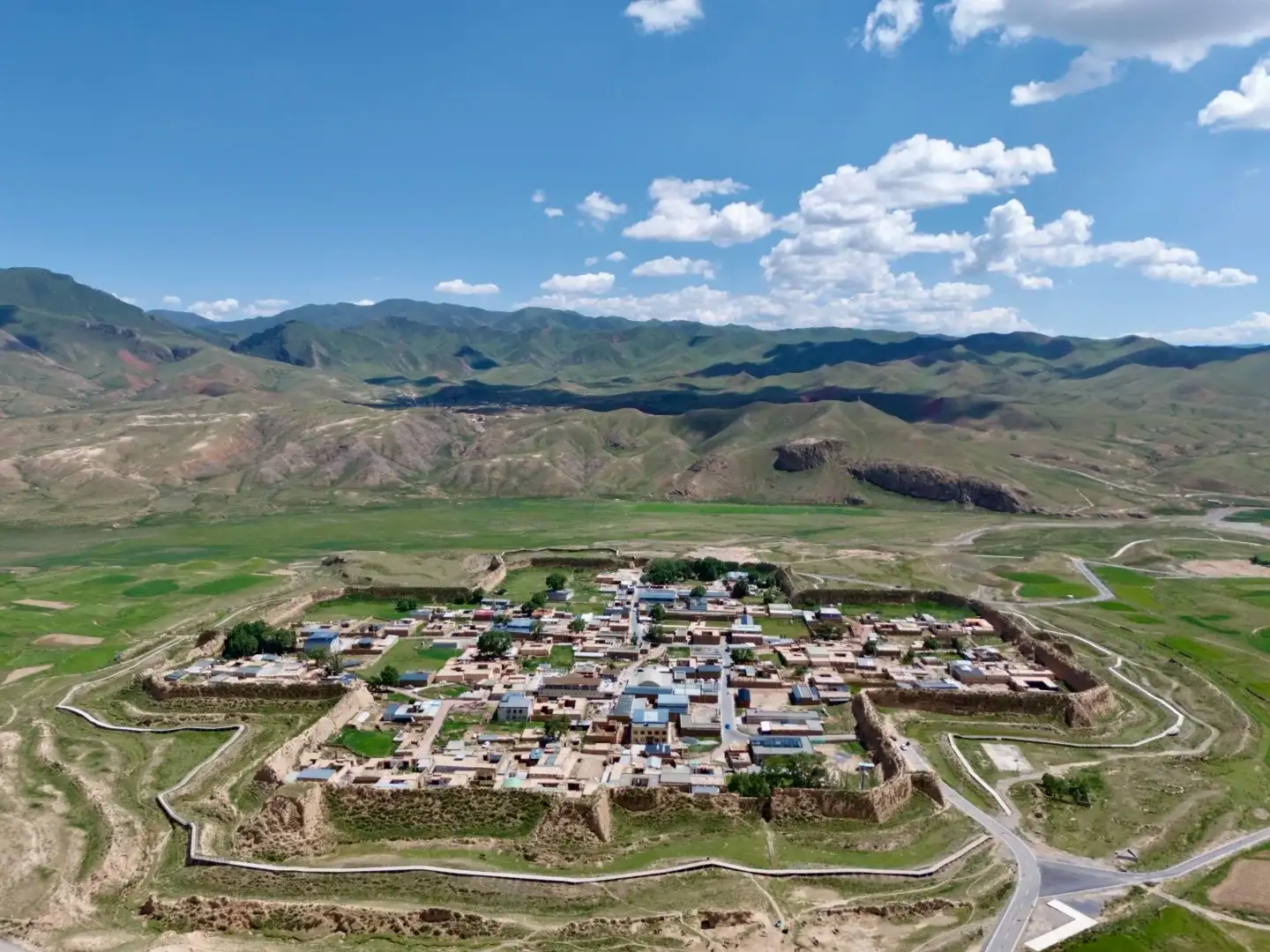
Ganjia can complement the cultural sights around Xiahe with a spatial contrast between grassland, walls and cliffs. It is more than a cliff photograph or an optional stop on the way back to Lanzhou. Houses inside Bajiao City, roads around it and grasslands beyond reveal both historic remains and residential life. Baishiya's cliffs give this settled landscape a much larger scale. First-time international visitors can ask an adviser to explain the geography, then explore through two main observation points rather than a dense checklist. Guiding and walking should follow actual open areas; temples, caves and other separately managed places have their own rules.
Begin with the whole of Bajiao City from an authorised viewing position, comparing angular wall lines with gentle grassland slopes. In open streets, houses, courtyard gates and roads turn the geometric outline into an actual place. Dates, defensive purposes and building histories need official interpretation or a knowledgeable guide; social-media titles are insufficient evidence. Homes are not automatically visitor spaces, so obtain permission before photographing private windows, entering courtyards or approaching residents. The sourced city-and-grassland view illustrates spatial relationships. It does not promise visitors the same aerial photography opportunities or access to every stretch of wall.
Observe Baishiya from different permitted places, focusing on how rock rises from grass slopes and how valley openings divide the continuous cliff line. Sun emphasises texture; low cloud can hide parts of the outline and change the mountain's appearance. Clear weather is not the only worthwhile condition, though wind, snow, rain and roads affect what can be done. Temple or cave visits require separate checks of opening, entry requirements and time, rather than being assumed within a grassland excursion. Do not leave open paths to reach the cliff face. Ordinary authorised viewpoints can already explain the relationship between town, grass and rock.
Half a day to a day from a suitable Xiahe base is an editorial starting point. Choose morning or afternoon according to religious-site visits, meals and onward travel rather than copying someone else's order. If you must reach Lanzhou that day, establish arrival constraints before choosing one main Ganjia stop or two. Traffic direction, temporary restrictions and parking arrangements change. An old announcement explains management context but cannot be treated as today's rule. Place grassland views and old-city observation along a sensible direction of travel; avoiding repeated backtracking is generally more useful than adding camera positions.
For a Ganjia excursion, choose accommodation around the wider Xiahe itinerary and check transfers to each stop. Similar place names do not make an in-area stay necessary. Hot water, heating, meals and vehicle meeting points affect a visit more than a promotional view. Leave breaks during plateau walking. Discuss particular health or mobility needs with your adviser and a qualified professional beforehand; this guide gives no medication or treatment advice. International guests should confirm passport names and accommodation arrangements, and request foreign-language interpretation in advance rather than assuming it at every location. These practical checks free attention for the landscape.
Grass colour, snow and cloud vary by season. Coordinate dates with the whole Gannan route rather than promising summer colours from one photograph. Bring walking shoes, warm wind protection and equipment for plateau sun. Respect the separate boundaries of pastures, homes and religious spaces: do not cross fences, obstruct roads or treat animals as props to approach freely. An aerial view reflects its source's shooting circumstances and cannot be converted into an assumed visitor right to fly. If weather or roads change, remove repetitive stops and keep one meaningful observation point instead of rushing through every name.
01Historic walls beside the grassland
Bajiao City offers a contrast between surviving walls and open terrain, with distant viewing and a street walk forming two parts of a visit. Follow accessible lanes to a clear section of wall and notice the houses around it.
02Rock faces and openings at Baishiya
Make the cliffs a landscape study, looking from the grass slopes toward the continuous rock face and its openings. Sunlight and low cloud create different patterns of shade, so one unhurried stop can be rewarding.
03Open scenery alongside a Xiahe cultural stay
Use your Xiahe-area accommodation as a base for a half-day or day centred on the city walls and cliffs. Coordinate it with surrounding temple or town visits, allowing separate time for driving, meals and observation.