
Landscape and ideas meet
Religious sites, academies and writing traditions sit within the mountain setting. Ask why a view has been interpreted repeatedly, rather than only photographing it.
A deeper China. A journey of your own.
UNESCO lists Lushan as a cultural landscape, linking its natural setting with literature, art and historic activity.
Plan my trip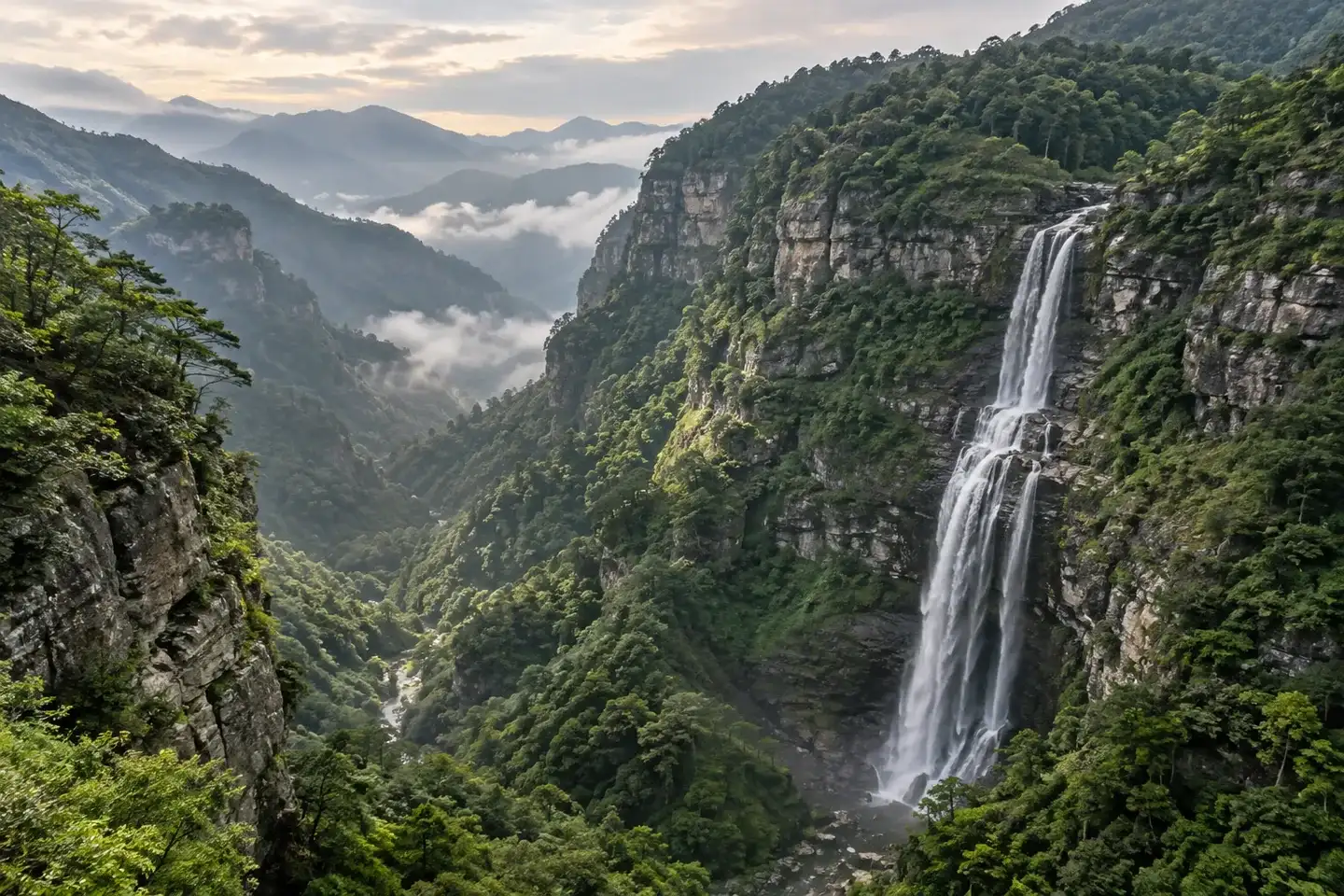
Lushan is a World Heritage cultural landscape for more than peaks, waterfalls or cloud. The mountain stands between the Yangtze and Poyang Lake, and its forest, water and terrain have long drawn religious communities, scholarship, poetry and painting. Temples, academies and later buildings show how successive generations gave meaning to the same natural setting. A day spent racing between lookouts by vehicle cannot easily explain those relationships.
Divide a visit into two themes: one for terrain, mist and water, another for buildings and intellectual history. They need not fit the same day, and you need not collect every scattered site. Weather differs between mountain and plain, while fog can erase a distant view without warning. When paths are wet or temporarily managed, a nearby cultural stop may be the better choice. From Jiujiang or another city, calculate travel up the mountain separately from movement on top; a map time to the foot is not the length of the outing.
Alternate seeing with understanding: study terrain on a valley walk, then find a nearby human site that explains how people wrote about, studied or worshipped within it. Keep those stops geographically coherent so the day does not become mostly vehicle time.
Religious sites, academies and writing traditions sit within the mountain setting. Ask why a view has been interpreted repeatedly, rather than only photographing it.
Lushan’s position creates a relationship among ridges, the Yangtze and Poyang Lake. In clear weather, viewpoints reveal different sides of that geography.
Religious and educational sites coexist with later architecture. Compare function and siting rather than treating every building as the same age.
Choose an open trail for rock, woodland and water. When mist arrives, enjoy close detail instead of chasing a hidden horizon.
Read interpretation at a site linked to learning, religion or architecture, then relate it to the surrounding landscape.
In an accessible settlement or group of buildings, compare roofs, courts and materials shaped by mountain weather.
Make room for both mountain scenery and cultural history, switching the emphasis as weather changes.
Make one valley, ridge or waterside walk the main thread, pausing to observe conditions rather than crossing the mountain repeatedly.
Use a second window for one or two cultural sites and consider why they occupy this mountain setting.
A mountain stay makes it easier to split natural and cultural themes over two days, but verify access and luggage transport. A Jiujiang base needs ample time for both ascent and internal movement.
Allow time first to reach the main mountain area, then for internal rides and walking; the foot of the mountain is not the end.
When views close, reduce transfers between lookouts and choose nearby heritage spaces. Use caution on wet trails.
Historic and active religious sites have separate access and photography rules. Check current notices before entering.
UNESCO lists it as a cultural landscape: long interaction between mountain nature and religious, educational and artistic activity is central.
Far views may disappear, but nearby forest and cultural sites can still matter. Adapt to safety and access; do not force wet trails.

Start with your interests, available time and the right combination of places.

Plan by region and interest, rather than choosing one season for the whole country.

Meet local life with curiosity, consideration and an open mind.
YOUR JOURNEY
Share the places and timing you have in mind, then discuss a suitable route with a guide or travel adviser. Services and availability need confirmation.
Contact a guide about this place
FROM INSPIRATION TO YOUR JOURNEY
A place you dream of. A journey shaped around you.
Plan my trip