
Eastbound Travel Editorial Department · Travel Diaries and Pre-Trip Reading
coastal road is long; start by choosing a stretch of coastline where you can stroll at a leisurely pace
The name “Dalian Coastal Road” might lead one to imagine a flat path that runs constantly alongside the sea, but in reality, the coastline constantly curves, and the road’s elevation changes with the contours of the hills. For first-time visitors, it’s best not to aim to walk the entire length of the route. Instead, choose a section of an open walking path around the Binhai East Road area. Plan your itinerary around the road’s curves, glimpses of the sea through the trees, and a wider spot to stop and rest, then take appropriate transportation back to the city center. The continuous blue shoreline on the map does not mean that walking spaces with the same conditions are available everywhere along the coast.
When selecting a route, first determine the starting and ending points, and verify road access, pedestrian pathways, and drop-off/pick-up locations. If you plan to include scenic areas near Bangzhu Island, check the entrance and visiting areas separately—do not mix the road walk with the scenic area visit. You can pack a lot into a single day: follow a stretch of road to observe the undulating coastline, view the water’s surface at two different elevations, and wrap up with dinner. Even if you don’t complete the entire route, you’ll still gain a complete impression of Dalian’s unique blend of mountains and sea.

Rocky shores, flower beds, and the sea along Dalian’s East Coastal Road. the sea changes shape The coastline’s
Round a bend, and the sea changes shape
The charm of the coastline often reveals itself just around the bend. The water, previously obscured by trees and hills, may suddenly open up at the next clearing, while distant islands shift from the periphery to the center of your view. While walking, you can use two adjacent bends as points of comparison: at the first, observe how the sea is framed by the rocky shores on both sides; at the second, see how it continues to stretch outward. The water itself remains unchanged, yet the land’s framing of it varies, and the ordinary pace of an urban walk thus creates a rhythm of observation.
Choose a spot to stop on the side where pedestrian space allows; do not walk into the center of the roadway just to get a full view. It’s not always possible to anticipate the speed and noise of approaching vehicles on a curve. The flowers and trees along the road make for great close-ups, while looking back allows you to appreciate the interplay between the road’s curves and the horizon. Packing away your camera and walking a short distance before looking up again at the next spot actually makes it easier to notice how the mountain contours and the shoreline cause the sea to appear and disappear intermittently.
rocks at the water’s edge reveal the depth of the shoreline
Some of Dalian’s coastline isn’t wide sandy beaches, but rather rocks jutting directly into the sea. The gray-brown rock formations up close feature cracks and layers, with the water creating varying shades of color between them. This is an ideal spot to view the interplay between the rocky shore and the ripples from a standard vantage point: white foam appears and recedes, while the deeper waters retain a bluish hue; the color of the water near the shore is influenced by the rocky seabed, light, and weather. The colors are worth appreciating, and there’s no need to chase a specific moment just to capture the crystal-clear blue-green tones seen in online photos.
rocks may appear dry and stable, but they can still be slippery, feature sudden drops, and be subject to rising waves. The walking route is bounded by the designated paths and safety barriers; climbing over railings to descend onto the reefs should not be considered a necessary part of experiencing the sea. From this vantage point, you can clearly see the thickness of the rock formations; if you wish to engage in seaside activities, you should select a separate area that is explicitly permitted and suitable for such activities. When viewing the rocky shore as a landscape, the details are no less abundant than when you’re down by the water’s edge, and maintaining a safe distance allows for a longer period of observation.
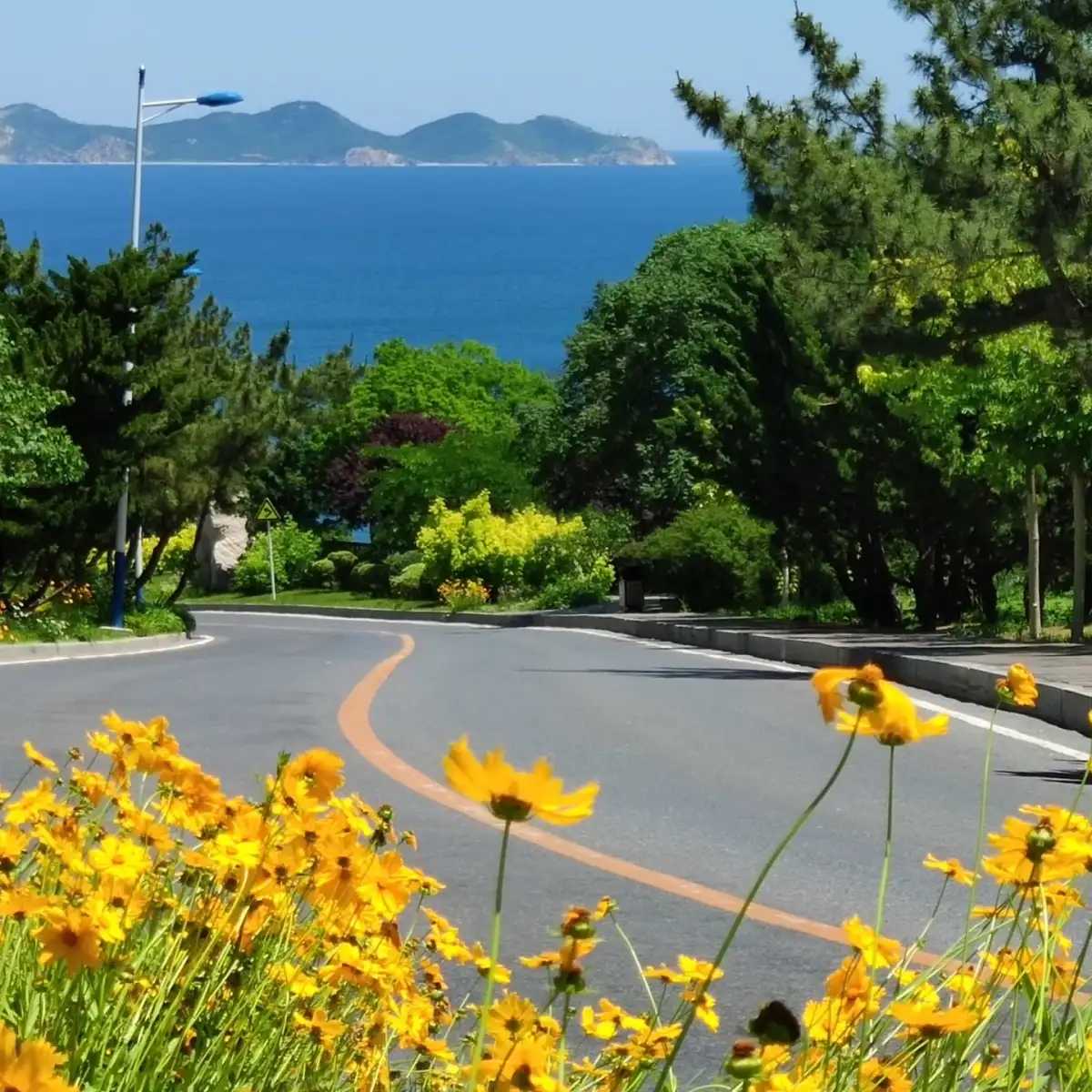
road curves, trees along the roadside, and the distant sea.
gaps in the trees and flower beds offer a close-up view of the vast sea
The trees along the road do more than just block the ocean view. Their branches form a dense pattern of lines in the foreground, while the sea leaves a larger expanse of empty space; when viewed together, the sense of depth becomes much more apparent than when facing the ocean alone. You can choose a spot where you’re allowed to stop and gaze at a stretch of water peeking through the gaps in the trees; then, after walking a few steps along the sidewalk, the same stretch of sea will be framed by another set of branches. Observing the scenery while traveling is like constantly changing windows, and the interplay between the mountains and the sea thus becomes more nuanced.
When the flowers are in bloom, the roadside adds a layer of vibrant color to the foreground, but there’s no need to step into the flower beds to find the perfect shooting spot. Whether the plants are in full bloom depends on the season and how well they’re tended; the yellow band of flowers in the photo isn’t a daily sight. On cloudy days, you can appreciate the interplay of hues between the foliage and the gray-blue water, while winter is better suited for discerning the direction of the branches. By incorporating the immediate surroundings into your stroll, the anxiety of waiting for that perfect view of the blue sea will ease—the details along the roadside offer plenty of interest on their own.
coves and the silhouettes of boats bring the sea back into the city
When ships, docks, or wake trails appear in the distance, Dalian’s sea becomes a backdrop for urban life. You can observe this from open vantage points on land: the silhouettes of ships are tiny, white wake trails stretch out slowly, and fixed docks anchor your gaze to a stretch of shore. They help gauge the scale of the sea and remind you that the water here is more than just a tourist attraction. Port functions and coastal recreation coexist side by side in the city, together forming the distant vistas seen during a seaside stroll.
There’s no need to guess a ship’s purpose, destination, or the lives of those on board based solely on its appearance. Once a wake disappears, the sea’s surface returns to a more uniform texture, providing a perfect contrast to the recurring white foam along the rocky shore. If the road passes by management facilities or restricted areas, follow the signs and view the distance from permitted vantage points. Treating such distant vistas as spatial clues is more accurate than turning them into unconfirmed nautical tales; it also makes it easier to preserve the true locations of cities, hillsides, and the sea.

The sea, silhouettes of boats, and distant islands beyond the tree tops in the foreground.
ascents, descents, and steps require planning for two different levels of physical exertion
fatigue from coastal walks doesn’t come solely from the number of kilometers. A downhill stretch may seem easy, but the return trip could turn into a continuous uphill climb; if a seaside boardwalk has steps, you shouldn’t estimate the time required based solely on the road distance. When planning, consider the route’s elevation changes, whether there are exit points along the way, and transportation options for the return trip. If you’re traveling with the elderly or children, choose shorter sections that allow for an easy return via the same path. Stop when you reach a clear vantage point—there’s no need to cover the next cove on the same day.
Plan to hydrate and rest at locations you’ve confirmed before setting out. Facilities and business hours vary along the route, so bring water with you and designate a spot where you can sit and rest as a midway point. When you’re sweating and the sea breeze hits, how you feel will change, so adjust your clothing according to the actual weather. This way, the route offers both the freedom to keep moving forward and the flexibility to shorten it at any time; the seamless connection between the mountains and the sea doesn’t require you to maintain the same pace the entire time.
fog, wind, and tides will reshape the day’s experience
The seaside is sometimes clear, and at other times, distant islands are shrouded in mist. When visibility is low, there’s no need to keep extending your route in search of the horizon; instead, turn your attention to the nearby rocky shores, tree branches, and the curves of the road. When the wind is strong, both photography and walking require a more stable footing; if strong winds, high waves, or temporary closure notices occur, shorten your time outdoors and return according to management instructions. The focus of the trip remains on how the coastline changes—there’s no need to wait for all conditions to align perfectly before deeming the outing worthwhile.
If you plan to visit a suitable beach, you’ll need to check the tides, wind and wave conditions, and actual opening hours separately. The shoreline after low tide cannot automatically be considered a safe area for recreation, and rising tides may alter your return route. For a casual stroll along the coastal road, stick to higher, open routes and reserve water-based activities for sections where conditions are clearly defined. By clarifying what activities you’ll be doing that day, the ever-changing sea becomes a subject of observation while helping you maintain a clear sense of your movement boundaries.
Plan your return trip before the light changes
When choosing where to end your walk, look for actual pedestrian exits and locations where vehicles can pick you up, rather than the spot on the map with the name closest to the sea. Buses, taxis, and pre-booked rides each have their own connection requirements. Before setting out, verify that day’s routes and pickup locations, and save the Chinese addresses on your phone. If the route is divided into several sections, it’s best to have a clear endpoint for each segment—don’t assume that the final scenic spot will necessarily be a place where you can immediately hail a ride.
Afternoon light gradually alters the hues of the sea and the shadows cast by the rocks. You can pause briefly, but don’t sacrifice your return time by waiting for the sunset. Since the coastline faces different directions, not every spot is ideal for watching the sun dip into the sea. Afterward, head back to the city for dinner. Reflecting on how the road just revealed a patch of water through the trees is usually a better way to wrap up this stroll than continuing to wait for an uncertain sunset. By balancing sightseeing with your return journey, the Coastal Road will become a relaxing part of your day in the city.
End the day with the coast, rather than collecting all shades of blue
Dalian’s warm season is ideal for observing the interplay of light and shadow between lush tree canopies and the water’s edge; on hot, sunny days, minimize your time in unshaded areas. In autumn, you can compare the colors of the vegetation on the slopes with those of the rocks; during the cold season, pay closer attention to sea breezes, slippery surfaces, and trail accessibility. Certain scenes exist only under specific weather and lighting conditions. Photos help you understand the best viewing angles, but the actual scene will always reveal its own unique version. Only by accepting this can you find meaning in the real landscape, rather than being led by a fixed image of the sea.
Before leaving, you can select three specific memories: a stretch of sea framed by trees, the zigzagging line of a rocky shore, and a distant vista that suddenly unfolds after a bend in the road. These are enough to illustrate how the mountains reach the seashore and how the city continues to thrive along the contours of the hills. On a future visit to Dalian, I can choose another stretch of coastline to compare; this time, I only took a leisurely stroll along a short section, yet I’ve already learned to interpret this city through its turns and distances.
Further Reading and Reference Sources
Compiled and organized by the Eastbound Travel Editorial Department based on publicly available travel notes and listed information. Intended for pre-trip reading; this is not a personal travel account. Please verify opening hours, transportation, reservations, and service arrangements according to your actual travel dates.
Liaoning Provincial Department of Culture and Tourism: Dalian Bangzhu Island Hotel Scenic Area
Do you need to walk the whole coastal road?
Choose clear endpoints for a Dalian Binhai Road walk and make changing sea views around bends your subject. Dalian rocky coast views let you compare nearby rock with distant water; gaps between trees also give the open sea a foreground. There is no need to cover every named section in a day. A steady pause at one viewpoint can reveal more than several similar hurried stops.
Planning slopes together with the return
A Binhai Road return plan should distinguish roadside walking, steps down towards the shore and vehicle pickup. For companions who prefer fewer climbs, retain a shorter elevated viewing section. If fog or wind changes visibility, shorten the outdoor stop and return from the agreed point. Do not wait until after sunset viewing to work out where a vehicle can meet you.
Planning references
Planning reference: Dalian Binhai Road walk 1