September 29, 2026 · Travel Diary
Before entering the cave, first observe the continuity of the mountain’s form
The Yungang Grottoes are not a museum where statues are concentrated in exhibition halls. The sculptures were carved into the mountainside alongside the caves; the rock face itself is an integral part of the artwork. As you follow the tour route, first take in the continuous contours of the mountainside, then observe how the individual cave entrances are distributed; this will make it easier to understand the interior spaces once you enter the caves.
UNESCO designates Yungang as a major representative of early Chinese Buddhist cave art and emphasizes its value in cultural exchange. It is sufficient to be aware of this background before your visit; there is no need to strive to identify all stylistic periods right from the start. First, observe the relationship between the artwork and the stone—only then can historical knowledge find its proper context.
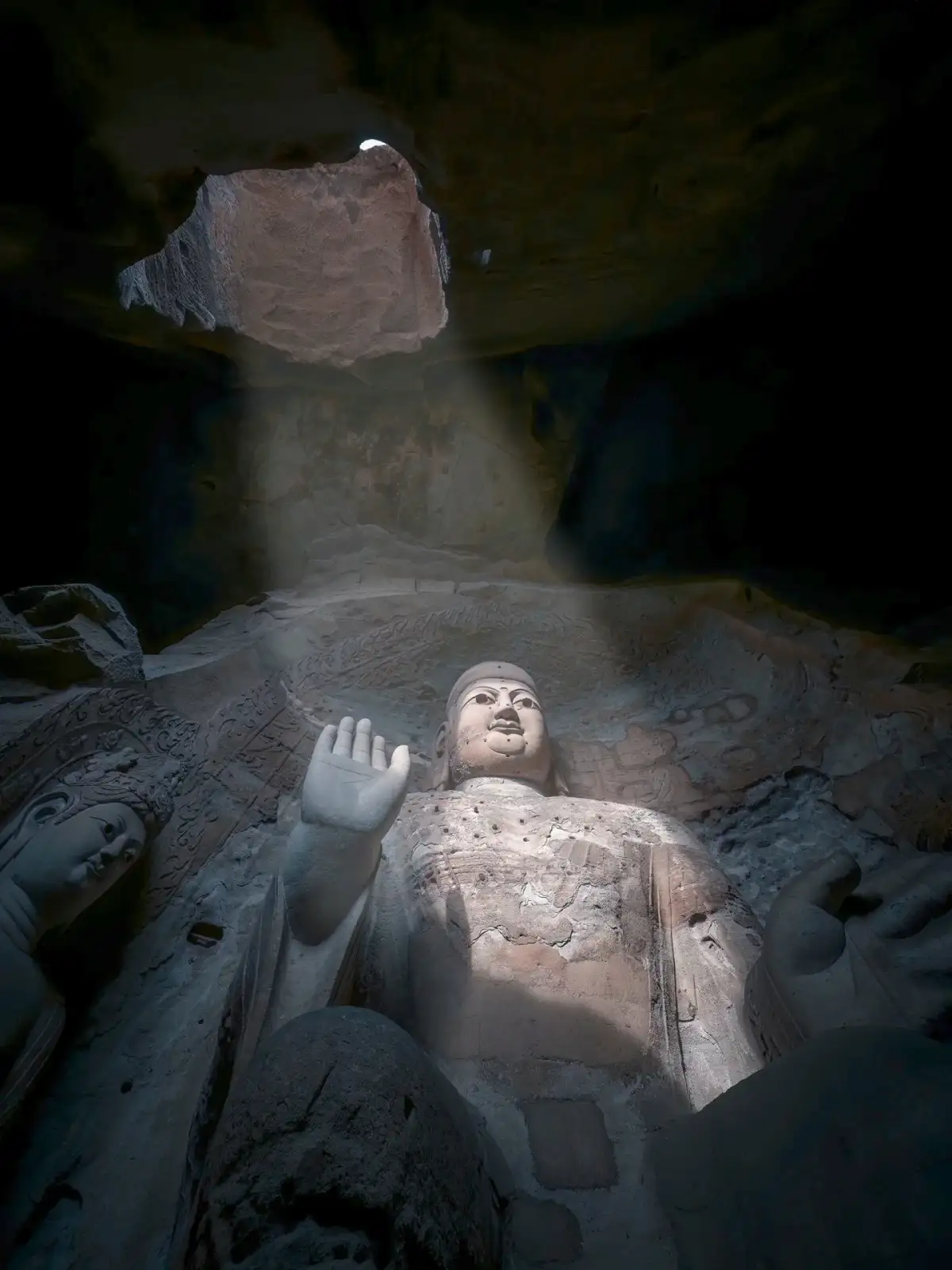
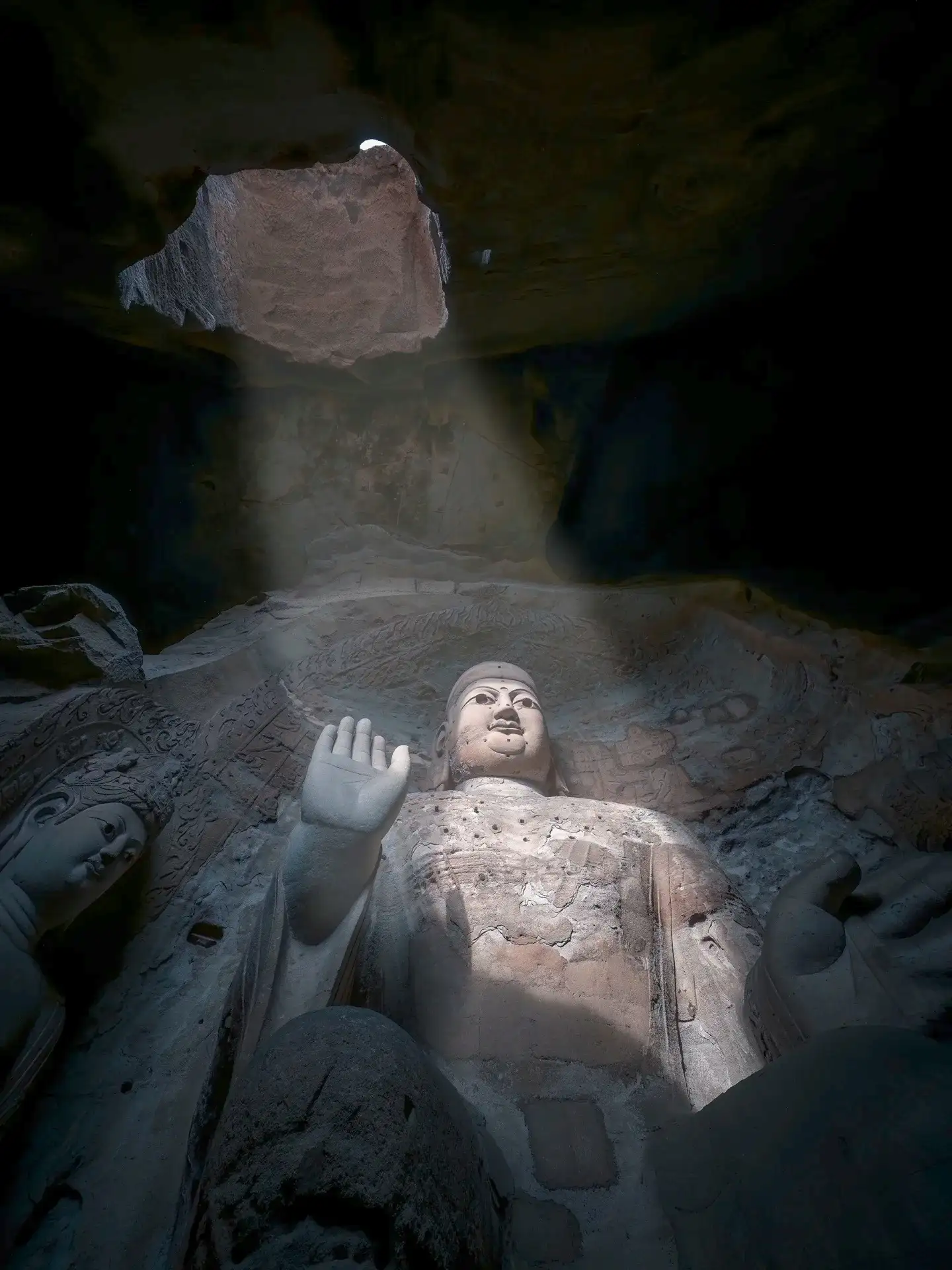
A view looking up from below at the Yungang Grottoes statues and the opening at the top.
Beyond the colossal statues, the caves hold an even more intricate world
Upon entering the accessible caves, the main statue often captures one’s attention first. After your eyes have adjusted to the light, take a closer look at the walls and surrounding details, and you’ll discover that small statues, decorations, and architectural elements collectively form a denser composition. The contrast between large and small is a striking aspect of the Yungang viewing experience.
You can choose a specific detail to examine closely: how the folds of the robe cascade down the body, how the fingers are rendered, and how the patterns on the back blend with the figure’s outline. This approach requires no specialized background, yet it transforms a vague sense of “awe” into concrete memories. Whether photography is permitted during the visit and which areas are temporarily closed to the public should be determined by the on-site guidelines in effect at the time; not everything the eye can see needs to be captured by a camera.
The light makes the reliefs stand out from the surface
The light in the caves is directional: it is brightest near the entrance and gradually dims as one moves deeper inside. Side lighting makes the folds of the robes and the texture of the stone surface more pronounced; changing your vantage point on the same carving alters its sense of depth. The intense beam of light seen in the photograph is not always visible; weather, season, and photographic techniques all influence the final image.
Therefore, when visiting, it’s better to observe how natural light actually works rather than waiting for a imagined “Buddha’s light.” Which side of the face is clearer, which layer of folds falls into shadow, and how the edges of the cave limit your field of view—these are details you can only truly appreciate on-site. Taking your time to look from a permitted vantage point usually provides a deeper understanding of the artwork than repeatedly adjusting your phone’s exposure settings.
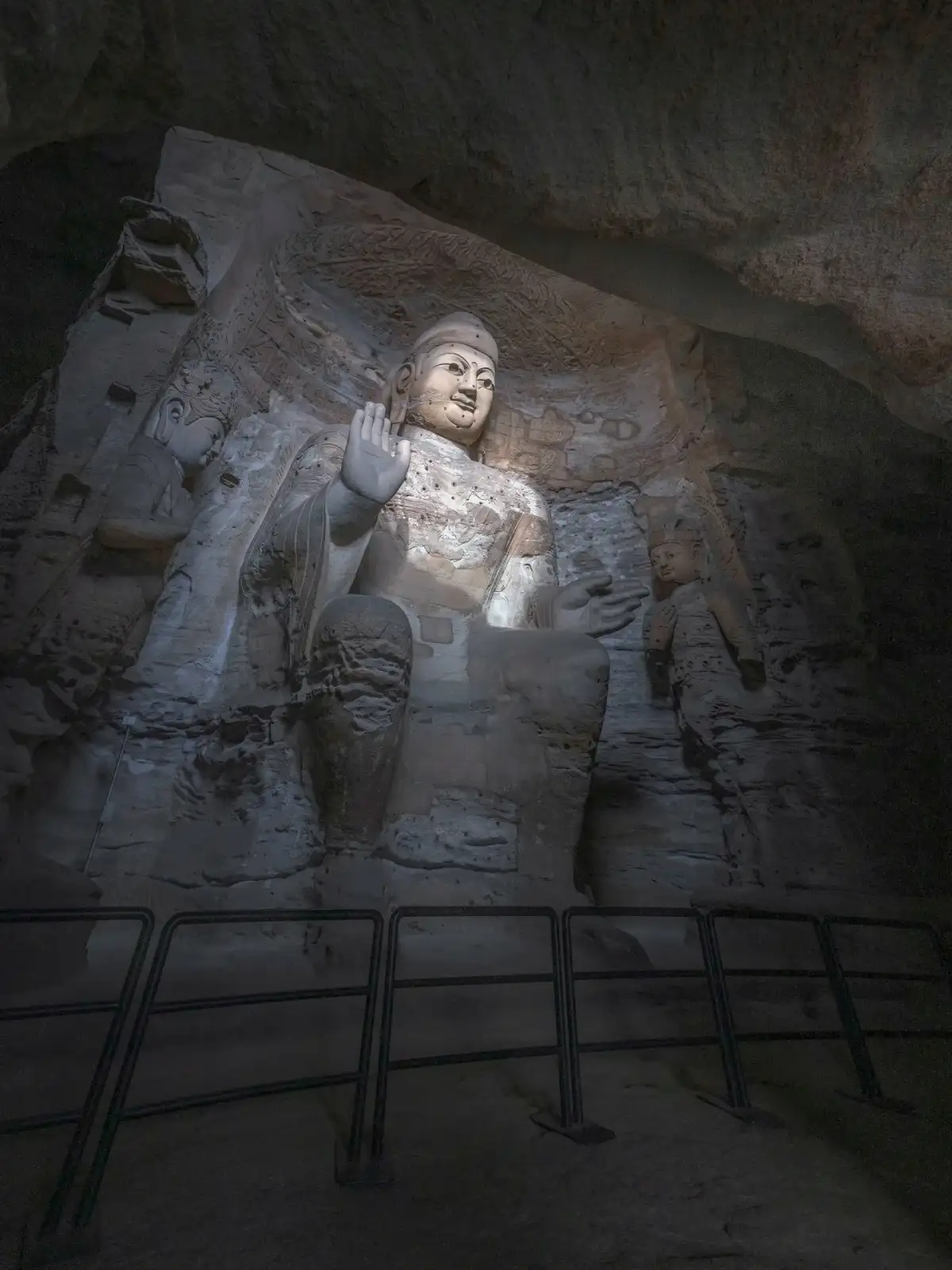
Statues, rock walls, and visitor railings inside the Yungang caves.
Inscribe the history of exchange in the details, not in labels
Yungang’s cultural significance lies in the exchange between different artistic traditions. For travelers, this need not become a mere list of place names; with the help of a reliable guide, specific patterns, costumes, and architectural elements can be connected to a broader historical context. It is more reliable to first observe the details and then understand why they are worth discussing, rather than immediately labeling all patterns with stylistic tags.
If you can’t quite make out a particular pattern, it’s perfectly fine to leave the question unanswered. Make a note of the cave number or the title on the exhibit panel; when you return home, you can look up the information in the research institute’s and museum’s resources to continue your exploration. The value of a heritage journey lies not only in what you learn on-site, but also in having clear questions to pursue after you’ve left.
Since transportation is required to travel between Yungang and Datong’s city center, it’s best to set aside a full half-day or longer for the cave tour, allowing ample time for the guided tour, adjusting to the light and shadow, and close observation. Upon leaving the caves and reflecting on that opening, you’ll realize that light is also an integral part of the space: it causes some elements on the same stone wall to stand out clearly, while others are temporarily concealed in the depths.
the musical scene in Cave 12, which transforms silence into richness
Yungang Cave 12 is often referred to as the “Music Cave,” and the official Datong guide also uses this name to describe its digital exhibition and promotion. This designation offers visitors a very concrete clue: the stone carvings not only depict static, frontal statues but also preserve images related to music and movement. The recognizable poses of figures holding objects, their body orientations, and the arrangement of the figures create a sense of rhythm in the images on the stone walls.
When first observing such details, it’s easy to rush to identify every musical instrument. Without a reliable guide, start by noting the visible postures: whether an object is positioned in front of the chest or at the side of the body, how the arm is bent, and in which direction the figure is facing. Once you have a clear understanding of the image, you can then look up its name and origin, allowing the discussion of cultural exchange to focus on tangible, observable details. Even if access to the relevant caves is limited on a given day, the museum and digital exhibits still provide entry points for further exploration.
the colossal statues, the musicians and dancers, and the densely adorned walls all demonstrate that Yungang offers more than one pace of viewing. When standing before the open-air Great Buddha, your gaze naturally rests on its overall silhouette; when facing the intricate images, however, you must examine each one individually. Allow a little time for both of these paces, so that the caves’ richness isn’t overshadowed by a single, familiar representative photograph. Pausing briefly between caves also helps prevent the drapery and wall surfaces you’ve just seen from blending into the same memory as the next set of sculptures.
The openness of Cave 20 stands in contrast to the interior of the cave
The open-air giant Buddha in Yungang Cave 20 is a classic example. When viewing this site, you can compare it with your experience in the previous caves: the setting is more open, with the sky serving as a backdrop, and the statue’s outline is revealed more directly; inside the caves, however, the space is defined by the ceiling, walls, and the cave entrance.
two different states—not only do they provide distinct backdrops for photographs, but they also alter the sense of distance between the viewer and the statue. When facing the open-air giant Buddha, you can first observe the overall proportions, then examine the face, shoulders, and drapery. If the on-site commentary covers the cave’s transformations and conservation history, it’s worth listening carefully, because the form we see today is the result of a process and should not be taken for granted as the original design.
Further Reading and References
Yungang Grottoes · Destination Overview
Compiled by the Dongxing Travel Editorial Department based on publicly available travel notes and the references listed in the text, for pre-trip reading; accompanying images are sourced from the notes indicated.
Datong Municipal Government: Revitalizing the Cultural Heritage of a Millennia-Old Capital
Datong Municipal Government: One Cave, a Thousand Years—The Myriad Wonders of Yungang