
East Travel Editorial Department · Travel Diaries and Pre-Trip Reading
Before visiting Mount Song, spend half a day at the academy
When traveling to Dengfeng, many people first think of mountain trails and Shaolin culture. Songyang Academy offers an alternative way to experience the area: rather than rushing to climb the heights, start by exploring the courtyards, stone steles, and ancient trees at the foot of the mountain. Though it is part of the “Center of Heaven and Earth” Historic Architectural Complex in Dengfeng, it has its own educational focus. Setting aside half a day for a leisurely visit—and then deciding whether to explore other cultural sites or engage in mountain activities—allows you to truly appreciate what this place has to offer, rather than treating the academy as a brief stopover on the way to your next destination.
Start by placing the academy’s location, accommodations, and subsequent transportation on the same map. The various heritage sites in Dengfeng are not part of a single walkable complex; if you wish to visit the Astronomical Observatory, the Temple of Mount Zhong, or other locations, you’ll need to set aside additional time for travel between sites. For first-time visitors, it’s best to focus the morning on the academy and add only one confirmed activity in the afternoon. This arrangement provides a clear starting point for the itinerary and gives international visitors—who may not yet be familiar with the tradition of Chinese academies—time to form their initial impressions through the gates, buildings, and trees before them.
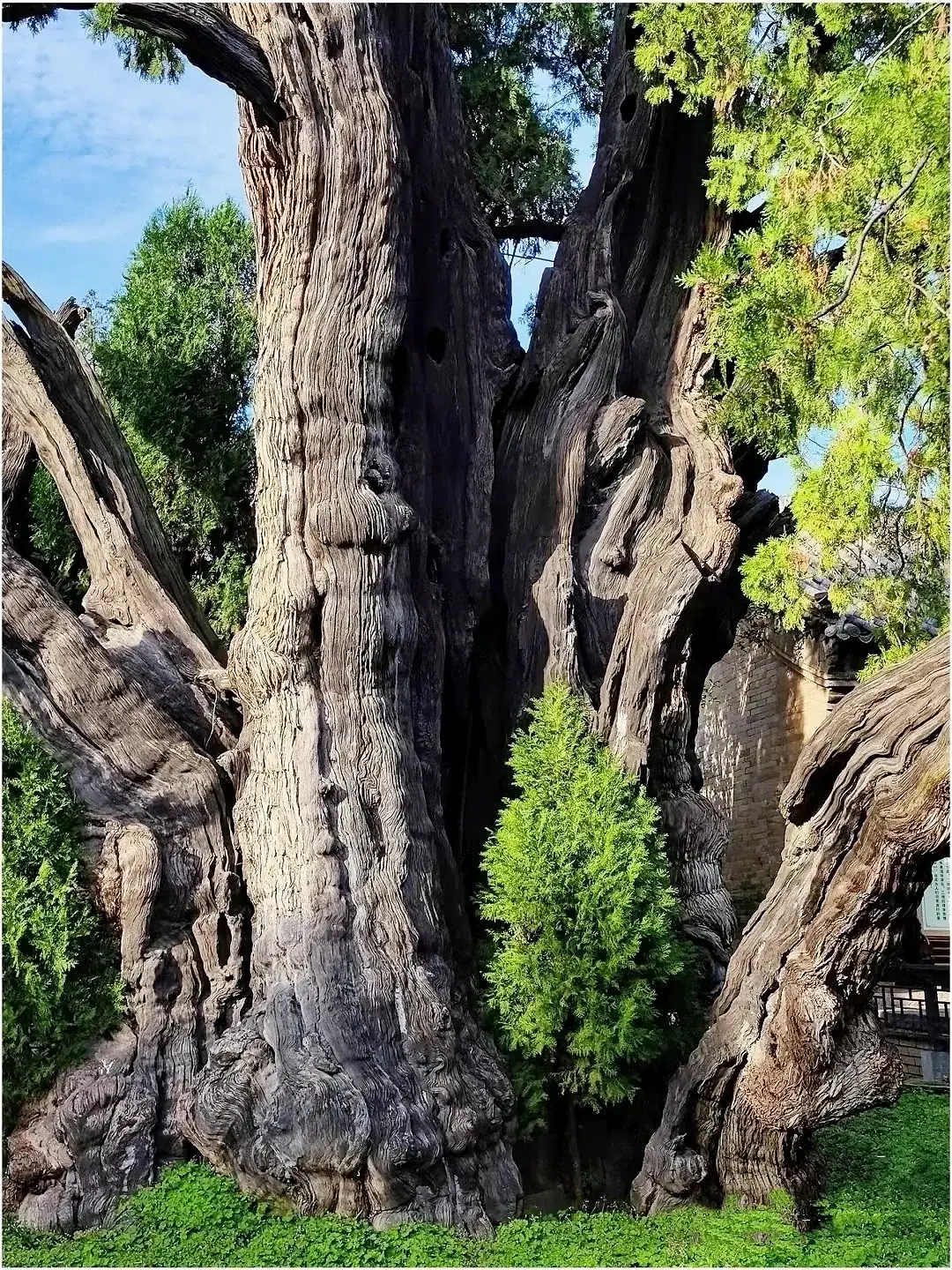
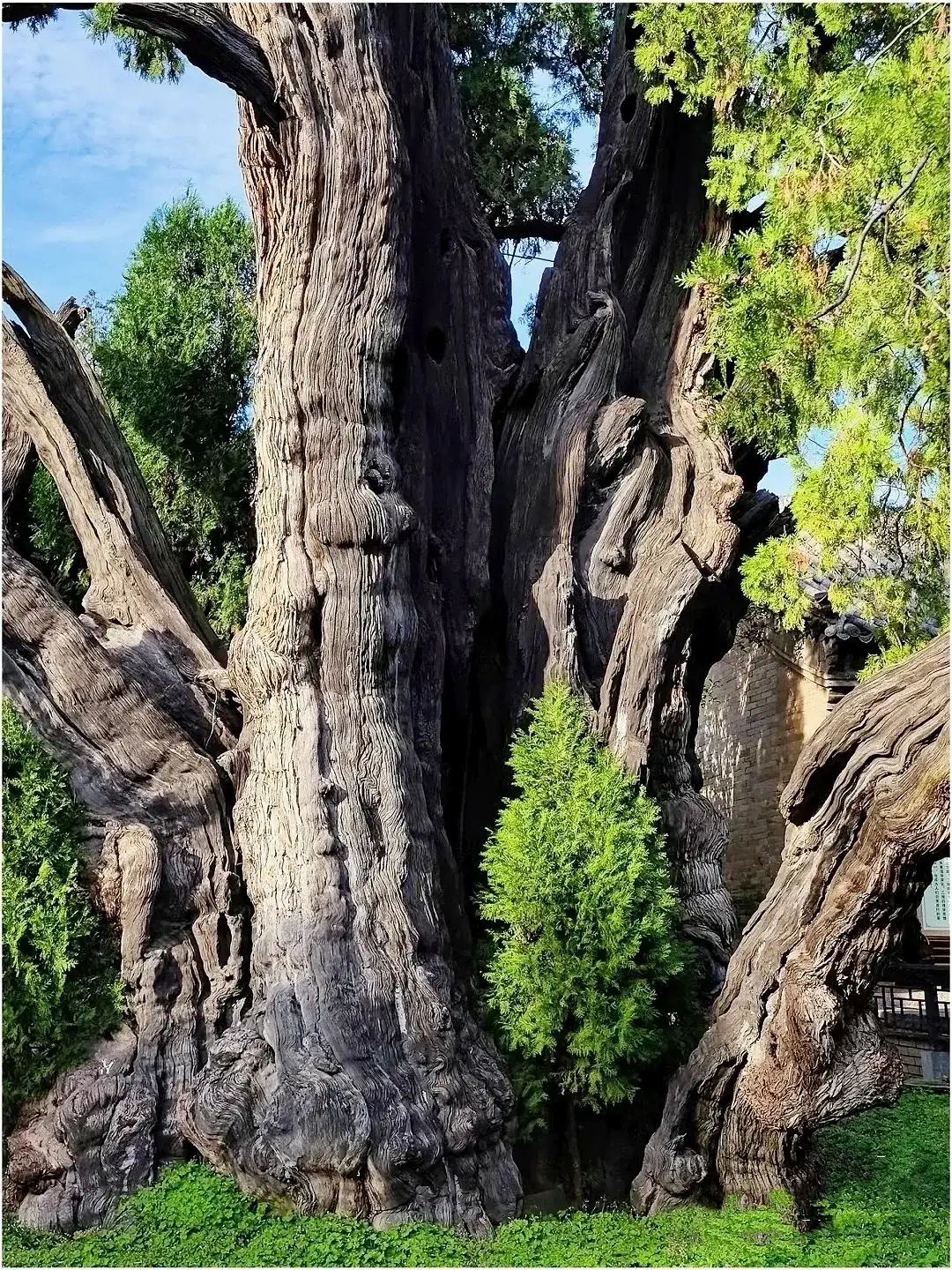
Branches and bark of the ancient cypress at Songyang Academy, with the surrounding courtyards.
The story of the academy has evolved over a period longer than a single era
The history of Songyang Academy encompasses various phases. According to official descriptions from Dengfeng, this site has served as a Buddhist temple, a Daoist temple, and later as a venue for scholarly lectures, gradually evolving into the academy tradition. When reading about this, there’s no need to memorize all the names and dates at once; instead, focus first on understanding one key transformation: how the same space at the foot of the mountain shifted between uses such as religion, residence, and education. Steles and buildings thus cease to be mere static backdrops; rather, they serve as clues left behind by these different modes of use.
Today’s academy has undergone restoration and preservation; therefore, not every visible building can be directly identified as an original structure from its earliest period. Upon entering, start by reviewing the guide and brief explanations to locate the main courtyards and exhibition areas, then select one or two spots for a closer look. For those interested in the history of ideas, you may request a professional guide to provide additional context on the educational and academic backgrounds of the Song and Ming dynasties; for first-time visitors, simply observing how spaces for reading, discussion, and commemoration are distinct from one another offers a rich viewing experience—there’s no need to memorize the entire history to fully appreciate the site.
courtyards are not grand; their details require a closer look
The architecture of the academy is best viewed from near to far. The walls, roofs, and steps at the entrance first form a clear boundary; once inside the courtyard, the doors, windows, and shadows beneath the corridors draw attention to finer details. Compared to large palaces, this place does not rely on grand scale to make an impression. Choose a courtyard that is open to the public, compare how the buildings, trees, and central passageways on either side are arranged, and imagine what kind of environment is needed for teaching, reading, and social interaction.
This interpretation should be grounded in architectural relationships rather than fabricating the specific daily life of any particular historical figure. When encountering tables, chairs, or restored displays, first identify the type of exhibition they belong to, then understand the learning methods they illustrate. For international visitors, a courtyard can serve as a concrete entry point for exploring China’s educational traditions: how public lectures connect with private reading, and how respect for teachers and academic discussion coexist. Questions need not be fully answered on the spot; the arrangement of doors, windows, tree shadows, and rooms alone can help unfamiliar concepts find a memorable place in one’s mind.
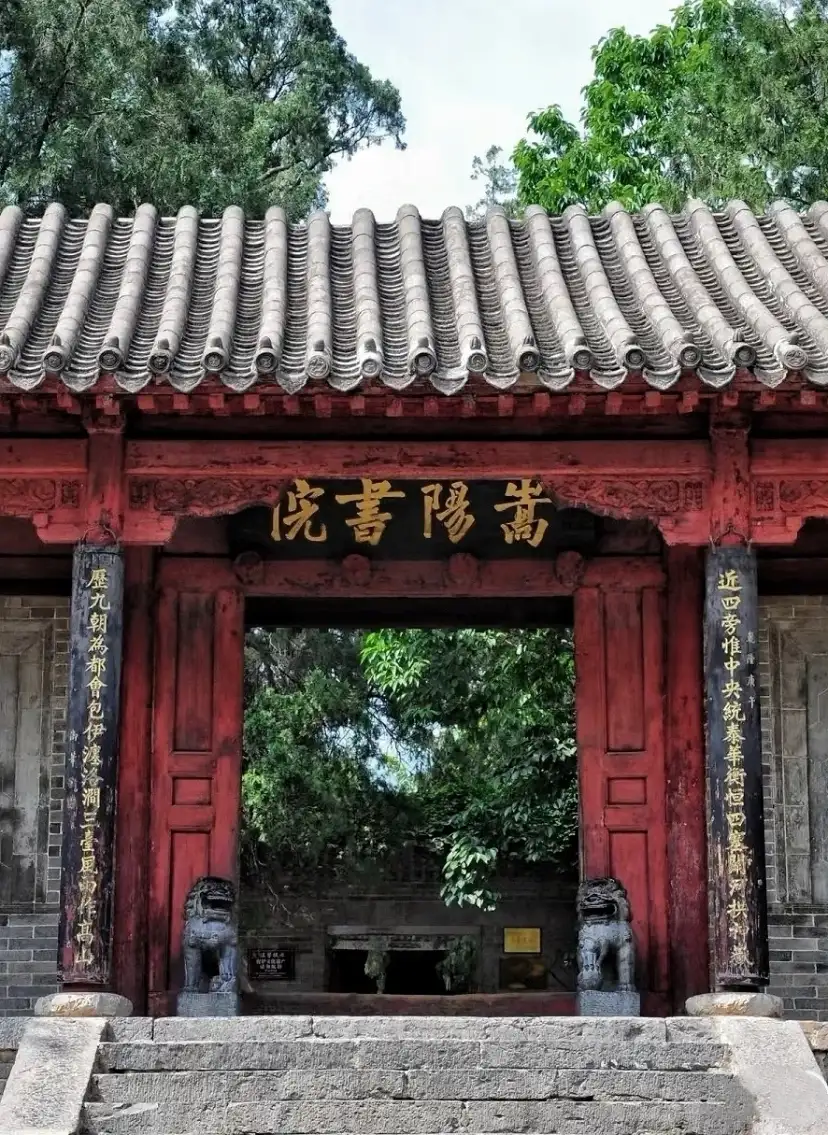
The plaque, gate, and stone steps of Songyang Academy.
General Cypress: First, Observe the Tree’s Form
The General Cypress within the academy deserves a dedicated visit. Rather than merely focusing on the tree’s age, one might first observe how the main trunk branches out, how the deep and light textures of the bark vary as they wind around the trunk, and in which directions the canopy spreads. The allure of ancient trees, distinct from that of ordinary garden trees, lies in their irregular forms; their many twists and turns allow one to truly sense the passage of time. Standing within the designated viewing area, a slight shift in perspective reveals different patterns of overlap among the same branches and trunks.
can be learned through on-site explanations, while the tree species, protection levels, and conservation measures constitute a separate set of facts. Official reports from Dengfeng regarding the conservation of the “General Cypresses” present them as ancient trees worthy of protection; viewing them from this perspective helps recognize that trees are not merely scenic subjects for photographs, but living beings requiring ongoing care. When viewing the trees, please do not touch the support structures or barriers, and do not cross the boundaries in an attempt to capture the entire tree canopy. Preserving the relationship between the trees and the academy’s walls and eaves better illustrates why they belong to the academy than a single close-up of the bark.
A Tang Dynasty stele at Songyang Academy transports us beyond the academy gates
The important stele inscriptions preserved around the academy add a temporal dimension to the tour that differs from that of the ancient trees. The title of the “Stele Commemorating the Holy Virtue and Divine Response at Songyang Monastery of the Tang Dynasty” is quite lengthy; on a first visit, it can be understood simply as a Tang Dynasty stone carving with a specific historical context, with the full text and purpose explained later by the guide. Start by observing how the stele body, capstone, base, and overall height are organized; even those who cannot read Chinese can appreciate it through its form. The fact that the stele coexists on the same site with the later academy tradition indicates that the history of this place encompasses more than just the theme of scholarly instruction.
Comparing the surface of the stone with that of the tree trunk reveals that these two materials record time in different ways: stone carvings convey information through text and ornamentation, while ancient trees preserve the passage of time in their growth patterns and state of preservation. Both require on-site explanations to be fully understood; one cannot judge their age solely by the degree of wear and tear. When taking photos, start by capturing the full view, then document the details that are permitted to be photographed. Be sure to save both the name and the exhibition label together for later verification. In this way, the long name on the stele will not merely be a label on a photograph, but will be linked to a genuine historical narrative.
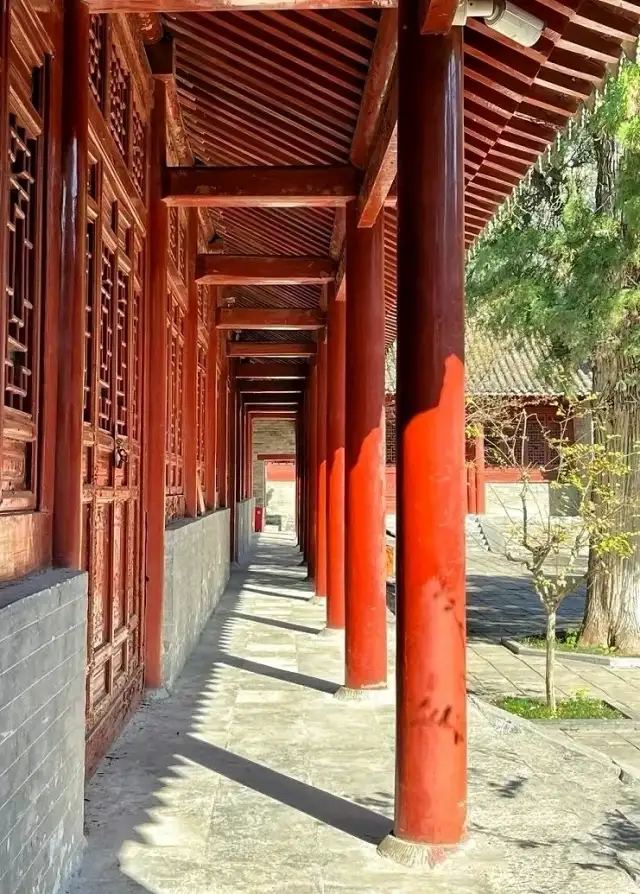
The corridor and tree shadows beside the red columns and wooden windows at Songyang Academy.
From the Study Space, Viewing the Location Before the Mountain
The relationship between Songyang Academy and Mount Song can be gradually understood by orienting oneself on-site. Look up to see how the academy walls meet the distant terrain, then look down to observe how the road in front of the gate connects this place to the city—only then does this cultural site at the foot of the mountain take on a concrete location. Weather and architectural obstructions can affect the view; there’s no need to expect every courtyard to offer a clear view of the mountain peaks. Even if only a distant silhouette is visible, one can understand that cultural spaces do not float on a map but are embedded within the actual terrain and transportation network.
UNESCO presentation of Dengfeng’s historical buildings as a unified heritage site covers diverse themes such as education, religion, and astronomy. A journey can begin at the academy to establish one thread of exploration, which can then be extended during subsequent stops. If the second stop is the Astronomical Observatory, the visit connects learning with observation; if a religious building is chosen, it allows for a comparison of how space is organized for different purposes. There’s no need to force every site into a single interpretive framework, let alone try to see all the components in a single day. By leaving questions open for further exploration, the rest of the itinerary will gain a clearer direction.
Turning a quiet visit into an exchange among fellow travelers
It’s best to pause at several spots along the way, find a place to rest, and exchange observations with your companions about the details you’ve just noticed. Some may notice the tree bark, others the rooftops, and still others may be curious about the inscriptions on the steles; these diverse interests can spark a meaningful discussion. If you bring children along, you can have them draw a gate or a branch—there’s no need to turn the entire visit into a series of questions. Learning themes can emerge naturally through observation, and the journey itself can serve as a relaxed shared reading experience.
For visitors unfamiliar with Chinese, reliable translations of key names should be prepared in advance, accompanied by brief explanations to aid understanding. Translation tools are suitable for character recognition and supplementary reading; historical interpretations should still be based on exhibition labels, materials from the managing authorities, and formal guided tours. It is better to read a clear passage than to translate every plaque word for word. If educational or cultural activities are taking place on-site, observe them according to the actual schedule; do not treat a past event as a daily fixture. Quiet reflection and interaction can coexist—the key is to be considerate of the venue and other visitors.
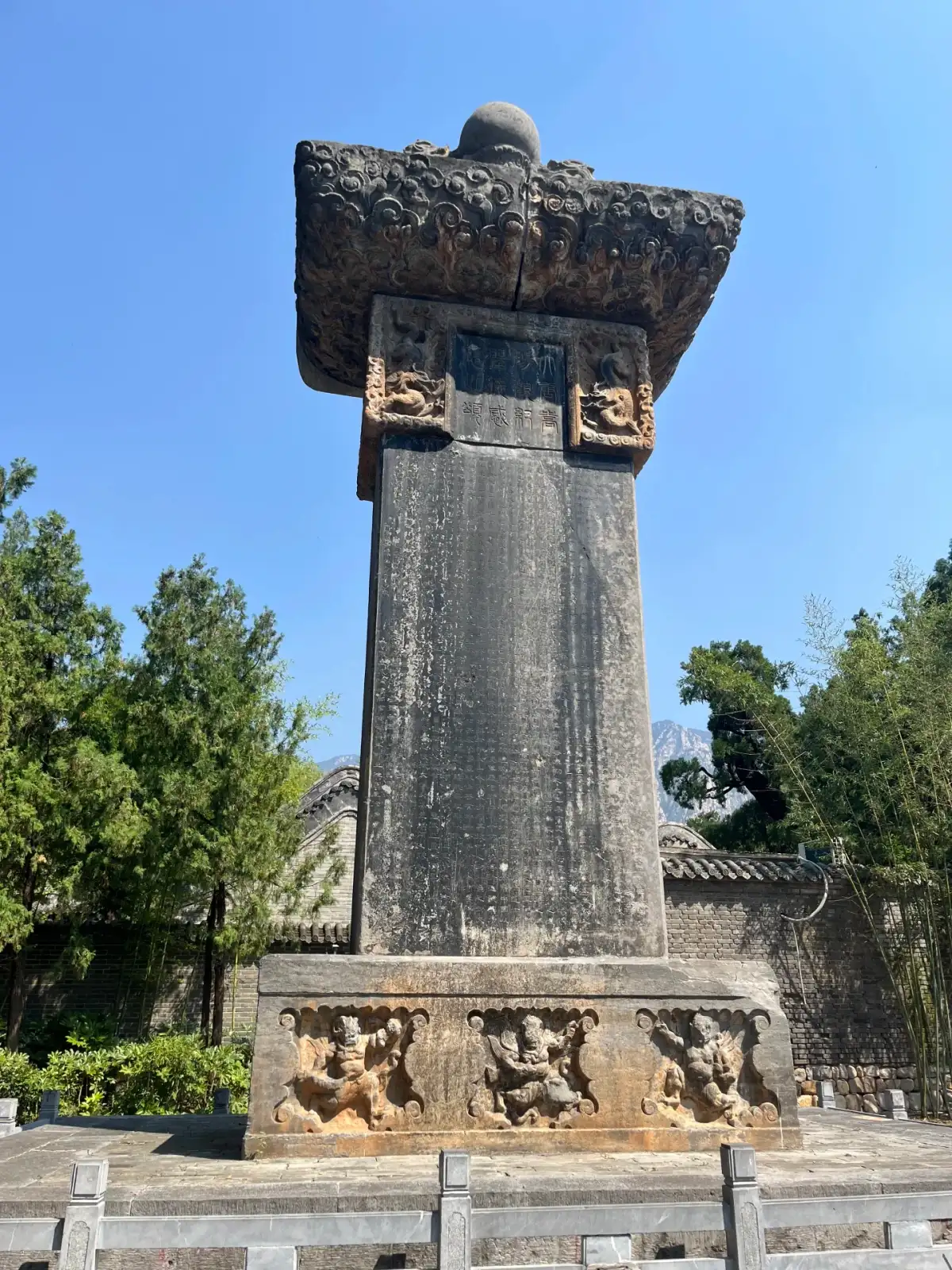
Stone carvings on the stele and pedestal of the Great Tang Dynasty stele in front of Songyang Academy in Dengfeng.
Afternoon schedule at Songyang Academy is determined by interest
, lunch and rest are scheduled first, followed by afternoon activities. Those who enjoy historic architecture can continue to a heritage site that has been confirmed as open; those more interested in nature and topography can plan a separate mountain hike for later. A half-day at the academy and a mountain hike are not the same kind of physical activity; they also require different footwear, time, and transportation. If you have a long-distance trip planned for the same day, set aside the afternoon for the return journey and packing. A thorough morning exploration of the courtyards, ancient trees, and stele inscriptions is more than enough to make for a complete experience.
Accommodation and transportation choices should be based on the actual itinerary, rather than centered solely around a single attractive photograph. Before departure, verify procedures for admission, passport, and other documentation, as well as current access restrictions; prepare Chinese names of locations and contact information. Specific ticket prices, discounts, and events are subject to current information. During the hottest parts of the day, allow time for shade and rest; on rainy days, minimize outdoor walking on slippery surfaces. There’s no need to strictly adhere to a set schedule—if your companions are engrossed in reading, spend more time at a particular spot; if they’re tired, wrap things up early to save energy for the days ahead.
ancient trees are not defined by a single age, nor is the academy defined by a single plaque
As I reflect on this journey upon leaving, the tree trunks, steles, and courtyards each leave a distinct impression. The trees make one aware of the ongoing care they require; the steles remind one to read the specific records they bear; and the buildings provide a space for the educational tradition to thrive. When these three elements are considered together, Songyang Academy is no longer merely a plaque bearing a famous name, nor is it simply a tree whose age must be proven. It can be a place that helps visitors understand how culture is preserved, utilized, and continually discussed.
After returning to the hotel, organize your photos by trees, stones, and courtyards, then choose a topic you’d like to explore further. You might research the academy’s role in China’s educational history or learn about ancient tree conservation efforts; there’s no need to draw conclusions about all of Chinese culture from a single visit. The next day, whether you explore Mount Song or other heritage sites in Dengfeng, these clues will continue to emerge. The richness of a journey often comes from being willing to delve deeper after seeing something, rather than simply adding a multitude of unrelated stops to your itinerary in a single day.
Further Reading and References
Compiled and organized by the Eastbound Travel Editorial Department based on publicly available travel journals and documented materials. Intended as pre-trip reading; this is not a personal account of firsthand experience. Please verify opening hours, transportation, reservations, and service arrangements according to your actual travel dates.
UNESCO: Dengfeng “Center of Heaven and Earth” Historic Architectural Complex
Dengfeng Municipal Government: The Scenery at Songyang Academy Is the Most Serene
Dengfeng Municipal Government: Conservation Efforts for the “General’s Cypress”
Academy or mountain walking?
In a Dengfeng cultural itinerary, give Songyang Academy its own stop before deciding on mountain walking. Its ancient cypresses, Tang inscription and courtyards offer distinct subjects. A nearby mountain adds a separate physical commitment; map proximity does not make the combination effortless.
Looking closely at the trees
Use formal interpretation for dates and naming stories. Observe trunks, branches and supports without touching or stepping onto roots. Children can compare tree and courtyard scale from a clear stopping place. Wet stone and muddy ground may change where you pause.
Planning references


