
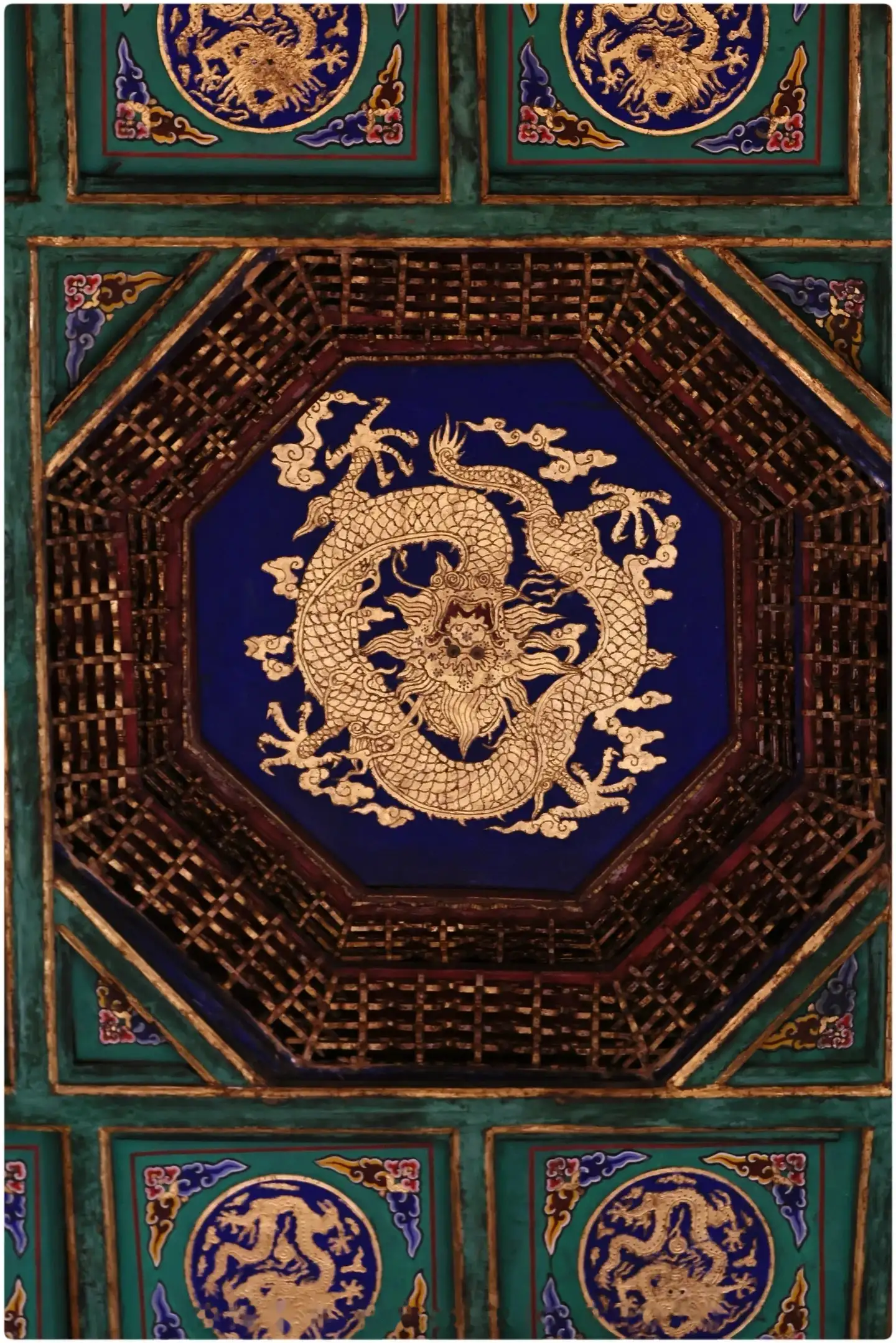
After walking through many courtyards in the Confucian Temple, a pavilion can easily be mistaken for the next waymarker. At Xingtan, it’s worth slowing your pace a bit—and especially worth looking up. The patterns, colors, and structural elements above form a space that converges toward the center, temporarily drawing your forward gaze back to your immediate surroundings. Even a brief minute can mark the beginning of a thoughtful understanding of architecture.
这是一份以建筑细部为主的观察,启发我们不再重新讲一次整座孔庙路线,而只研究一个问题:上方的装饰与空间怎样让讲学象征变得可见?具体营建年代与彩画等级,阅读时仍依专业资料解释。
Viewing the Center from the Whole
When looking up, first take in the overall scope, identifying where the center of the upper space lies and where it extends outward. The center and the periphery are not two separate decorative elements; together, they organize the viewer’s gaze. The center may draw the eye to linger, while the repetitive peripheral patterns create a sense of rhythm. Establishing this relationship first, before examining the individual motifs, makes it easier to understand the work than zooming in directly on a single dragon or a specific patch of color.
Next, let’s examine how color blocks and lines distinguish themselves from one another. The original post pays particular attention to the visual layers of blue, green, and gold. We can translate these observations into on-site questions: Where do the colors form boundaries? Which lines highlight the center? Which parts extend to the beams and columns? These perceptions stem from the actual visual conditions; there is no need to immediately interpret every color as a fixed symbol.
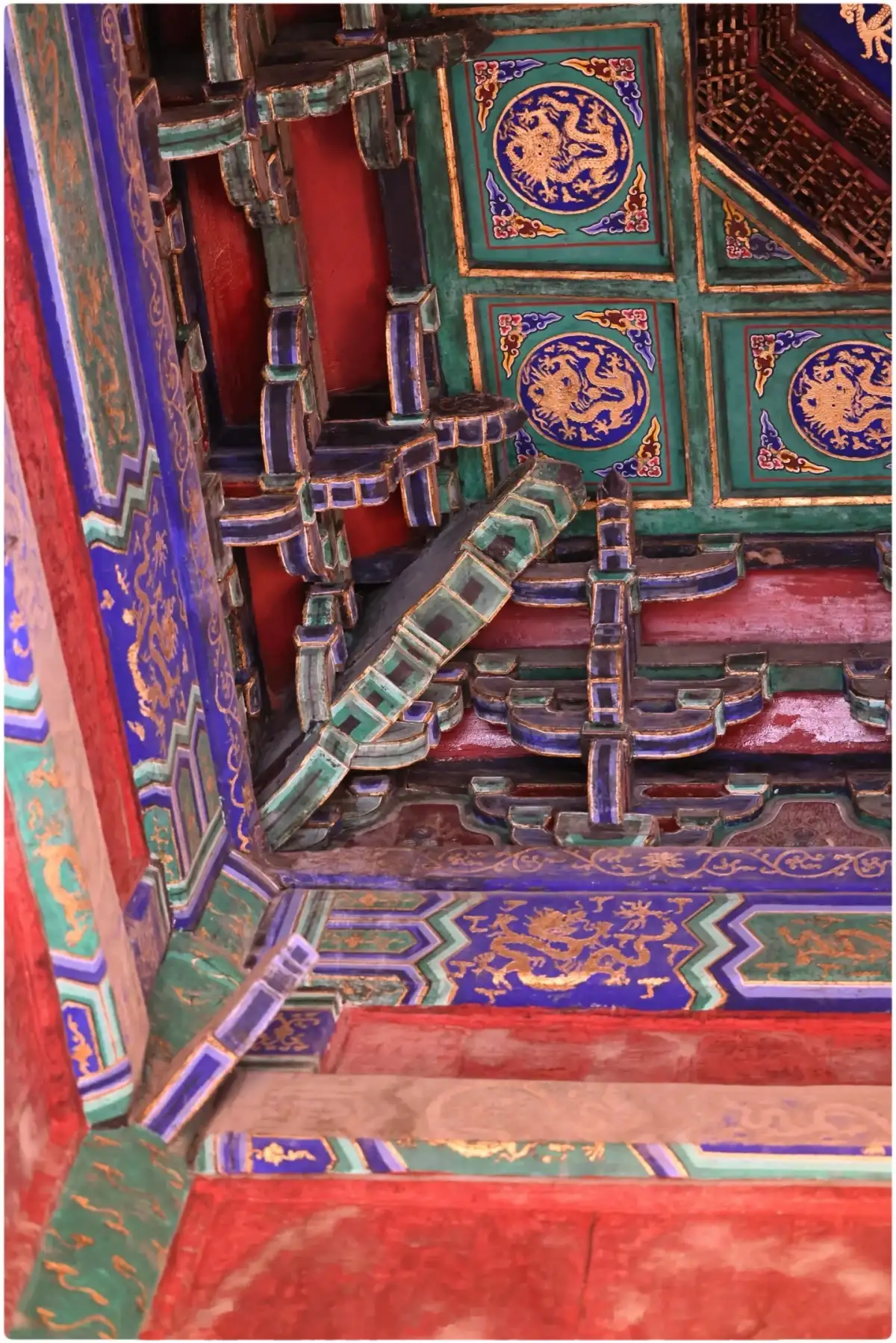
Finally, let’s examine the relationship between the upper and lower parts. Decoration is not a two-dimensional painting suspended in mid-air; together with the supports, openings, and the viewer’s vantage point, it constitutes the space. From different vantage points within the space, the relationship between the center and the border appears to shift; stepping back outside the pavilion, the roof and interior decoration once again form a unified whole. The intricate details of the interior and the scale of the building’s exterior represent two distinct levels of perception within a single viewing experience.
How can a one-minute observation be structured?
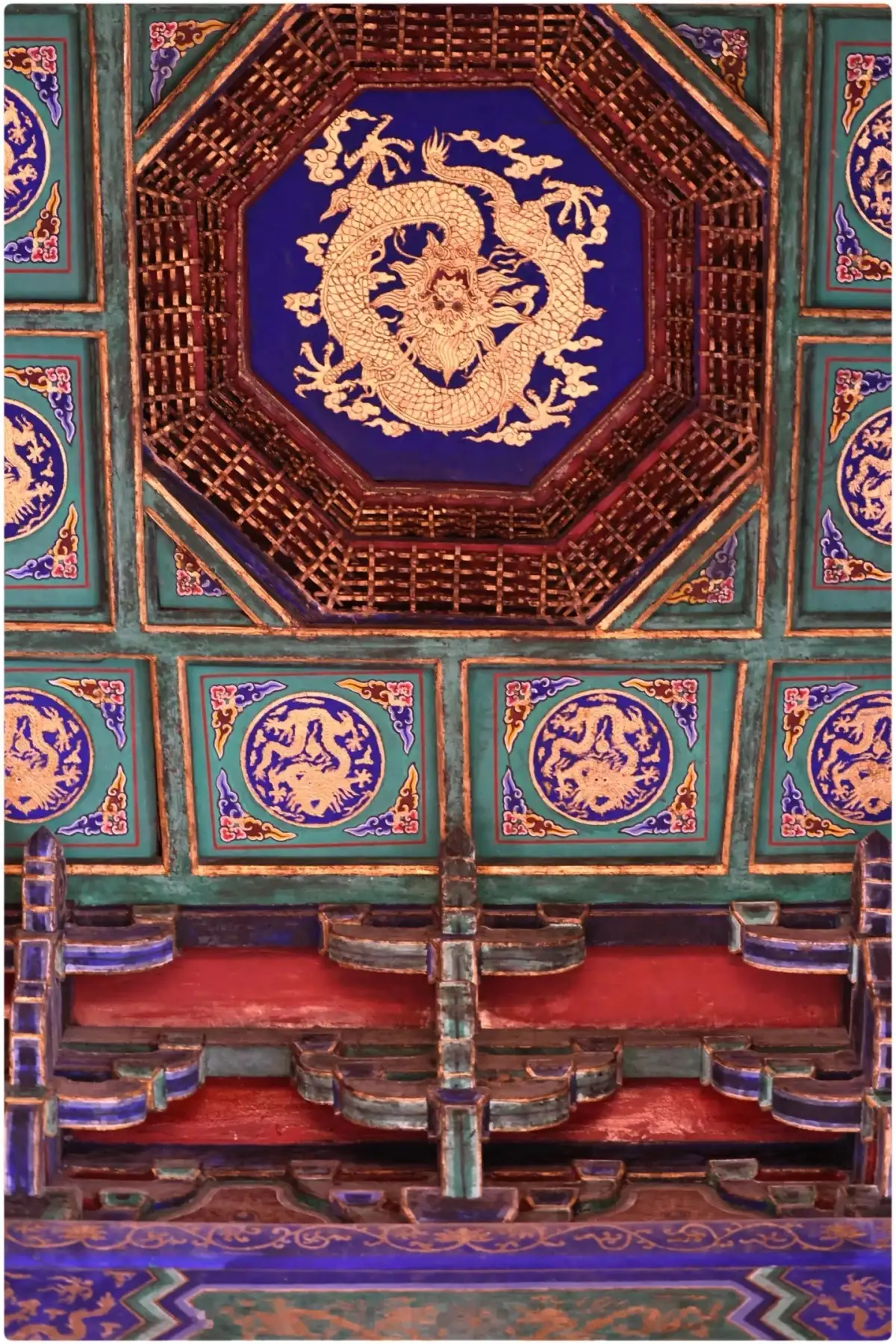
First, take a quick glance to confirm the outline of the entire upper space; don’t rush to take a photo—let the relationship between the center and the periphery sink into your memory.
Next, choose another visible line or color block and observe how it repeats, turns, or converges; describing the actual shape is more practical than rushing to find a name for it.
Finally, observe how it connects to the beams, columns, and openings, then return to the spatial context of the entire pavilion, placing the details back within the architecture.
The “one minute” mentioned here refers to the observation method; it is not a requirement for all visitors to time themselves precisely. If the site is crowded or it’s inconvenient to linger, you can shorten the duration or adjust your angle where permitted. Do not block the passageway just to position your camera directly above the center. The true value lies in the three-tiered viewing sequence; even if the photo isn’t perfectly symmetrical, the spatial relationships can still be understood.
Why Is the “Xingtan” Connected to Lectures?
When the Institute of Botany, Chinese Academy of Sciences, introduced the allusion to the “Xingtan” (Plum Grove), it traced it back to a relevant parable in the *Zhuangzi* and explained how it later became a symbol of education and lecturing. This background endows the pavilion with cultural significance that transcends its structure and decoration. Visitors arriving here encounter a space of enduring commemoration and expression, rather than an ancient classroom preserved exactly as it was.
Monumental architecture excels at translating abstract traditions into visible locations. Lecturing is an activity; education is a set of ideas; yet pavilions and names allow people to locate them within the city. As you tour, consider how architecture enables future generations to remember a certain spirit, and how it continues to express that spirit through repeated reconstruction. The relationship between form and tradition is more worth exploring than a simple statement that “a certain event once took place here.”
For foreign visitors, it is more accurate to first explain the commemorative and symbolic aspects rather than directly translating it as “Confucius’s classroom.” People can imagine tradition through architecture, but there is no need to confuse imagination with historical evidence. If the tour commentary involves allegories, later construction practices, and actual historical figures, these three layers should be explained separately. Cultural differences do not hinder understanding; on the contrary, a clear contextual framework makes the story all the more compelling.
The Order of the Upper Realm and the Imagination of Learning
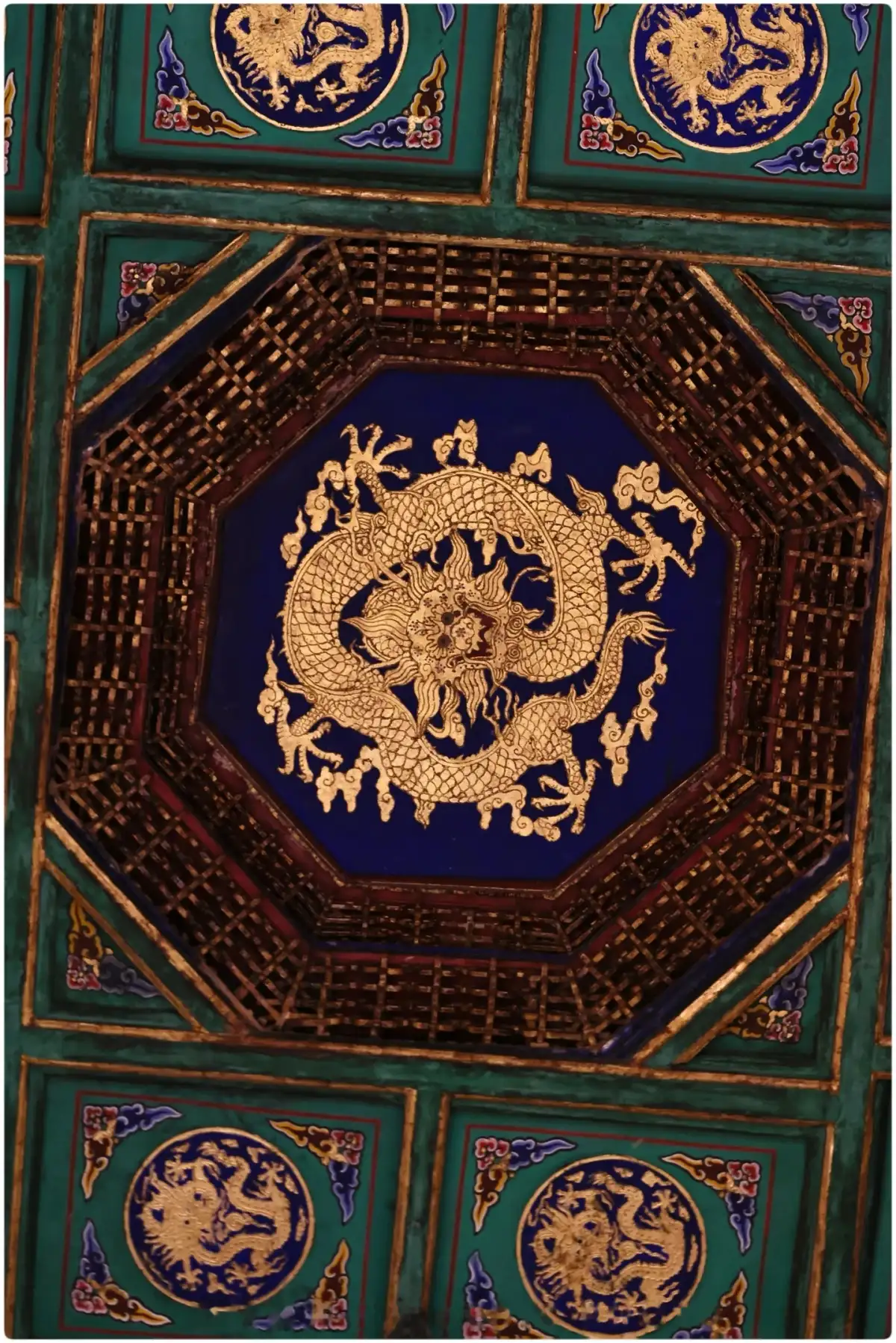
The coffered ceiling and the surrounding decorations organize the visual order, while the name “Xingtan” organizes cultural imagination; the two converge within this same small space. As viewers look up at the center and then return to the scale of people and their activities, they can sense how architecture shifts from form to meaning. This is a curated interpretation—not a forced explanation of every structural element as a symbol of the educational system; the connection between form and meaning must still be maintained with restraint.
An interesting parent-child activity is this: If you were asked to design a building to commemorate learning, what would you include? Children might think of books, desks, or trees, while adults can guide them to observe the expressive choices made here. Comparing today’s creative ideas with the visible architecture allows cultural traditions to become topics for discussion, rather than a set of terms that must be memorized.
Those familiar with design can further examine repetition and variation. Similar patterns create order, while subtle differences introduce focal points; when these elements are arranged in the upper space, the viewer’s position also becomes part of the composition. Static photographs typically focus on a single corner, whereas being on-site allows one to gradually discern the variations. Give your body a little room to move, and your experience of reading the architecture will be richer than if you simply stare at the center of the screen.
Reconnect the examination of details to the Confucius Temple as a whole
The Xingtan Courtyard can serve as a thematic focal point along the entire route. Before arriving, decide in advance whether you want to focus on the overhead space or the symbolism of teaching; once here, there’s no need to listen to the entire history of the Confucian Temple all over again. The other courtyards should each retain their own distinct themes. The most tiring aspect of a cultural tour is receiving the same intensity of commentary at every stop. By varying the emphasis and priority, it becomes easier to maintain focus.
If someone in your group prefers to walk slowly, you can first share the view from outside the pavilion where permitted, then allow those who are interested to examine the details closely. The tour should also be divided into segments: first explain the symbolism, then discuss architectural terminology. This way, people with limited Chinese proficiency, children, and architecture enthusiasts can all find a point of entry, without needing to share the same level of knowledge to appreciate the same spot.
Photography recommendations should also be layered: one shot should capture the pavilion’s overall appearance and its relationship to the surroundings, while another should document the visible details above from a permissible vantage point. These two shots address different aspects, so there’s no need to repeatedly reposition yourself just to precisely replicate the original post’s composition. Clearly label the photos as architectural details of Xingtan; when reviewing them later, this will make it easier to recall what you observed than a vague “Confucian Temple” tag.
When preparing a foreign-language explanation, you can provide a few specific terms: commemoration, lecture hall, coffered ceiling, painted decoration, center, and periphery. The translator should not fill the explanation with a large number of technical architectural terms right away, but rather connect what is actually seen with the cultural context. Once a single detail is understood, expanding that understanding to other buildings will lead to a natural growth in comprehension, rather than being overwhelmed by an all-at-once influx of information.
Just one minute spent looking up transforms the Xingtan from a mere landmark into a legible space. The upper decorations provide aesthetic appeal, while allusions and later commemorations imbue the space with meaning; these two elements must be recognized separately and then connected. Walking back through the courtyard of the Confucian Temple, visitors may be more inclined to pause and examine another set of beams and the roof, rather than simply moving forward to check off the next item on their list.
Source and Editorial Notes
They do not serve as proof of actual travel experiences or services provided by Dongxing Travel.
Institute of Botany, Chinese Academy of Sciences · Xinglin and Xingtan · Official materials; Verified/compiled on: October 3, 2026.
Wang Guixiang / School of Architecture, Tsinghua University · Architectural History of the Confucius Temple at Quli · Official materials; Verified/compiled on: October 3, 2026.
Is this an original classroom?
Read Qufu Xingtan as a commemorative symbol of teaching, rather than an unchanged classroom. When exploring Confucius Temple architecture, distinguish the literary story, later commemoration and visible construction. Study the Xingtan coffered ceiling through its centre, edges and relationship to the beams.
Without a central viewpoint
If the space is busy, study the whole and one clear detail from a permitted position. Avoid blocking a passage for symmetry. Record the pavilion context and visible painting separately, and label the photographs accurately. Explain the commemorative meaning before adding structural terms.
Planning references


