Huangdong Travel Editorial Department · Travel Diaries and Pre-Trip Reading
Treat Huanglong as a water-themed journey
Huanglong’s appeal is often summed up with the phrase “the Five-Color Pools are beautiful,” but what’s truly worth exploring on-site is the entire route by which the water flows down the mountain. The pools, thin streams, terraced edges, and forest are all interconnected; the mountainside does not divide the landscape into unrelated display cases. As you walk along the boardwalk, look for where the water pools to form deeper pools, and where it overflows the pool walls to flow into the next level.
Huanglong is located in the Min Mountains region of Songpan County, Aba Prefecture, Sichuan. The UNESCO description of this World Natural Heritage Site highlights the environment formed by the travertine pools, limestone landforms, waterfalls, and forests. Having this overall impression before entering the scenic area helps prevent you from overlooking the scenery along the way in your rush to see the group of colorful pools at the very top. The trees and pool walls offer different sights in each season; the interplay between the green coniferous forests, autumn foliage, and pale travertine gradually changes as your perspective and the light shift. First-time visitors might set themselves a simple observation task: choose a section of the stream where the water is clearly visible, and follow it from the surface of the pool to the edge, then downwards. Completing this short segment offers a far deeper understanding of Huanglong than constantly asking how much longer it will take to reach the end.
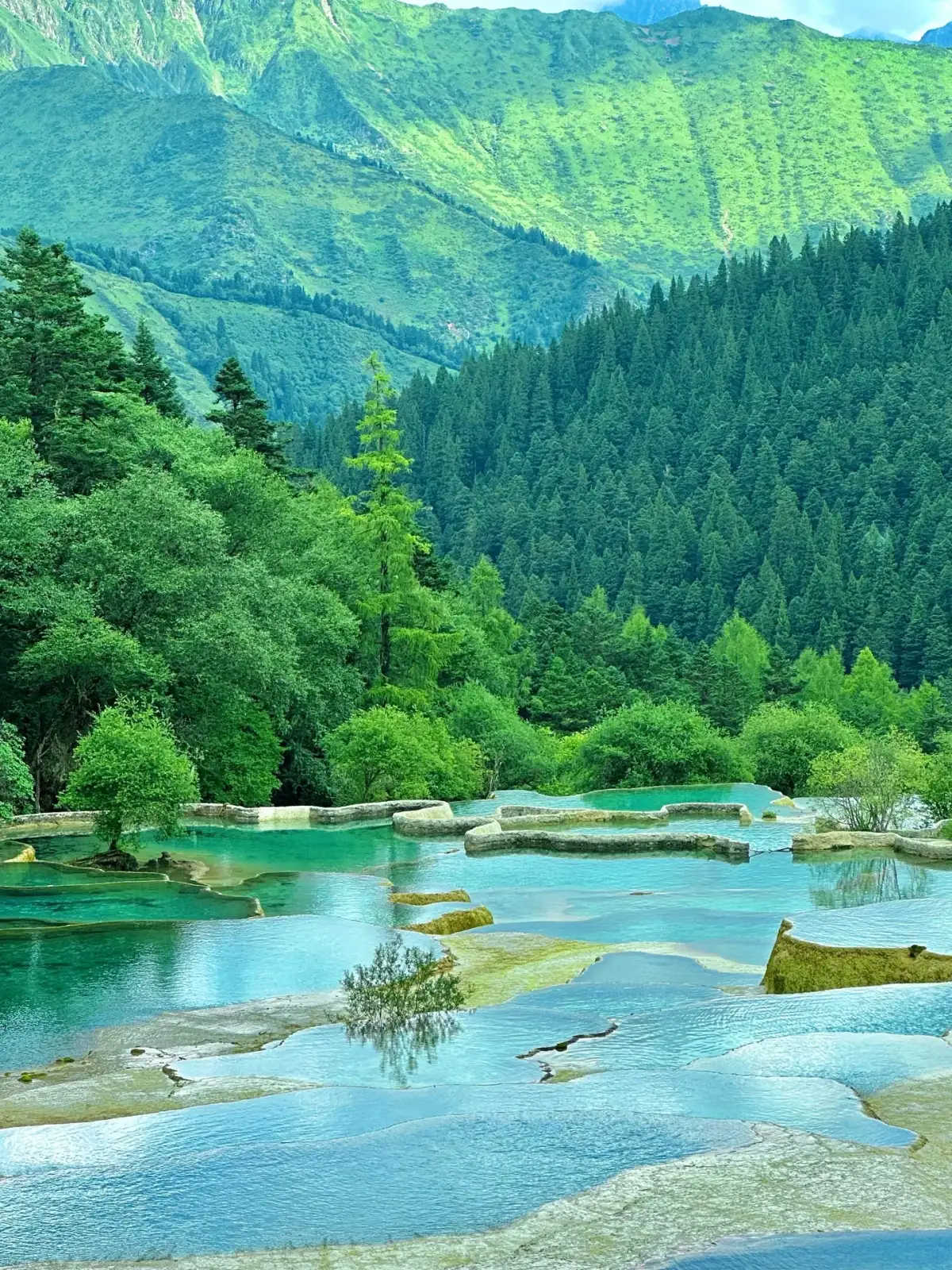
Huanglong’s blue-green pools, separated by light-colored embankments, contrast with the surrounding mountains and forests.
The shapes of the Huanglong pool walls are more captivating than their colors.
The pale, winding edges between the colored pools are a vital part of the travertine landscape. Water containing dissolved minerals deposits calcium carbonate under suitable environmental conditions, gradually forming pool rims, shoals, and other features over time. This process involves a combination of hydrological, topographical, and biological factors and cannot be simply described as a static result of a single solidification event of spring water. The scenic area’s educational signs and official exhibits provide more detailed explanations, but visitors can begin by understanding the phenomenon through its shapes.
In the photos, some edges resemble low steps, while others wind repeatedly around shallow pools. Adjacent water surfaces may appear similar in color, but the pool walls reveal the slope and flow direction. Standing on the designated boardwalks, observe the heights and gaps in the pool walls and where the water overflows—there’s no need to search for places to touch them. Tufa formations are not ordinary stone platforms meant for walking on, and trampling them cannot be justified simply because they are light in color or appear dry. Official tourism advisories from Songpan explicitly require visitors to stay on the wooden boardwalks and prohibit trampling the tufa terraces. Close-up details can only be viewed from the designated walking path; understanding the boundaries of conservation is itself an essential part of this journey.
The Five Colors of Huanglong are not a fixed color chart
In photographs, the water in Huanglong’s pools may appear transparent—blue, green, or with a yellowish tint—but the on-site experience varies depending on water depth, lighting, the pool bottom, and the surrounding vegetation. The water’s surface in direct sunlight and that in the shade of the forest will not always appear equally bright. Cloudy days aren’t necessarily devoid of interest, nor do sunny days mean every pool looks like a digitally enhanced photograph. The color settings on cameras and cell phones further widen the gap between the images and what the naked eye perceives.
When observing the layout of the pool cluster, try to distinguish the curves of the pool walls, the boundaries of the water’s surface, and the tree shadows separately, then place them back within the context of the entire slope to understand the three-dimensional terrain beyond what’s captured in a photograph. From the same viewing platform, start by taking in the whole scene, then focus on a small patch of water near the tree shadows, noting how reflections and the pool bottom coexist. Season and water levels are also important: water-filled pools, shallow shoals, and temporarily exposed edges each represent a distinct state of the environment. Don’t assume a scenic spot has lost its appeal just because a particular spot doesn’t have the full pool of blue water you imagined. Check the latest information about the scenic area before you go, and once you arrive, accept the actual lighting and water conditions—only then will you be able to focus your attention on the ever-changing hillside.
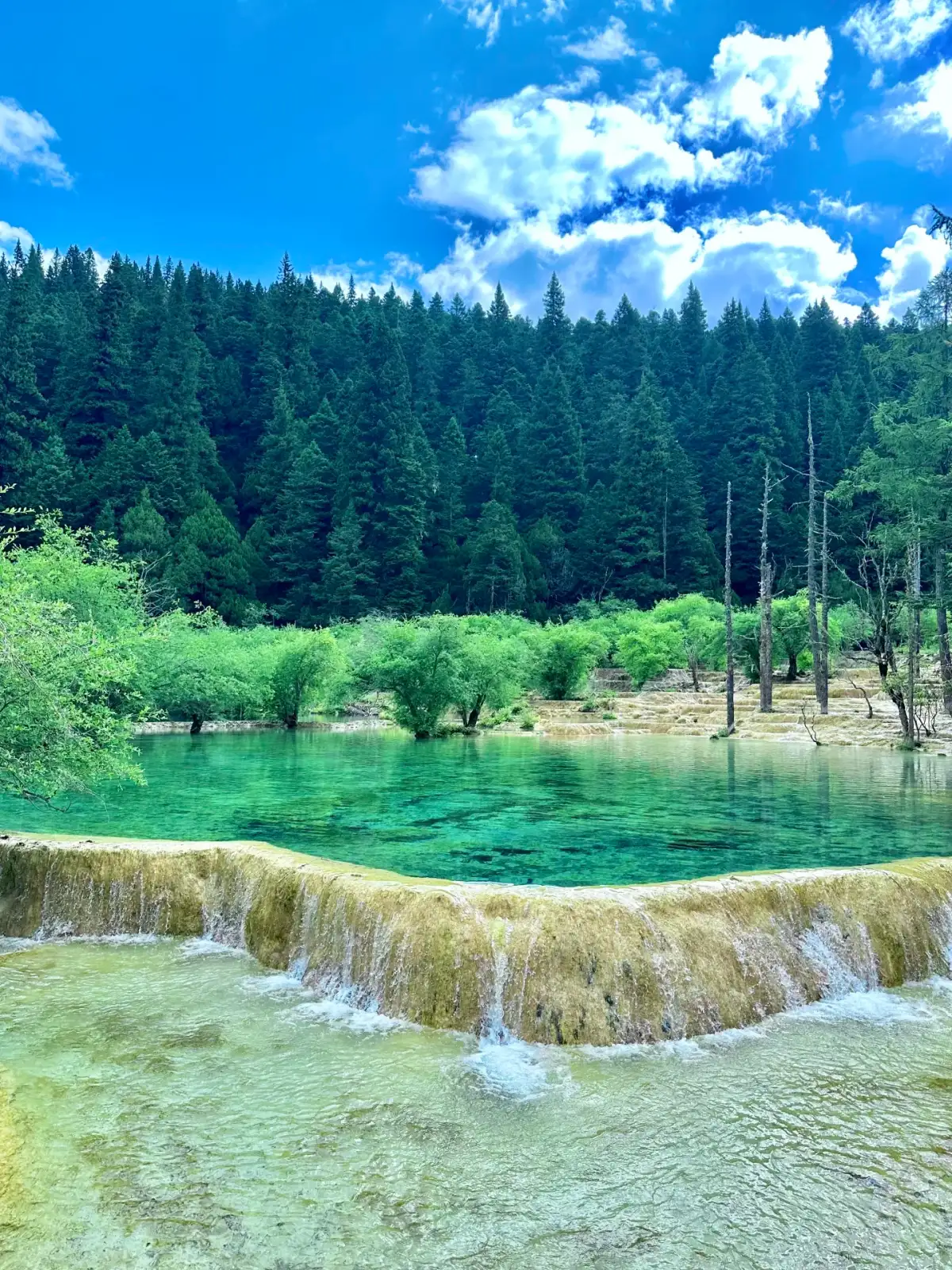
In the Huanglong Forest, the stream flows over the walls of the travertine pools.
When choosing a route, prioritize the higher-altitude sections first
Huanglong is a high-altitude scenic area. The Songpan County Government’s 2026 travel advisory notes that the area is located at an altitude of approximately 3,500 meters and explicitly states that high-altitude hiking should be tailored to one’s physical condition. The itinerary should not treat reaching the highest point as a mandatory goal for everyone, nor should one assume that high-altitude discomfort will not occur simply because a fellow traveler is young, regularly exercises, or has purchased certain equipment.
Whether you choose to take the cable car up or walk in, first check the day’s operating status and open routes, then decide based on your personal circumstances. The cable car can reduce some of the ascent, but it cannot turn the entire visit into a walk-free experience; after arriving at the upper station, there are still trails to walk to reach the colored pools and other open areas. Agree on a meeting point for the return trip and rest stops, and allow fellow travelers to choose routes of varying lengths—the pace for the entire group shouldn’t be dictated by the fastest hiker. If you have a pre-existing medical condition, recent health issues, or concerns about your ability to acclimate to high-altitude travel, consult an appropriate medical professional before departure. If you feel unwell while on-site, do not push yourself to continue walking just to take photos; seek assistance from park staff or medical personnel immediately. Whether to continue ascending should be determined based on your physical condition and professional advice on-site. Rest areas can serve as starting points for turning back; reaching the highest point does not have to be a shared goal for everyone.
Set aside a little time for both the upper section’s colored pools and the lower section’s forest.
If the park is open that day and your physical condition allows, you might consider a combination of the cable car and walking as a preliminary plan: first head to the upper section of the scenic area, follow the open boardwalk to view the Five-Color Pools and related landscapes, and then, based on on-site signage, proceed to the lower section to explore the colorful pools, shallow shoals, and forests. The specific order of the route is determined by the scenic area’s access arrangements; you should not use an outdated map to walk one-way sections in the opposite direction. The Five-Color Pools are a cluster of pools, not just a single named photo spot.
The descent also requires stamina and time. You should factor in continuous staircases, photo stops, and the time needed to regroup for the return trip; do not assume that “going down” is an effortless few minutes. If you’re unable to complete the entire route, ask staff about available shortened routes or return options for that day, and choose to skip a few sights to keep your itinerary manageable. Plan to set aside most of a day for your visit; the actual duration will still need to be adjusted based on cable car wait times, weather, and your personal walking pace. When visiting the Huanglong Ancient Temple and related cultural landscapes, stay within designated areas and do not enter non-tourist zones without authorization. The forest trails are not merely connecting paths to the final destination; the tree roots, the sound of flowing water, the play of light and shadow beneath the canopy, and the varying shades of green provide a more complete environmental backdrop for the colorful pools.
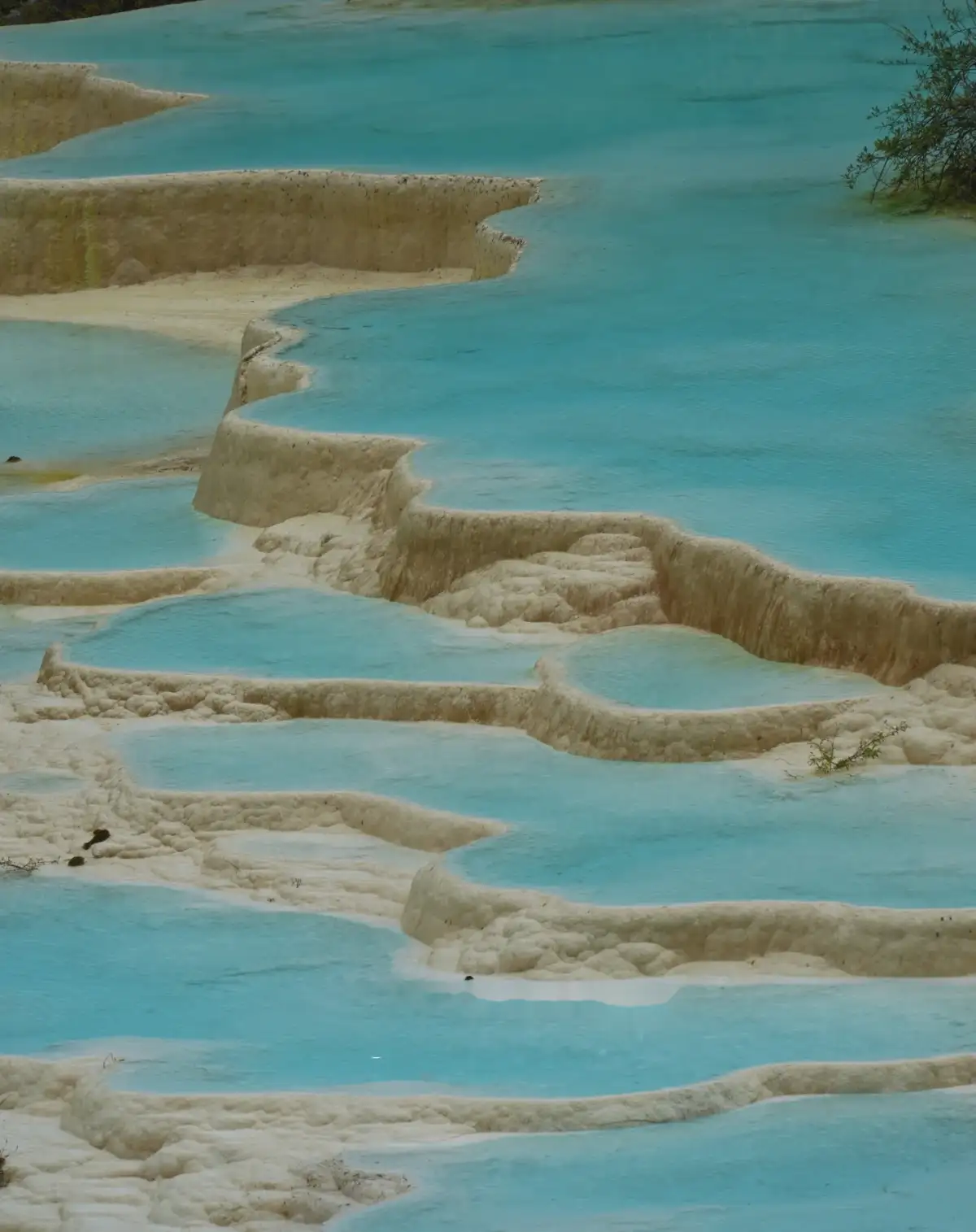
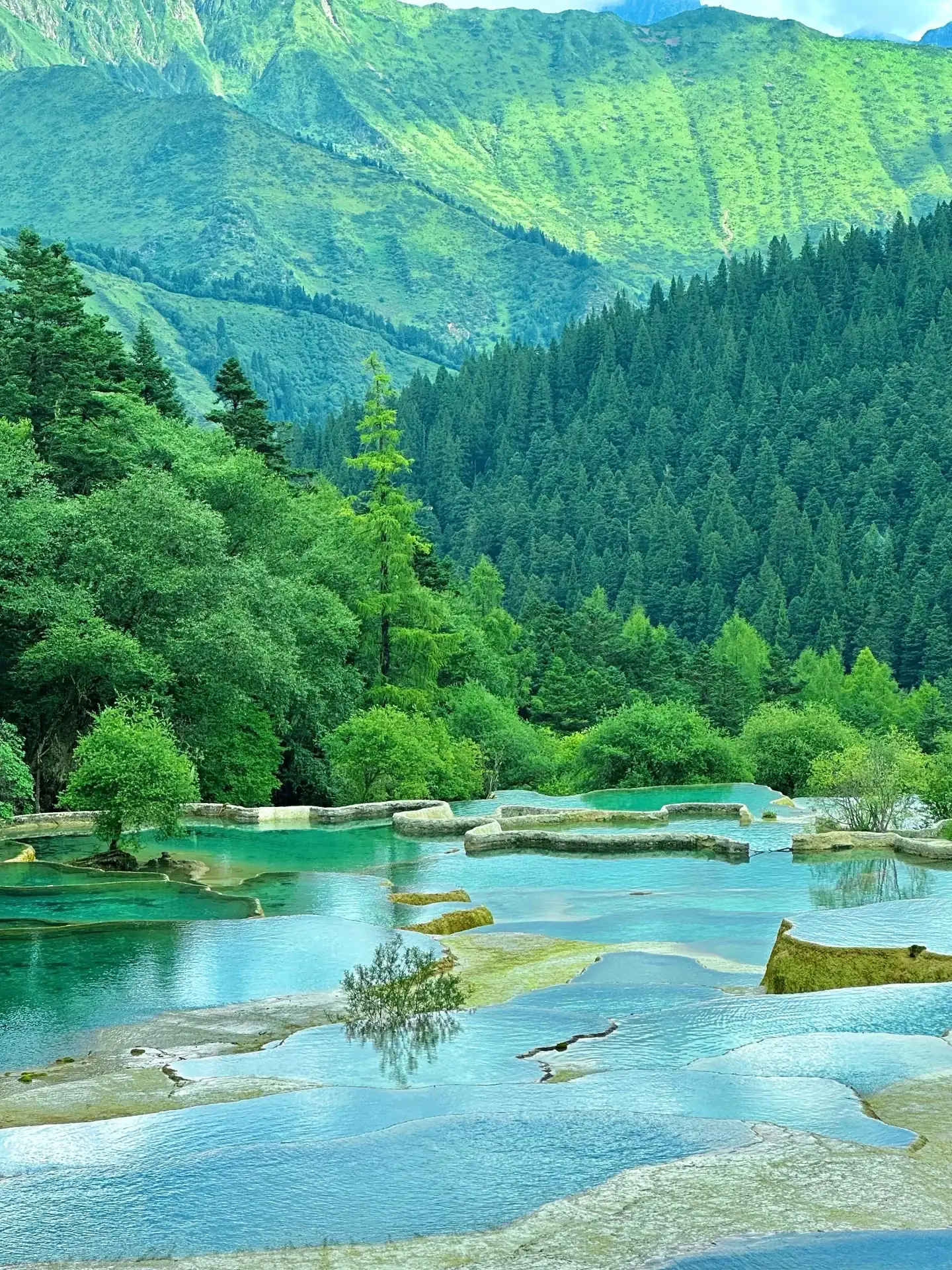
Huanglong’s winding travertine terraces and tiered shallow pools. Author’s watermark retained.
Whether arriving by rail or road, the shuttle ride is a must.
The railway option between Chengdu and Huanglong has opened up new travel possibilities, but the Huanglong-Jiuzhai Station is not located right next to the colored pools. According to the latest transportation guidelines from the Songpan government, upon arrival at the station, visitors can transfer to a direct shuttle bus to the visitor center; however, the road transfer following the train still requires separate verification of schedules, ticket reservations, and return arrangements. Don’t assume that just because the station name includes “Huanglong” and “Jiuzhai,” the two scenic areas are neighbors within walking distance.
For international travelers, it’s best to compile train schedules, shuttle pickup points, contact information for drivers or operators, and instructions for booking with your ID into a document that can be viewed offline. If using a pre-arranged vehicle, confirm that you’ll arrive at the main scenic area visitor center and where you’ll board the vehicle after your visit; if you have luggage, arrange for storage or hotel pickup in advance. Both rail and road schedules are subject to changes due to weather and operational adjustments, so you shouldn’t rely on the assumption that “you’ll probably make it” when planning your last return trip. Huanglong and Jiuzhaigou can be included in the same trip to Sichuan, but you should set aside separate time for sightseeing at each location and for travel between them. Trying to cram both into a single, tightly packed day will cut into the rest and recovery time you should be allowing for in a high-altitude environment.
Check your reservation, clothing, and physical condition all at once
In July 2026, official notices from Songpan listed online real-name reservation channels, including the “Aba Tourism” mini-program and Huanglong’s official WeChat account. Reservation time slots, ticket types, and cable car and sightseeing bus schedules are subject to the latest regulations on the day of travel; seasonal discounts should not be treated as standard ticket prices. Visitors using foreign identification documents should confirm in advance through official channels or their tour operator the reservation, verification, and ticket pickup procedures available to them. Do not assume that a passport will automatically grant direct entry based on screenshots showing procedures for domestic ID cards.
When packing, take into account the temperature fluctuations in the mountains, rainfall, and strong sunlight. Lightweight, warm layers, rain gear, drinking water, and appropriate hiking shoes will all come in handy. Don’t pack based solely on the day’s temperature in Chengdu. Once inside the scenic area, first check the latest road conditions and cable car updates, then locate restrooms, rest areas, and medical assistance points; the availability of these facilities is subject to the conditions on the day of your visit. Please return snack wrappers and rain gear to designated trash collection points; do not rinse items or feed animals near bodies of water. Drones are not photography tools that can be used simply by carrying them with you; officials remind visitors that the scenic area’s airspace is regulated, and flights must be registered in accordance with regulations—do not fly without permission. By completing these specific checks in advance, you’ll have more time to enjoy the scenery once you arrive.
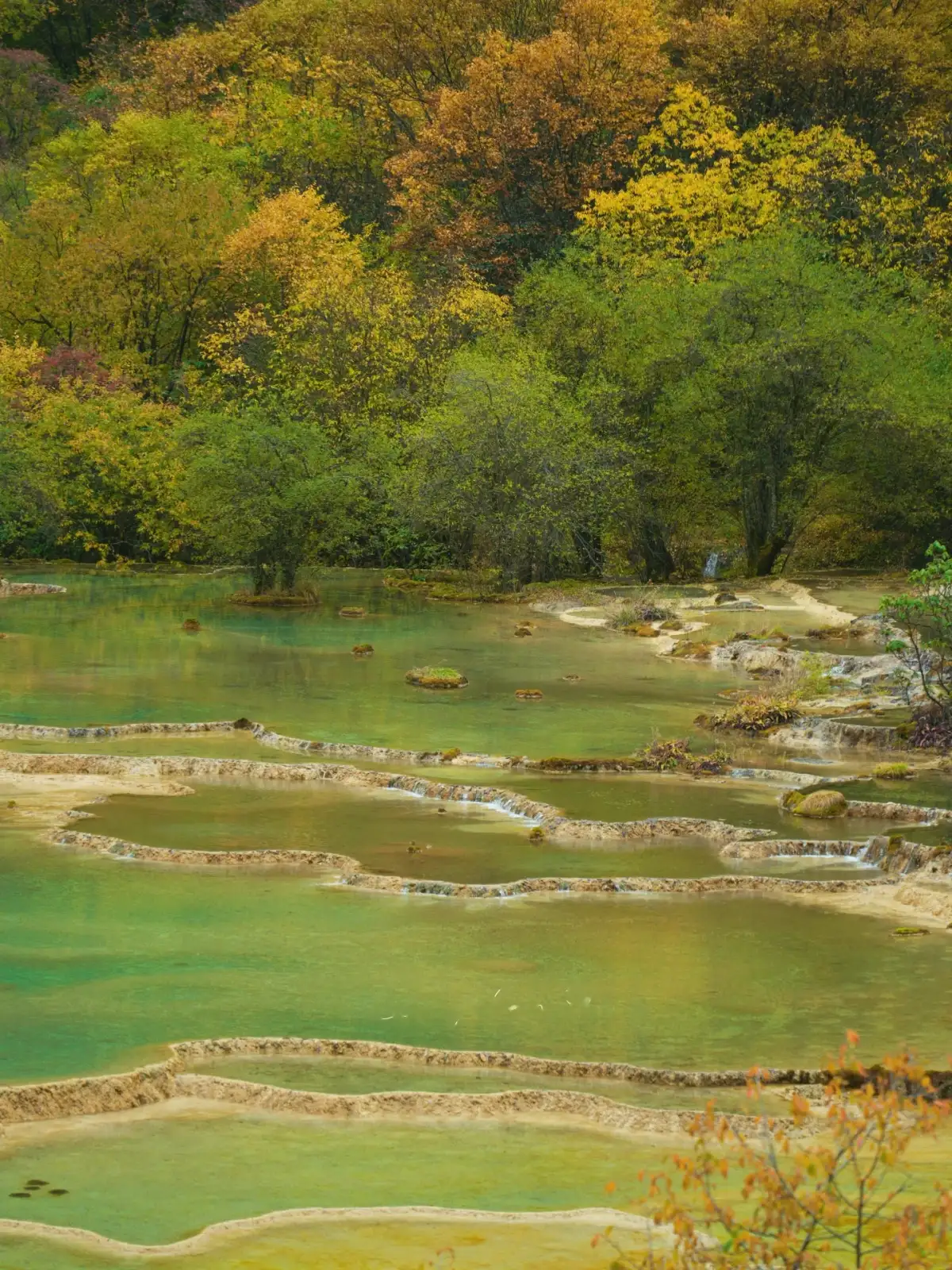
Autumnal trees and the pale edges of travertine formations beside the Huanglong Colorful Pools.
water landscapes require protection and must be appreciated in their seasonal variations.
Huanglong’s landscape remains subject to hydrological and ecological processes. The Aba Prefecture government has officially announced initiatives for travertine conservation, leakage control in the pool clusters, and environmental quality improvement. This means that the colorful pools before you require ongoing research and maintenance; they are not permanent natural decorations that will forever retain the same colors and water levels. When certain viewing platforms or walking trails are under temporary maintenance, detouring and minimizing your stay are part of the visiting guidelines; you should not enter fenced-off areas just to replicate the camera angles seen online.
The pond’s surface during the summer high-water season, the colors of the trees in autumn, and the scenery in the colder months are all distinct; the open areas and cable car schedules may also vary. Those planning trips in winter or spring should specifically check the current announcements; you cannot infer this year’s entire schedule based on records of when the park closed or opened in a particular month in previous years. Before setting out, choose one main scenic spot to look forward to; once you arrive, let the water, the weather, and your stamina determine how far you can go. This approach will be far more relaxing than insisting that every pond match the promotional photos. Huanglong can leave you with unforgettable visual memories—provided you treat it as a real mountainous landscape with elevation, operational boundaries, and ever-changing conditions. Simply remembering how water overflowed from a pond’s embankment as you leave is, in itself, a concrete and fulfilling experience.
Further Reading and References
Sichuan · Destination Overview
Compiled and edited by the Huangdong Travel Editorial Department based on publicly available travel notes and listed information. Intended for pre-trip reading; this is not a personal account of the experience. Please verify opening hours, transportation, reservations, and service arrangements according to your actual travel dates.
UNESCO: Huanglong Scenic and Historic Interest Area
UNESCO: Huanglong Biosphere Reserve
Songpan County Government: July 17, 2026—Huanglong Reservations, Transportation, and Visitor Tips
Aba Prefecture Government: Protection of Huanglong’s Tufa Landscapes
Does the uphill cable car replace all walking?
Choose a Huanglong pool route around your condition and the day's access before balancing upper pools with lower forest. Huanglong cable car walking still needs a clear direction and room for rests; reaching the station does not mean the whole visit is finished. Adjust effort to the group's actual ability and confirm which viewing subjects remain suitable if a longer walk is impractical.
What matters when colours differ from photographs?
Begin Huanglong travertine observation with pool-wall shapes, shallow-water direction and the position of the forest rather than waiting for a fixed palette. Light and seasonal water levels change appearances, while lower water can still reveal terrain. Stay on open boardwalks and never enter pools for a photograph. Compare one detail with the whole slope to understand how water shapes it.
Planning references
Planning reference: Huanglong pool route 1
Planning reference: Huanglong pool route 2
Planning reference: Huanglong pool route 3