September 20, 2026 · Travel Diary
Start by exploring Wuyi Mountain from a single bend
It is difficult to capture the essence of Wuyi Mountain in a single frontal photograph. As the stream meanders, the angles of the rock faces shift; a mountain that appeared broad from one angle may appear as a narrow profile from another. When looking at a map before your trip, start by locating the Nine-Bend Stream and use it as a guide to understanding the mountain scenery, rather than memorizing the names of peaks as a string of isolated coordinates.
The scenery around the Nine-Bend Stream is best appreciated while on the move: in the foreground are the water and the reflections of trees; in the middle are the cliffs overlooking the stream; and in the distance lie more mountain ranges. Whether you choose to explore along the stream or view the scenery from the riverbank should depend on current access arrangements and your personal preferences. These options are not mutually exclusive; each offers a different vantage point and pace.
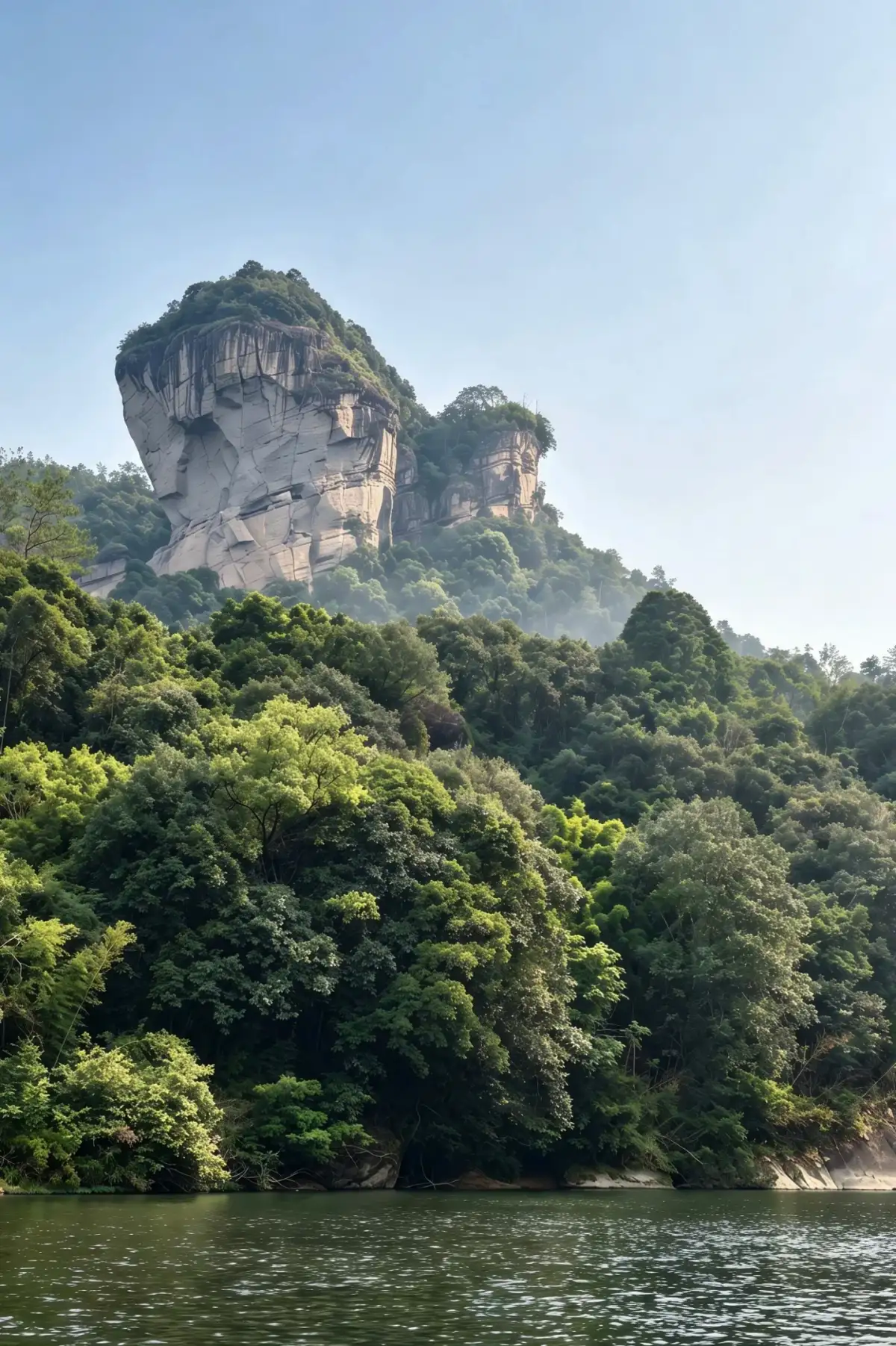
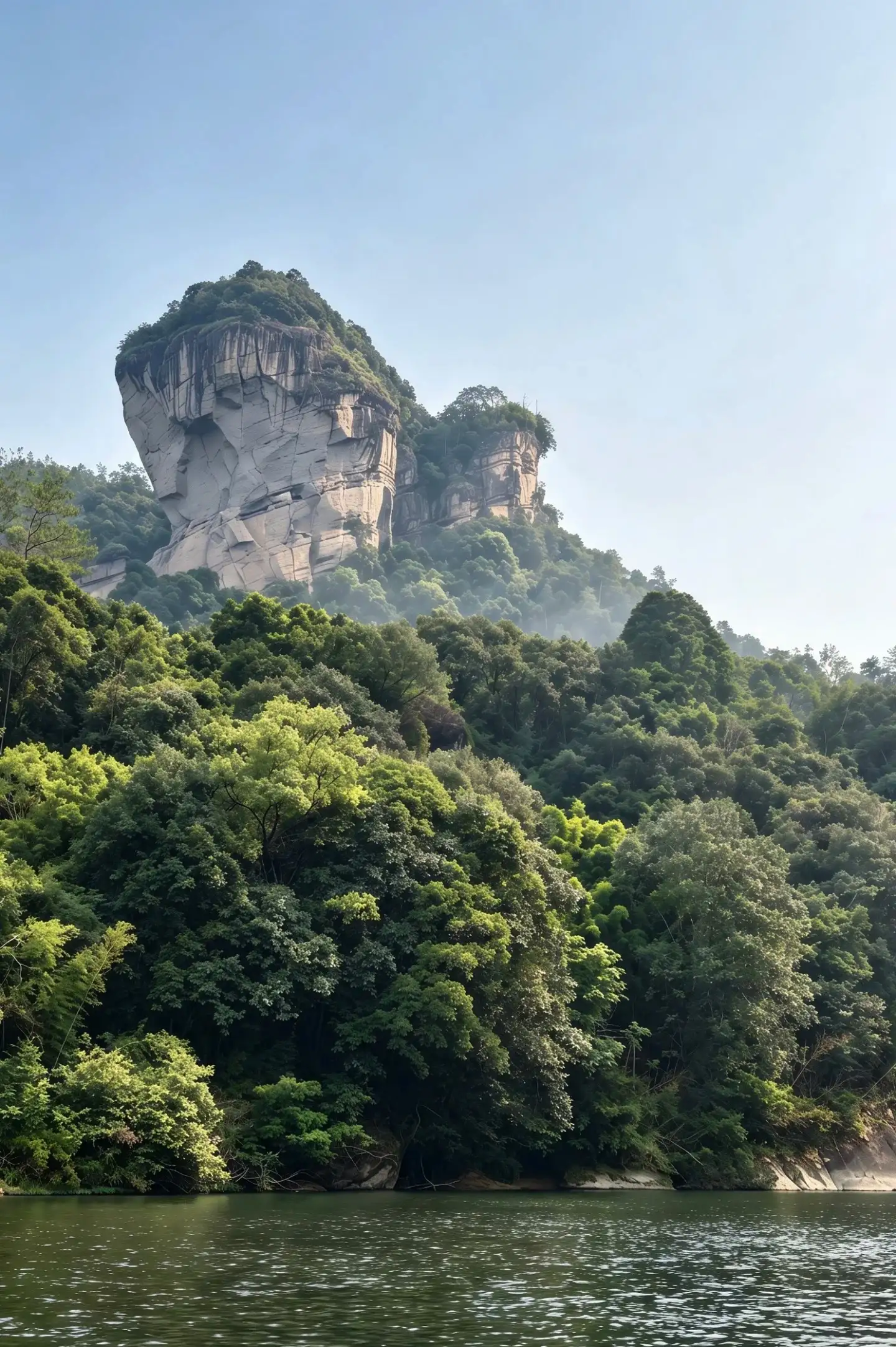
Rock peaks and riverside forests along the Nine-Bend Stream.
The water’s surface makes the rock face appear even taller
As you approach the stream, your eye level drops, and the mountains appear even more vertical. The light and dark stripes on the rock surfaces, the boundaries of the vegetation, and the junction between the mountain’s base and the water’s surface all become much more distinct than when viewed from a distance. The colors of the Danxia landscape are not always vivid red; depending on lighting, weathering, and vegetation, the rock surfaces take on various shades of gray-brown and green.
The color of the stream varies with the weather and hydrological conditions, so don’t expect it to be as crystal-clear as in the best-curated photos every day. Even when the water is slightly murky, the mountain contours and the reflections of the trees still provide rich layers of depth. When observing the scenery, try looking back and forth between the two banks rather than focusing solely on a single famous peak; many rock faces that are easily overlooked actually illustrate how the water winds its way through the mountains.
From the silhouette of Jade Maiden Peak, one can see a mountain that goes beyond its name.
Famous peaks like Jade Maiden Peak have widely told stories associated with them. Listening to these stories can enhance your memory, but you can take it a step further: observe why a peak stands out from a particular angle. The spacing between the peak and adjacent rocks, the vertical textures on its surface, and the shape of its summit all help reveal its natural form beyond the legends.
After traveling a short distance by boat or on foot, the same peak may no longer present its familiar silhouette. This does not mean you’ve gone to the wrong spot; rather, the mountain naturally has multiple facets. When photographing, including a bit of the surrounding mountains and vegetation helps the image convey its context; focusing solely on a very tight close-up, while striking, can easily isolate the mountain from its overall relationship with the Nine-Bend Stream.
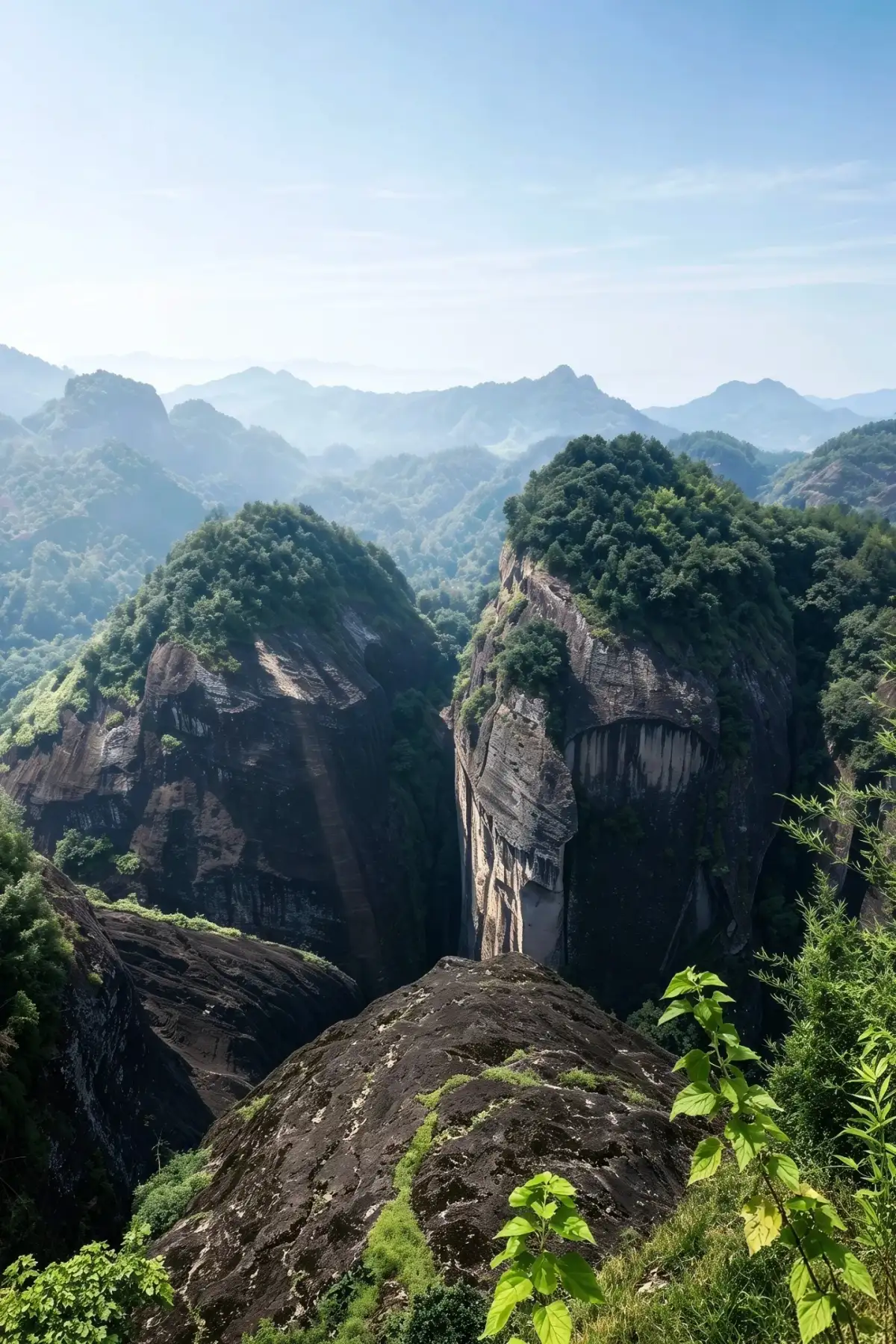
the rocky peaks and green valleys seen from the heights of Wuyi Mountain.
After climbing to a higher vantage point, retrace your steps to the bend you just passed.
If your stamina and itinerary allow, you may want to schedule a separate hike to the Tianyou Peak area for panoramic views. Viewed from above, the stream becomes a line cutting through the valley, and the mountain massifs that previously obscured the distant landscape are now incorporated into a larger structural context. The most fascinating observation is trying to identify the directions you’ve seen from the stream or its banks, and then understanding why you could only see one side of them as you passed by.
Hiking and exploring the stream need not be crammed into back-to-back time slots. Continuous staircases, transportation connections, and rest periods should all be factored into your itinerary. Choose one main activity for the morning and another for the afternoon, leaving time in between for meals and rest, so your eyes have the energy to continue taking in the sights. If you don’t plan to hike that day, you can still gain a comprehensive understanding of the area by consulting maps and taking in the distant views.
Amid the mountains and waters, traces of ancient academies can still be found.
The Wuyi Mountains World Heritage Site encompasses both natural and cultural values, with Zhu Xi and the tradition of Neo-Confucianism forming an important part of its cultural context. Consequently, the Nine-Bend Stream is not merely a scenic waterway; the landscape has long been associated with scholarly pursuits, contemplation, and the activities of Confucian academies. If you read about these aspects before your trip and then look at the valley along the stream, the scenery will take on an additional human dimension: the mountains provide a sense of enclosure, while waterways and land routes facilitate travel, and people choose where to read and linger within this landscape.
This activity is best scheduled separately from the hike, reserved for travelers who wish to delve deeper into local history. When viewing the on-site exhibits, focus on the relationship between the academies and the surrounding terrain, rather than rushing to reduce complex intellectual history to a single insight about the landscape. Rock faces, trees, and streams do not automatically explain a school of thought, but they do illustrate the environment in which cultural activities took place. Precisely for this reason, there can be a quiet interlude between the mountain scenery and the tea ceremony: spend the first half of the day identifying natural landforms, and the second half understanding how people lived here. Place names are no longer merely markers of scenic vantage points; they have also become gateways into local culture.
A green border along the stream
In photos of the Nine-Bend Stream, a band of dense vegetation often lies between the water and the mountains. The varying heights of the tree canopies partially obscure the bases of the rocks, while the exposed rock faces rise straight up from above the greenery, creating a contrast between softness and hardness. As you walk along the stream, observe how this boundary shifts: at times, the trees seem to touch the water’s surface; at other times, the rocks reveal their light-colored bases first.
If you focus your gaze on the riverbank, the twists and turns of the entire stream become easier to follow. Trees ahead block the view; only after rounding a bend do new rock faces appear, allowing the scenery to unfold in segments. The sense of depth in Wuyi Mountain comes not only from the height of its peaks but also from these unobtrusive obstructions.
tea to bring the valley into your cup
Another theme of Wuyi Mountain is tea. After exploring the mountain scenery, find a spot that explains tea varieties and brewing methods, sit down, and shift your focus from the distant views to the aromas and flavors. First, pay attention to what you’re drinking, then compare the changes across different infusions—there’s no need to rush to learn an entire set of technical terms.
Tea is closely tied to the local culture, but one cannot infer the specific origin, grade, or quality of a tea based on a single photograph of a tea garden. It is sufficient to record what can be confirmed at the moment: the shape of the leaves, the sequence of aromas, and the sensation upon tasting. If you are interested in history, the section on cultural landscapes in the Wuyi Mountains World Heritage documentation can also help you understand the connection between the landscape and long-term human activities.
Further Reading and References
Wuyi Mountain · Destination Overview
Compiled by the Eastbound Travel Editorial Department based on publicly available travel journals and the references listed in the text, for pre-trip reading; accompanying images are sourced from the noted journals.