Dongxing Travel Editorial Department · Travel Diaries and Pre-trip Reading
The stretch of street in front of the temple gate
Huayan Temple is well-suited to serve as a key stop on an urban walking tour to explore Datong’s historic architecture. Unlike the grottoes, which require transportation from outside the city, it is located within the old city’s neighborhood, allowing you to keep your attention on the streets, shopfronts, and rooftops even after you arrive. Before entering the temple, take a moment to observe how the complex connects with the surrounding streets, then put away your smartphone map. The smaller scale of the street makes the halls within the courtyard seem even more imposing once you enter. The temple gate is not merely a ticket entrance; it is also a transition point between the sounds of the city and the light within the building.
This isn’t a tour that requires you to memorize Liao and Jin architectural terminology before you begin. You can start by observing the orientation of the courtyards and the scale of the structures, then consult the exhibition panels to learn about their historical periods. According to Datong’s official guide, the Great Buddha Hall and the Bhagavata Sutra Hall are designated as important historic structures; both deserve separate time allocations and should not be lumped together under the general name “Huayan Temple.” Plan a flexible itinerary of about half a day; whether to extend the visit to the city walls or other temples can be decided based on how much energy you have left.
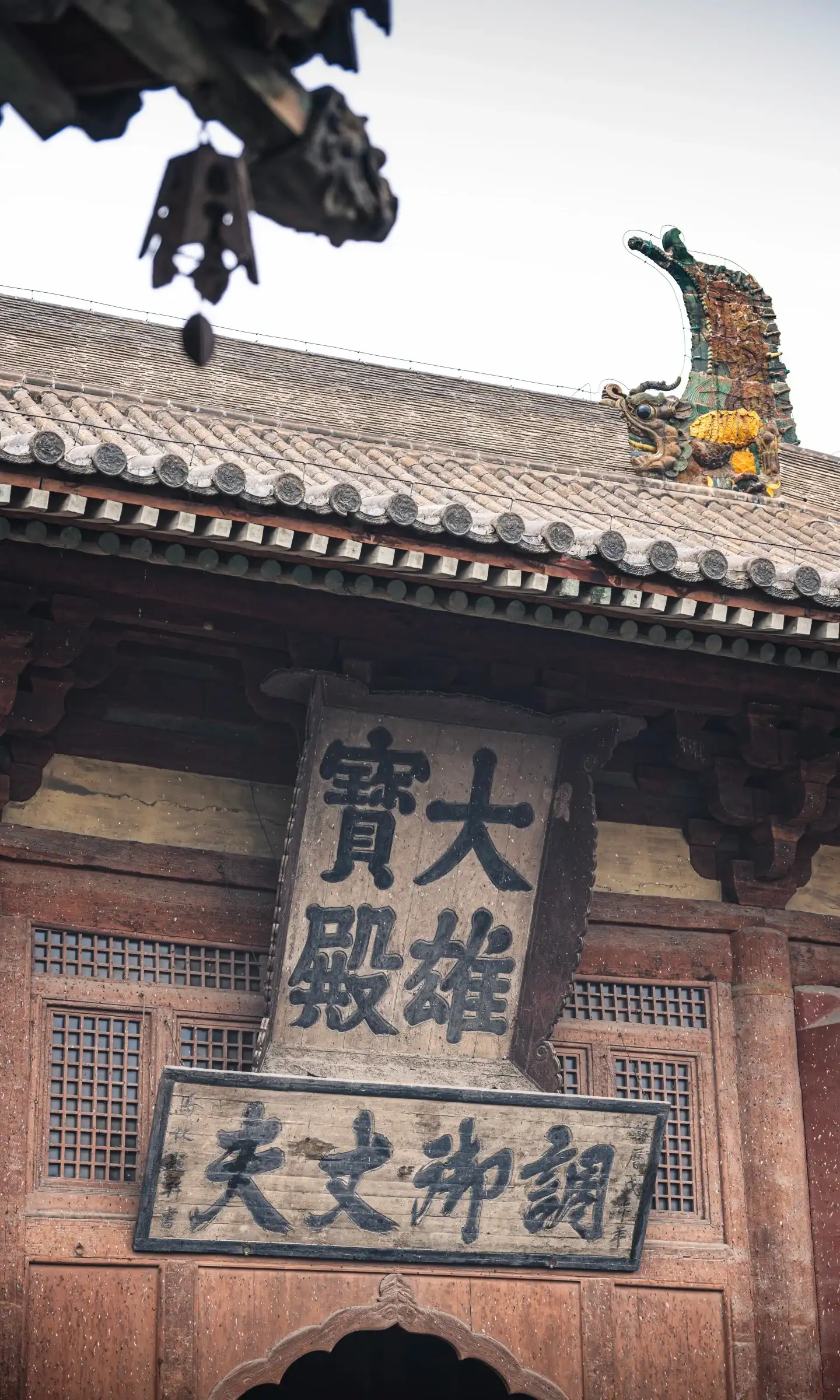
Plaque and wooden eaves of the Great Buddha Hall at Huayan Temple. Image source: Xiaohongshu · Wang Zhenglin
Why You Need to Step Back to Appreciate the Grand Roof
As you approach the main hall, the roof may be so vast that you cannot take it all in at once. At this point, there’s no need to force the entire structure into the frame with an ultra-wide-angle lens; instead, step back to a suitable distance where you’re allowed to linger, and observe how the eaves curve upward at both ends and how the columns support the weight above. Viewed from an oblique angle, the contour that appeared flat from the front reveals its depth, transforming the hall from a beautiful facade into a building with a sense of depth. Stepping back does not mean sacrificing detail; rather, it means first finding the details’ place within the whole.
The beauty of the roof lies not only in its upturned eaves. The slope of the tile surface, the ridge line, the end decorations, and the shadows beneath the eaves all contribute to the composition. Choose a specific detail to examine closely, then return to the whole to appreciate why that detail does not detract from the expansive roof surface. Regarding the exact age and restoration status of decorative elements, one must rely on on-site documentation for judgment; do not assume an element is original simply because it appears weathered, nor dismiss its historical value merely because it appears brighter in color.
The chiwen at both ends—the two “commas” on the roof
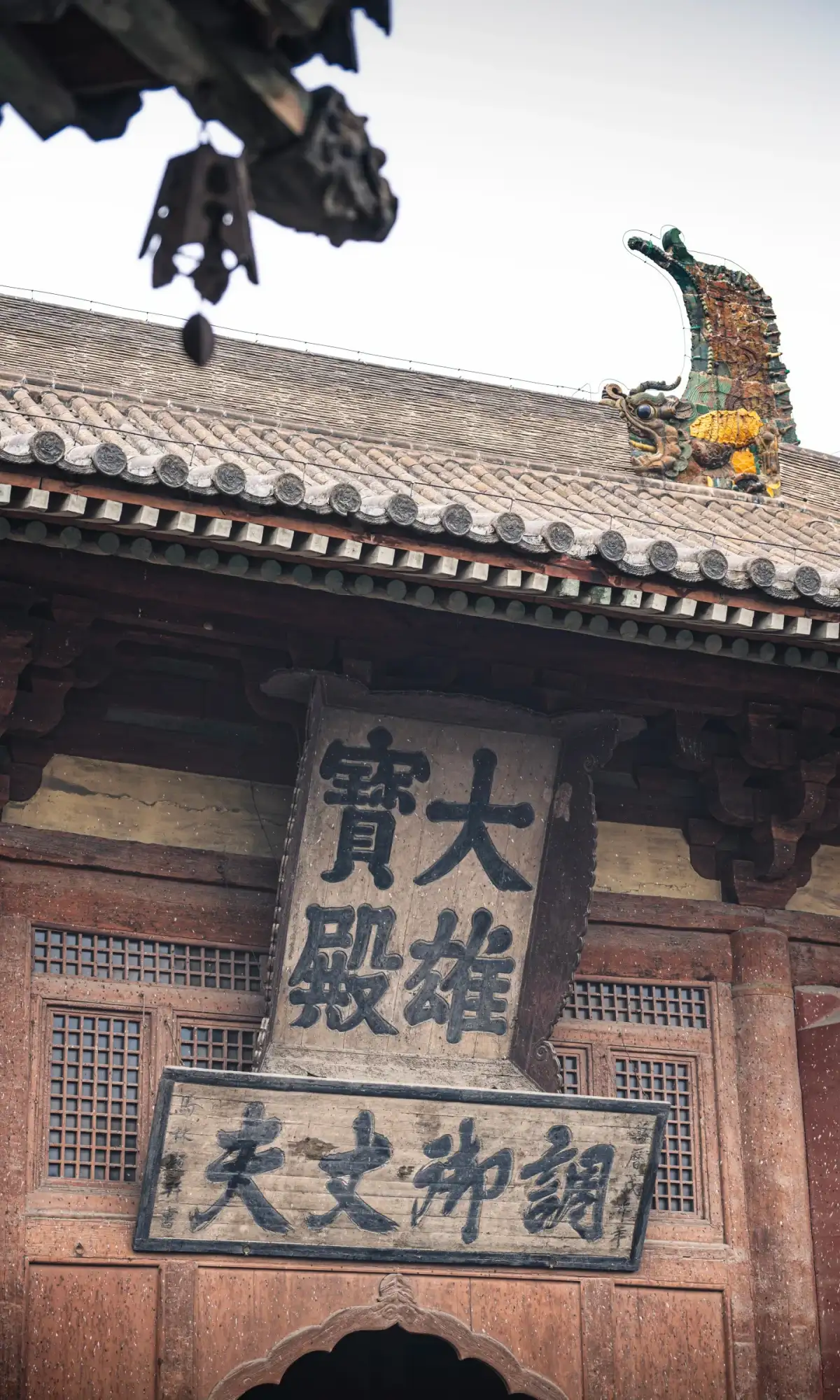
The glazed components in the photo stand at both ends of the ridge; their green and yellow hues contrast against the gray tiles, making their shapes stand out distinctly against the sky. At first glance, there’s no need to rush to look up their names; instead, observe the angle they form with the ridge line: how the high, sweeping curve frames the long, flat roof surface; and how the patterns on the components coalesce into blocks of color when viewed from a distance. Once you learn they are called “chiwen,” the name becomes linked to the actual form before your eyes.
compare the decorations at both ends; one should not draw conclusions about its age based solely on appearance. On-site explanations may detail architectural elements and restoration work from different periods; by cross-referencing this information with the location of your photos, you can see that an ancient building is also the result of continuous maintenance. When taking photos, maintain a normal standing posture on public walkways; do not seek angles that involve climbing onto the roof or climbing over guardrails. Even on overcast days, the contrast between glazed and gray tiles remains visible, though the difference in brightness is less pronounced than in direct sunlight.
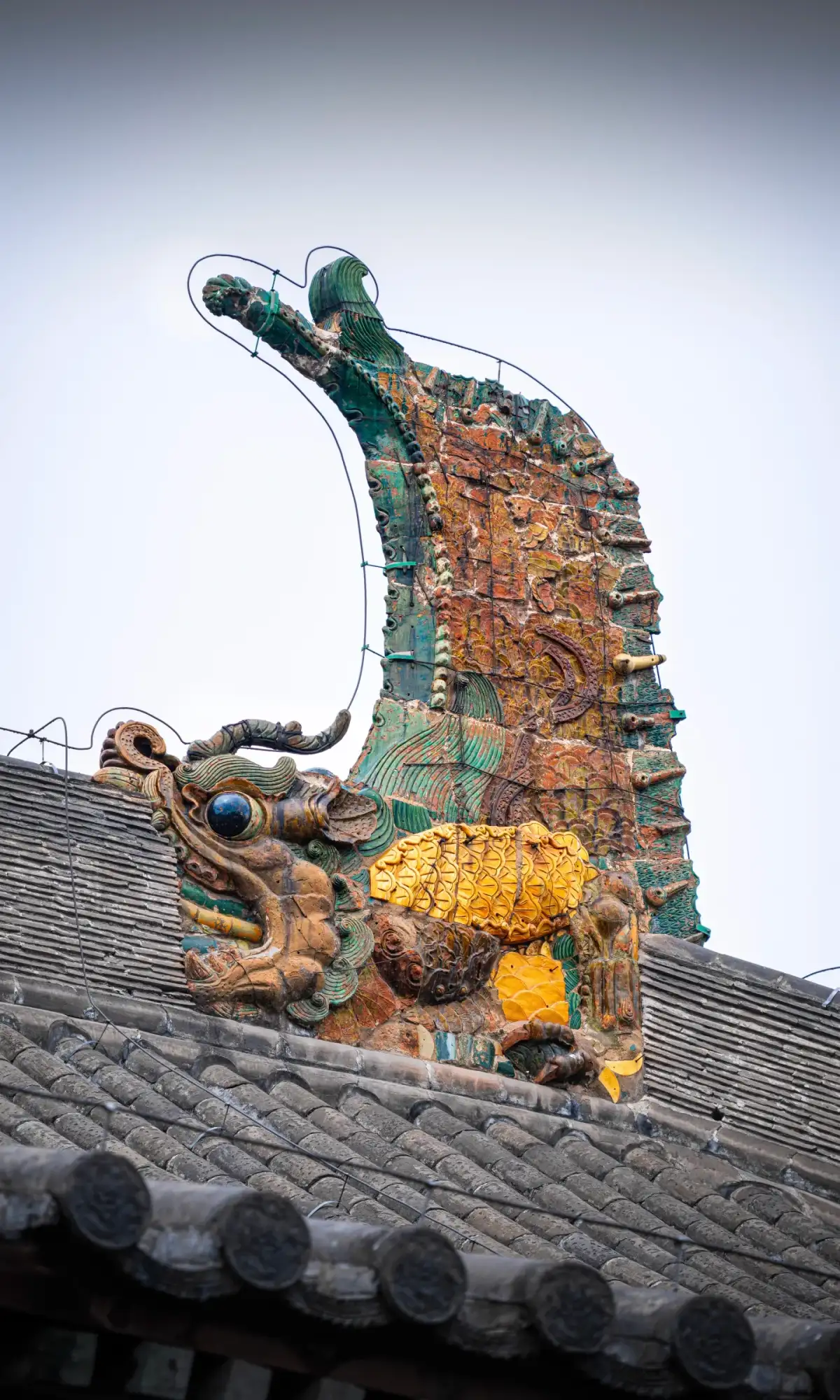
Detail of the glazed ceramic chimera ornament on the Huayan Temple roof. Image source: Xiaohongshu · Wang Zhenglin
Inscribed plaques are also an integral part of appreciating the architecture
the plaque on the Great Hall of the Buddha once again frames the facade beneath the expansive roof. The character forms, borders, and the color of the wood create a clear focal point; by looking up at the plaque first, then at the surrounding windows and columns, it becomes easier to identify how to direct your attention along the building’s front. For those who cannot read Chinese characters, one can first observe the thickness of the strokes and the arrangement of the lines, and then verify the meaning of the text. The date of creation, the author, and the history of replacements of the plaque should not be inferred from its appearance alone.
treating the text as an integral part of the space adds another layer of insight to your visit. The roof defines the width, the plaque marks the center, the colonnade sets the rhythm, and the pedestal lifts these structural elements off the ground. No single element bears the burden of the hall’s grandeur alone; rather, it is the combination of their positions that collectively forms the complete structure.
Beneath the wooden structure: the roles of columns and beams
While tours of ancient architecture are often dominated by the term “dougong,” first-time visitors can actually start with simpler observations: where are the vertical elements, how do the horizontal elements connect, and which areas beneath the roof are particularly thick and dense. Looking along the colonnade, you’ll notice that support and decoration aren’t two entirely separate systems. Whether you can see specific components depends on the area open to the public and the lighting; there’s no need to cross the protective line in pursuit of a closer view.
For foreign visitors unfamiliar with Chinese characters, finding an illustrated explanation is more effective than listening to a string of technical terms. After viewing the illustration and then the actual building, the words take on a concrete meaning. If you opt for a guided tour, confirm the language and scope of the content in advance—do not assume that English commentary is available at every location. Follow the on-site photography rules within the temple grounds. Insufficient lighting is not a reason to use a flash, and you should never lean against wooden structures or rest your camera on pillars to steady the shot. Once your eyes adjust to the dim light, more details will gradually come into view.
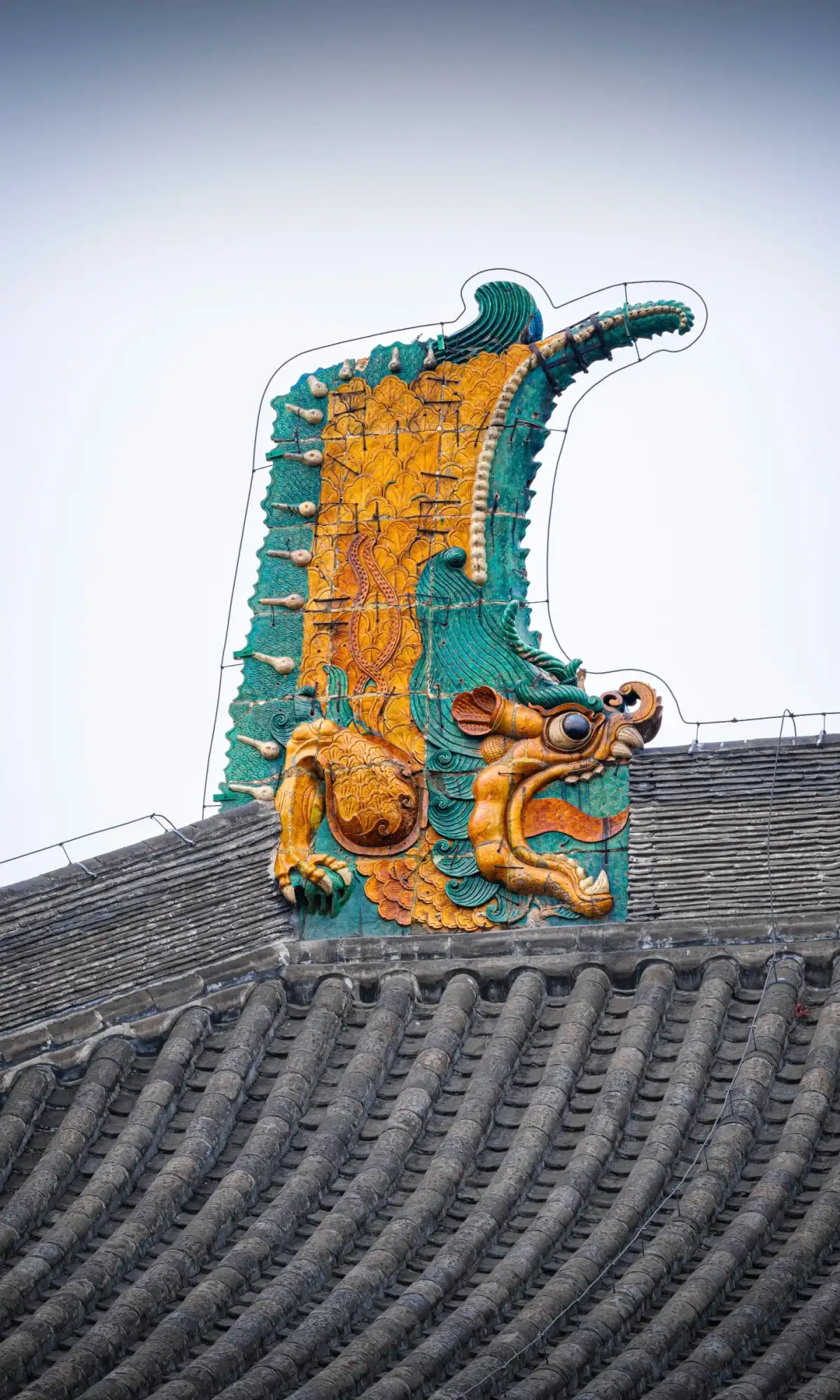
The glazed chimera and roof ridges from another angle. Image source: Xiaohongshu · Wang Zhenglin
Buddha’s Teachings Treasury Hall: Start your observation anew
If you simply follow the most obvious path to view the largest hall, you may easily overlook smaller but significant structures. The Bhagavata Sutra Hall deserves to be marked separately on your itinerary; locate it using that day’s guided tour, then begin your observation anew. When comparing large-scale halls, don’t rush to judge which is more magnificent. Instead, consider the column spacing, how the roof and interior space are arranged for viewing, and where your gaze first lands upon entering the hall.
Official sources mention that the hall houses preserved Liao Dynasty sculptures—this is the starting point for understanding its value. Read the exhibition labels for specific details on the statues’ names, dates, and condition; do not rely on a single smartphone photo for authentication. Take your time transitioning from the exterior to the interior: first observe how the architecture captures the light, then see how the statues’ contours emerge within that light. If access to the interior is restricted on a given day, focus primarily on the areas that are open to the public. Ensure at least one complete vantage point is available to prevent visitors from rushing through the hall simply because they spent too much time in the previous one.
Beyond facial expressions, the sculptures also feature drapery and center of gravity
When viewing the polychrome sculptures, it’s easy to imagine the characters’ inner thoughts based on their facial expressions. A more reliable approach is to observe how their eyes shift, how the position of their hands alters their contours, where the folds of their robes are densest, and how their bodies connect to the pedestals. These are all visible physical characteristics. Start by focusing on these elements first, then move on to interpreting the religious roles and historical periods. This approach allows you to appreciate the artistry without mistaking imagination for scholarly research. Choose a statue that’s clearly visible, then compare it to the one next to it—the differences will be more apparent than if you were to view the entire group at once.
from the designated viewing spots on-site, first observe the overall posture of the statues, then compare the folds of their robes and their hand gestures—this will transform Liao and Jin dynasty sculptures from mere historical terms into concrete subjects of observation. Remain quiet during your visit and keep your distance from those who are praying. Even if the photo shows no tourists, do not expect the actual site to be completely empty at all times. The physical space serves the purposes of faith, preservation, and tourism simultaneously, and all three require adequate boundaries.
a pause within the courtyard allows each hall to come into view one by one
it’s worth taking time to explore the open spaces between the halls. As the sun moves, the shadows at the base of the walls and on the steps shift, making it easier to discern the orientation of the complex than it is from inside the buildings. Choose a spot that doesn’t obstruct traffic, frame the buildings you’ve passed in a single field of view, and observe which is taller, which is wider, and which is obscured by trees. Courtyards are not merely empty transitional spaces; they are breathing spaces arranged between different architectural volumes.
Modern restoration and historic structures coexist within a single temple complex; when observing them, be sure to distinguish between the dates, reconstruction details, and conservation information indicated on the information plaques. Do not assume that all the buildings before you belong to the same dynasty simply because their overall styles are harmonious. Travelers with a deep interest in ancient architecture can keep their on-site observations separate from the information in reference materials in their notes, and cross-reference them later. Drawing a rough sketch of the courtyard with just a few boxes can also help you keep track of the distances between the buildings.
Meals and the Return Trip: Considered Within the Context of the Ancient City
After visiting Huayan Temple, it’s a good idea to find a place to sit down for a meal in the old town district, allowing time to recover from the visual fatigue caused by the indoor surroundings. When choosing food, communicate your personal preferences, allergies, and dietary restrictions; don’t treat a particular Shanxi noodle dish as a “must-try” for everyone. The bustling streets near the temple gate offer a glimpse into how the city is used today; before heading to the next historic site, check the walking route and traffic conditions.
Please verify official information regarding reservations, required documents, operating hours, and interior access; do not rely on ticket prices or free admission eligibility listed in older notes. The perceived temperature difference between winter and summer in Datong is significant, and the time required for outdoor viewing varies accordingly. On sunny days, you can observe the deep shadows cast by the roof; on cloudy days, you can appreciate the more uniform tones of the wood; and on rainy or snowy days, prioritize checking the accessibility of the stone steps and thresholds. Make Huayan Temple and the most important architectural site of the day your focal points, while keeping your plans for other locations flexible—this will leave you with clearer visual memories.
Further Reading and References
Compiled and organized by the Dongxing Travel Editorial Department based on publicly available travel notes and listed information. Intended for pre-trip reading; this is not a personal travel account. Please verify opening hours, transportation, reservations, and service arrangements according to your actual travel dates.
Wang Zhenglin · Datong Huayan Temple | Echoes of the Liao and Jin Dynasties
Datong Municipal Government: Huayan Temple
Large roofs first, or straight to the sculpture?
Begin at Huayan Temple Datong with the courtyard's scale: compare roof outlines, ridge ornaments and columns before turning to labelled interiors. Huayan Temple sculpture details draw attention closer to folds, balance and gestures. Moving from whole to part explains how figures inhabit buildings instead of producing isolated close-ups.
Choosing objects with limited time
For a Bhagavan Sutra Hall visit, select one architectural detail and one interpreted figure, then compare them with the roof of another major hall. Architecture enthusiasts can linger in courtyards; art enthusiasts can reduce repeated distant views. A meal in Datong's old city connects the temple with a street walk and leaves room to absorb what you saw.
Planning references