Eastbound Travel Editorial Department · Travel Diaries and Pre-trip Reading
When you arrive in Tongli, start by mapping out the rivers
Tongli is best explored on foot, but you shouldn’t treat every alley as a maze you can wander through at will. The rivers necessitate that nearby locations be connected by bridges, and the riverside paths often change direction at courtyards or intersections. According to the Suzhou Municipal Gazetteer, the town is described as a water town divided by a network of waterways and connected by numerous bridges. Knowing this before your visit means that if you take a wrong turn, you don’t have to rush to find a direct route—instead, you can first locate the next accessible bridge.
You can enter from the ancient town’s entrance, walk along the main streets and alleys for a while, use the area near the Three Bridges as a reference point, and then turn onto one or two public riverside paths. A half-day visit focuses on the water alleys and one indoor attraction, while a full day allows for an extra opportunity to sit down for a meal and return to the riverbank. Travel time should be calculated separately: arriving at the town entrance from downtown Suzhou or a rail transit station does not mean you’re already standing on the bridge you want to see; be sure to factor in the final leg of your journey and the time needed to enter the pedestrian area into your schedule.
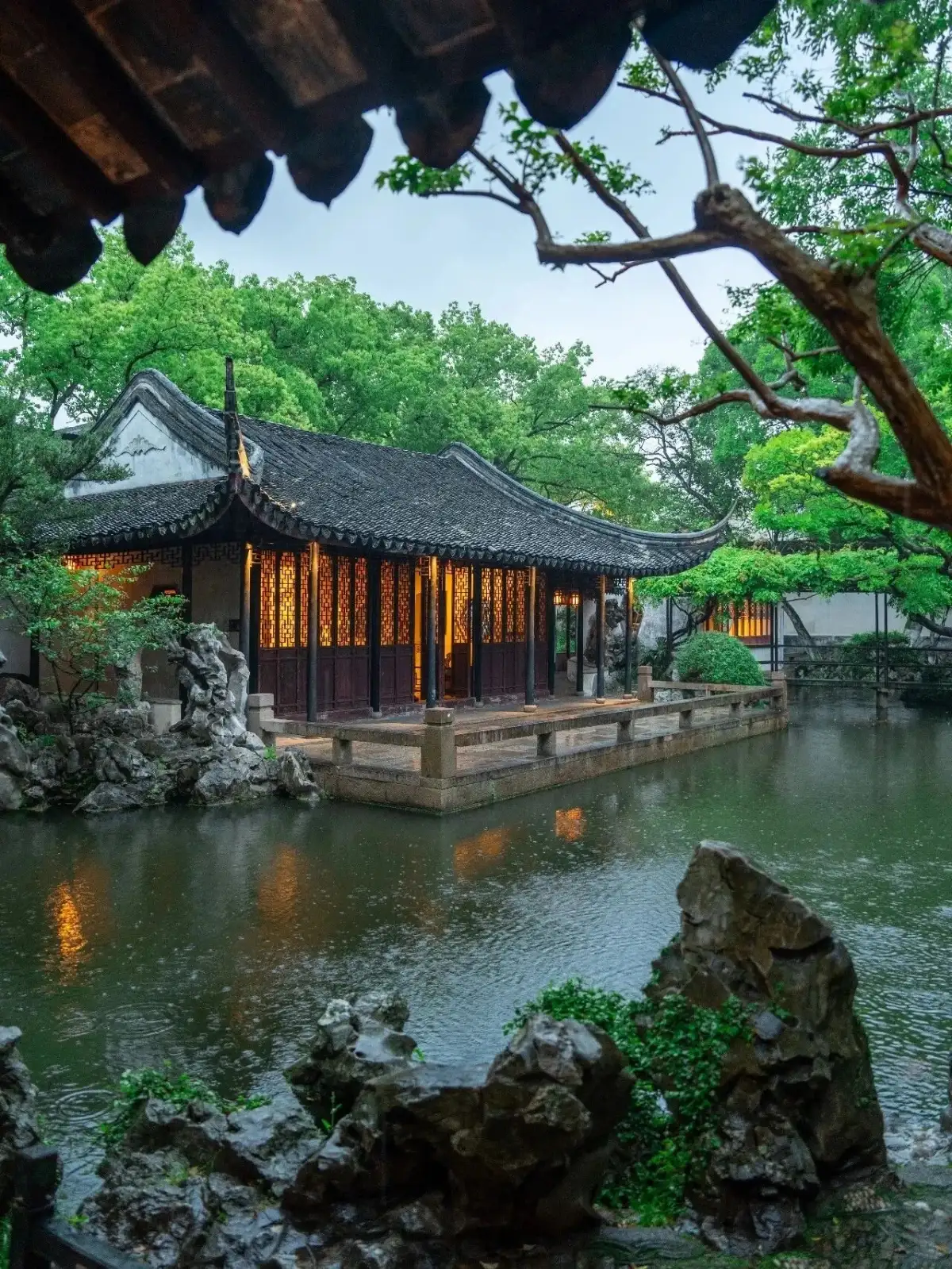
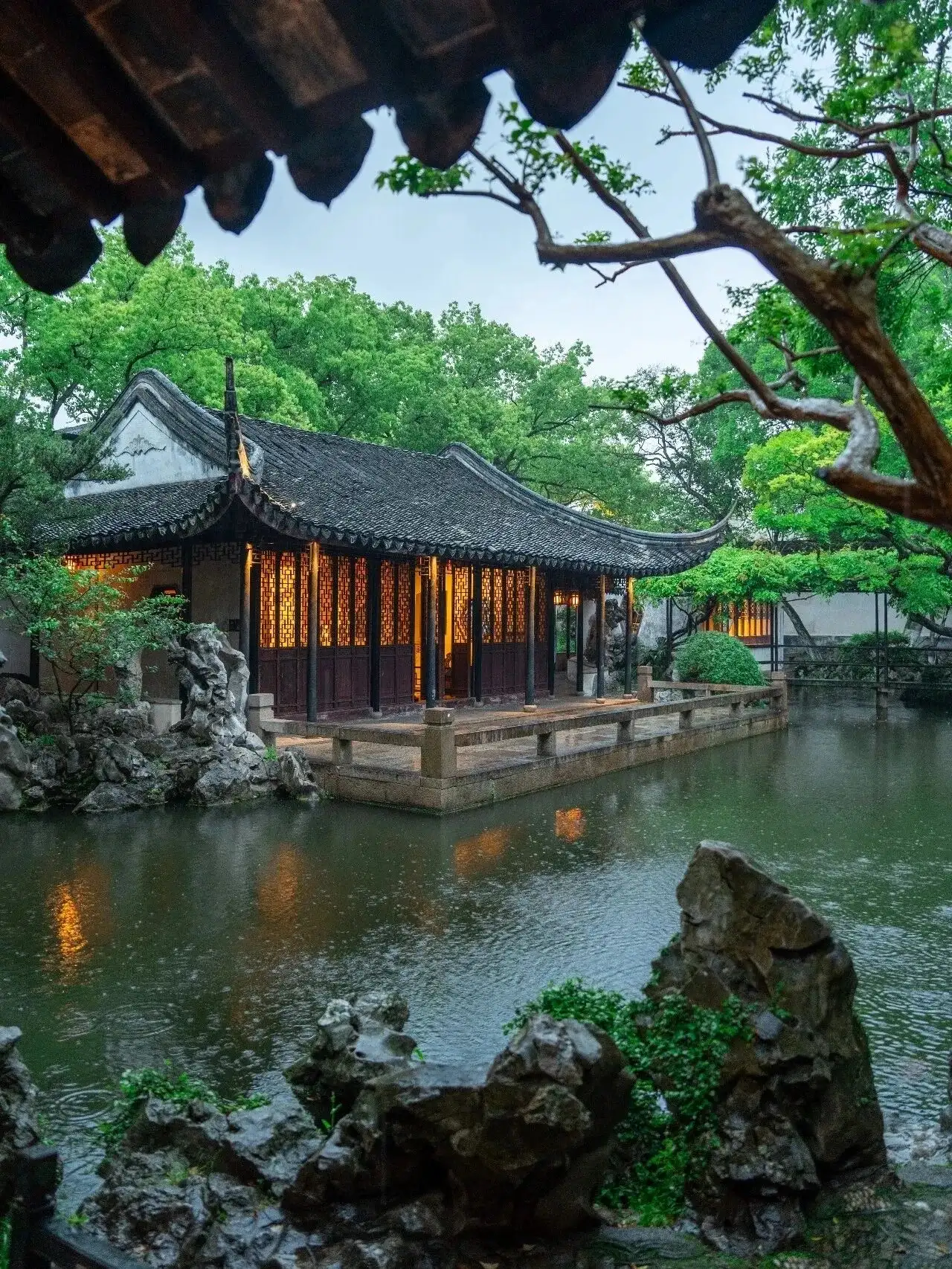
A water pavilion in the rain at Tuisi Garden in Tongli. Image source: Xiaohongshu · Suzhou Xingxing
Where Three Bridges Meet: First, Observe How the Waterways Converge
The area around the Three Bridges often becomes the first photo spot for visitors, but the significance of the bridges goes beyond mere numbers. Standing at the bridgehead, observe the direction in which the waterways converge here, then note which two sections of the riverbank each bridge connects—you’ll discover that the bridges simultaneously organize both passage and the viewing experience. Before stepping onto the bridge, you see the facades on the opposite bank; once on the bridge, the water’s surface stretches out before you; and as you walk across, you return to the scale of narrow alleys and eaves.
These three bridges are linked to local culture and traditional customs. To understand their specific meanings, you can listen to an official on-site guided tour; there’s no need to interpret every action taken while crossing the bridge as a fixed ritual. If you encounter a crowd taking photos or a group tour, first step aside to the public walkway to observe the river and the bridge arches, then cross once the area clears. Bridge surfaces often have a slope, and the stone surfaces may be slippery after rain; by separating sightseeing from walking, you can clearly observe the relationship between the bridge and the riverbank without blocking others’ view.
Shuibu and Xiaomen better illustrate the scale of daily life than the entire street does
As you stroll along the river, keep an eye out for the stone steps leading down to the water’s surface. Water wharves connect residential buildings to the waterways, reminding us that water was once not merely an object of observation but was also integral to transportation and daily life. When viewing the area, simply identify the locations of the stone steps, wall bases, and doorways from the shore; do not descend the slippery steps just to touch the water, and certainly do not treat doorways that are still in use as exhibition entrances you can enter at will.
allows you to capture both a riverside wharf and the adjacent bridge within the same frame: the bridge spans the river, while the stone steps lead down to it. These two approaches create a three-dimensional network of waterway transportation in this water town. The side view of a house often reveals its proximity to the water more clearly than the front, and the angles of the walls also highlight the meandering river. Even if no boats pass by that day, these spaces remain meaningful; there’s no need to invent unsubstantiated scenes for the photo—such as “a boatman delivering goods”—because the stones and entrances already provide clues to their purpose.
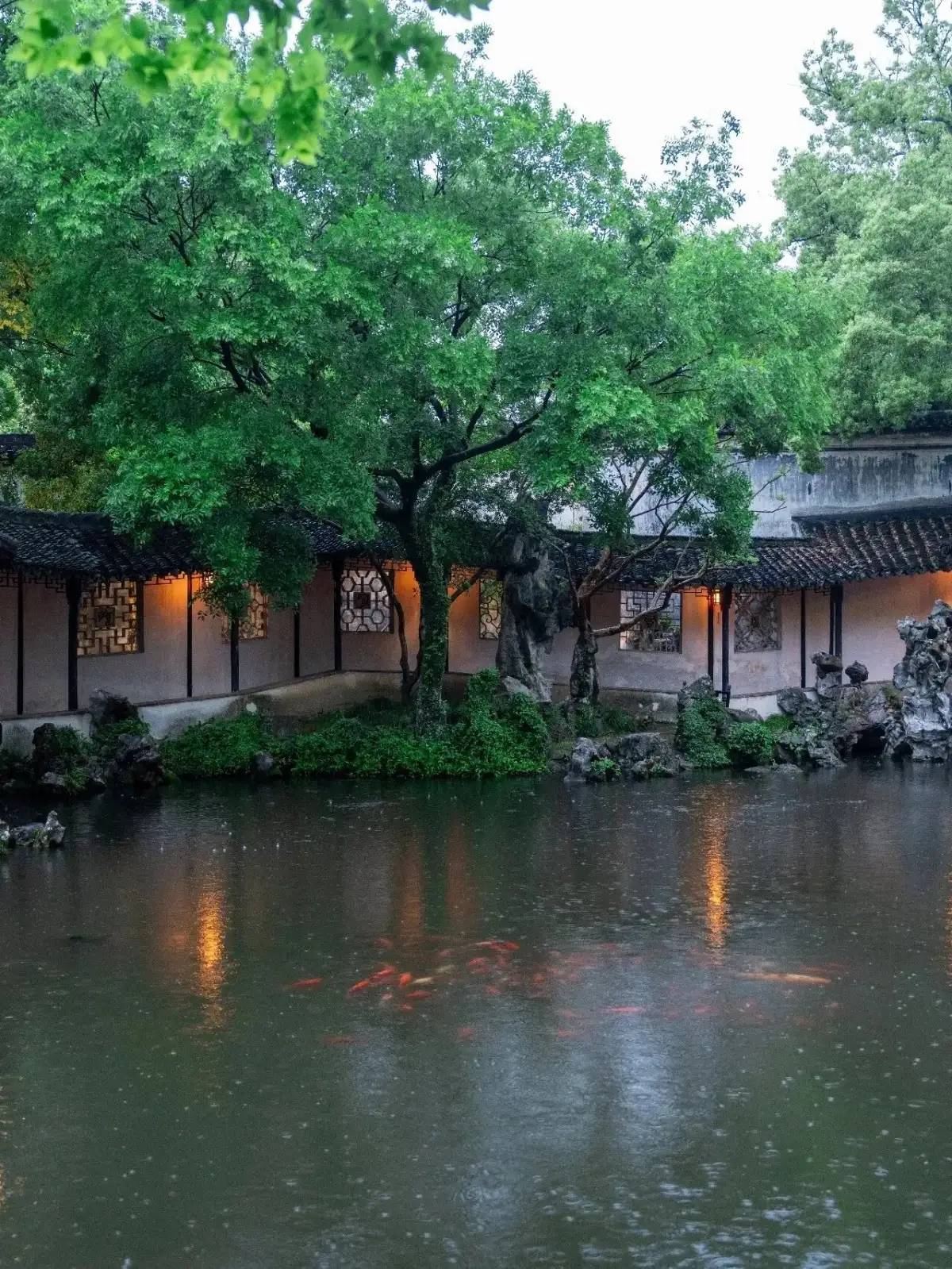
Latticed windows by the pond and fish swimming in the water at Tuisi Garden. Image source: Xiaohongshu · Suzhou Xingxing
Residences along the river: observing both continuity and discontinuity
White walls, tiled roofs, and the river’s surface—this is the most common visual composition in Jiangnan water towns. In Tongli, however, it’s worth looking a bit deeper: Are the eaves continuous? Are there narrow gaps between the houses? Do the doors and windows face the water or the street? And are the upper and lower floors used differently? What appears as a neat silhouette from a distance often reveals many nuances up close. These details preserve the town’s character and prevent the entire waterfront from being viewed as a mere, uninhabited decorative backdrop.
Residents’ daily lives and tourism businesses may coexist side by side on the same street. While public walkways are open to pedestrians, keep your distance from private windows and courtyards; when photographing buildings, try to avoid capturing residents’ daily activities. If you encounter laundry hanging out to dry, deliveries, or temporary items left out, there’s no need to dismiss these as detracting from the traditional charm—they simply demonstrate that the space is still in active use. If you want to capture a quieter scene, move to another section of open waterfront—you can’t expect real life to conform to an imagined image of a water town.
In Tuisi Garden, the open water town is enclosed within the garden walls
If you plan to explore only one site in depth, Tui Si Garden can serve as a transition after your riverside stroll. The town’s waterways form an open system of streets and alleys, while the water within the garden is meticulously organized by architecture and rockeries. According to the Suzhou Municipal Bureau of Gardens, Tui Si Garden separates the residential quarters from the garden, with the garden landscape arranged along the water’s edge. Upon entering, start by observing the main hall and the moon-shaped archway, then proceed to the pond to identify the location of the Water Pavilion and other waterside structures.
compare it to the riverbank you just passed: the bends here are more concentrated, and your line of sight is more easily framed by gates, corridors, and rockeries. The water surface may not be large, but a single obstruction can cause the scenery on the opposite bank to appear in segments. Don’t rush to photograph every nameplate. Choose a vantage point where you can see the reflections of the buildings, then shift your perspective to a different angle nearby—this will help you appreciate the intricacy of the layout. When visiting, be sure to check the ticketing policies and access restrictions for each individual site; just because you can walk through the ancient town’s streets doesn’t mean the same rules apply inside the gardens.
If you happen to visit Tui Si Garden on a rainy day, it’s a good idea to shift your focus from the distant waterways back to the eaves. Raindrops break the surface of the pond into countless small circular ripples, while the illuminated floral windows stand out clearly beneath the dim tree canopy; At this point, there’s no need to venture far—simply choose a section of the corridor where lingering is permitted to observe how the pond’s surface and the roof simultaneously catch the rain. Look at the pavilion across the way through the window panes, then shift your view to the pond’s edge where there are no window frames; the presence or absence of boundaries alters the focal point of the garden’s scenery. When taking photos, do not open or close doors and windows, nor should you occupy narrow passageways for extended periods to avoid the rain. Whether the garden lighting is on and how late you may stay are subject to the management’s arrangements on that particular day; the lighting shown in the photo merely reflects the conditions at the time of shooting. Stepping outside the courtyard walls to view the ancient town’s water alleys reveals a similar interplay of water and eaves—one organized into an enclosed space for viewing, the other extending along the waterway as part of daily life. The contrast between the two is far more striking than simply remembering the image of “white walls and black tiles.”
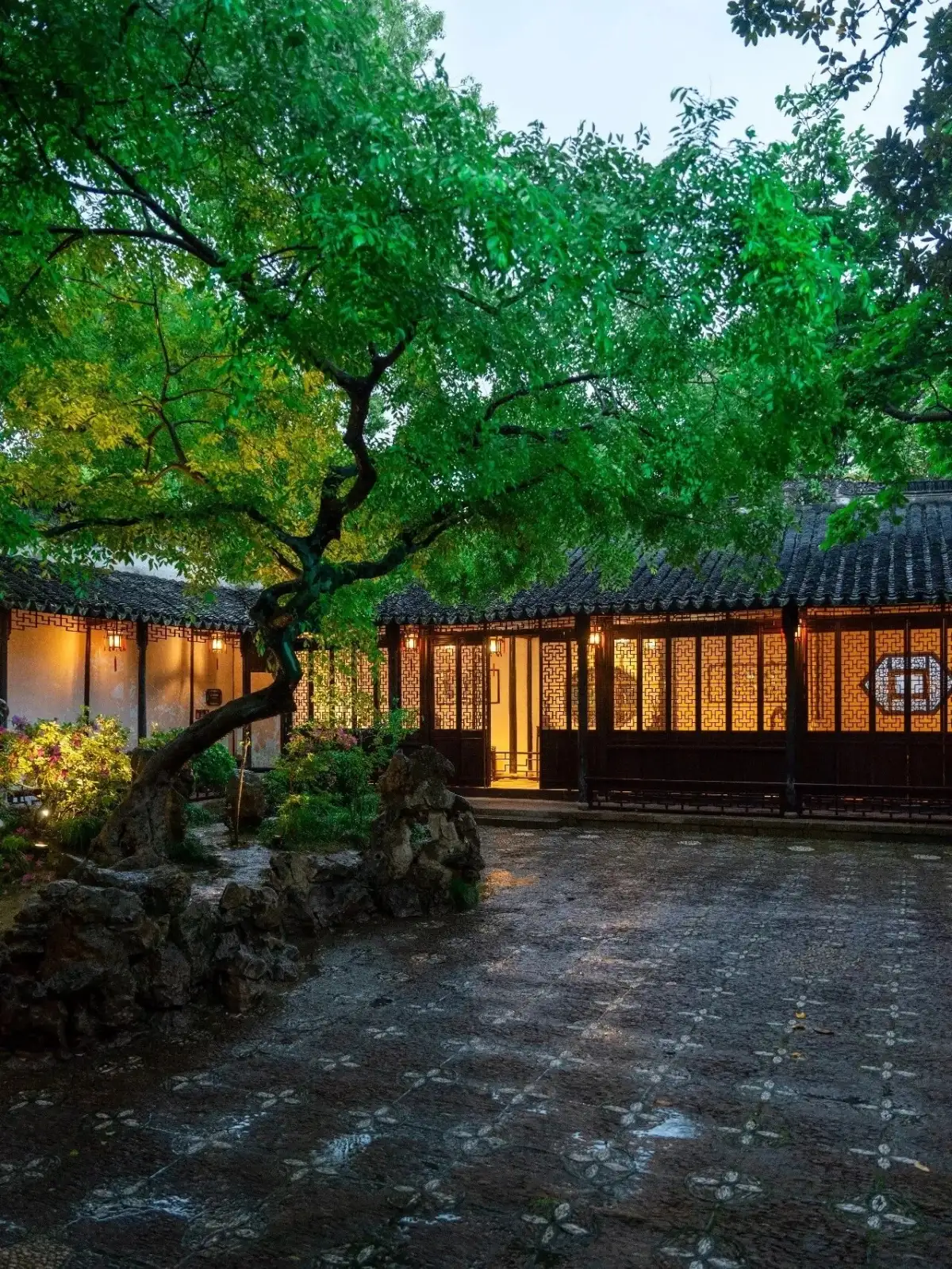
The Hall Under the Trees and the rain-soaked ground at Tuisi Garden. Image source: Xiaohongshu · Suzhou Xingxing
Between courtyards and gardens, leaving room for choice
Tongli also preserves historic buildings such as Gengletang and Jiayintang. If you feel you’ve taken in a lot after visiting Tuisiyuan, you can save another courtyard for your next visit; if you’re more interested in traditional residential architecture, make the courtyards the focus of your day and treat the gardens as a brief supplement. Having a clear focus will yield more rewards than simply visiting every location on a combined ticket one by one, and it will also make it easier to remember the differences between the various buildings.
Upon entering a courtyard residence, you can discern the functional hierarchy through three types of spaces: halls, courtyards, and side passageways. Halls typically have a distinct front, courtyards provide light and air, and narrow passageways serve as connectors; these elements are combined in different ways across various buildings. Decorative details require contextual explanation to be fully understood; elements whose historical period or symbolism cannot be verified should simply be observed. A carved window, a brick gatehouse, and two walls with contrasting light and shadow are sufficient to form a concrete record; there is no need to turn the entire residence into a legend.
season—changing the color of the water and the rhythm beneath your feet
On sunny days, the river’s surface tends to reflect light, so adjust your angle when photographing the opposite bank; overcast days are better for observing the fine details of walls and eaves. Spring blossoms, summer shade, and autumn and winter branches create varying degrees of density along the same stretch of riverbank, but blooming seasons, falling leaves, and water reflections should never be taken for granted. Rain in a water town certainly creates a unique atmosphere, and the slippery bridge surfaces and narrow spaces beneath the eaves also call for a slower pace.
In hot weather, schedule long outdoor walks for cooler times of the day, and spend midday visiting an exhibition or sitting down for a meal; in cold weather, standing by the river for a long time may be colder than walking. For visitors with luggage or strollers, check the bridge steps and your accommodation’s entrance first—the dense cluster of stone bridges makes it inconvenient to constantly drag suitcases from one neighborhood to another. If you shorten your walk due to the weather, you can still focus on the Three Bridges, a courtyard, and a stretch of the riverbank; these are enough to give you a sense of the town’s basic layout.
Take a detour on your way back to identify the direction you missed the first time
before they come to an end and return to the first bridge you saw, you’ll find the route becomes much easier to follow. On the way there, you see only the river’s surface; on the way back, you can make out the banks you’ve walked along. On the way there, the facades may seem similar; on the way back, you might recall a wharf or a corner. Retracing a short stretch of the route doesn’t detract from the journey—it connects scattered snapshots, turning a half-day excursion into a truly purposeful path.
You might want to have your last meal near the exit on your way back to avoid having to walk through the entire ancient town again after eating to find your ride. Keep the Chinese names of the transfer locations handy, check the day’s schedules and boarding points, and—most importantly—don’t treat old routes from social media posts as confirmed information. The experience of Tongli doesn’t depend on capturing a bridge with no one on it, but rather on how the bridges, rivers, and courtyard walls collectively guide people’s movements. Leave with this understanding in mind, and you’ll have something to compare against when visiting your next Jiangnan water town.
Further Reading and Reference Sources
Compiled and organized by the Dongxing Travel Editorial Department based on publicly available travel notes and listed information. Intended for pre-trip reading; this is not a personal travel account. Please verify opening hours, transportation, reservations, and service arrangements according to your actual travel dates.
Suzhou Xingxing · A Rainstorm “Trapped” Me in Tuisi Garden: Tuisi Garden on a Rainy Day
Suzhou Municipal Bureau of Gardens: Tuisi Garden
Suzhou Local Chronicles: Tongli Ancient Town
How should bridges and a garden share your time?
Start a Tongli half-day visit near the Three Bridges to understand where the waterways meet, then choose whether to explore one garden. A Tuisi Garden visit suits an interest in how water, buildings and sightlines are arranged within walls. For the scale of waterside life, give more time to lanes and landing steps. Avoid filling the visit with several similar mansion interiors.
Details to notice beside the canals
A Tongli canal walk can follow one question: bridges connect opposite banks, but how do landing steps connect streets with water? Record the whole setting before focusing on thresholds, covered edges and stairs. In rain or with slower companions, shorten the route and return along a familiar canal; the changed direction can reveal relationships missed earlier.
Planning references
Planning reference: Tongli half-day visit 1