Upon arriving at the Gansu Provincial Museum, it’s easy to be drawn in by a list of precious artifacts. In addition to the Bronze Galloping Horse, there are also painted pottery, bamboo and wooden slips, Buddhist art, and Silk Road artifacts. The more names there are, the harder it is to decide where to stop. Rather than trying to see everything, give yourself a “two-artifact exercise”: one that communicates through lines and form, and another that communicates through text and questions about daily life. See how these two types of materials preserve different aspects of history.
小红书作者“_2丫丫~”整理了跨展览的文物名单,“刚好在旅行”也把丝路、彩陶和佛教艺术串成参观方向。它们显示出游客面对内容丰富时的整理愿望。本文把这个愿望收拢成可以现场实施的步骤,不依赖原帖固定展位或所谓速通时间,适合第一次到访而又希望真正读进几件文物的人。
Complete these five steps first, then add your own goals.
Before entering the exhibition, choose one theme that focuses on form and another that requires interpretation. This guide uses painted pottery and bamboo slips as examples; if the day’s exhibits or your personal interests differ, you may substitute them, but the principle is to maintain these two distinct approaches to viewing.
In the “Painted Pottery” section, find a piece that is well-preserved and positioned at a suitable viewing angle. First, note the relationship between the rim, neck, body, and base, then observe how the lines unfold around the vessel. For now, use the names on the exhibit labels only to identify the objects; there’s no need to memorize them all at once.
In the “Written Materials” section, start by reading the exhibition explanations to understand what the materials were generally used to record, and then examine the character forms and their arrangement. For ancient characters that are difficult to decipher, focus on the content presented in the explanations; this will help you understand historical life better than guessing based on their appearance alone.
After moving past these two focal points, find a suitable place to rest and share one discovery each that you’ve noted with your companions. Sharing these details will reveal which aspects have truly been understood and help determine whether to proceed to a third theme.
Finally, decide whether to delve deeper or leave based on your remaining attention span and physical condition. If you’ve already examined the second piece thoroughly, you can save the rest of the exhibition for another time; two clear discoveries are easier to take home with you than a long list of vague names.
This sequence is not a fixed route through the museum. It emphasizes defining your questions first, examining the materials on-site, organizing your thoughts during breaks, and then deciding whether to explore further. The location of exhibition halls and the actual exhibits are subject to the information available on-site at the time of your visit. If there are specific artifacts you’re particularly looking forward to seeing before your visit, treat them as one of your focal points; there’s no need to sacrifice your own interests just to follow the order outlined in this guide.
First Stop: The Lines on Painted Pottery Are Shaped by the Vessel’s Form
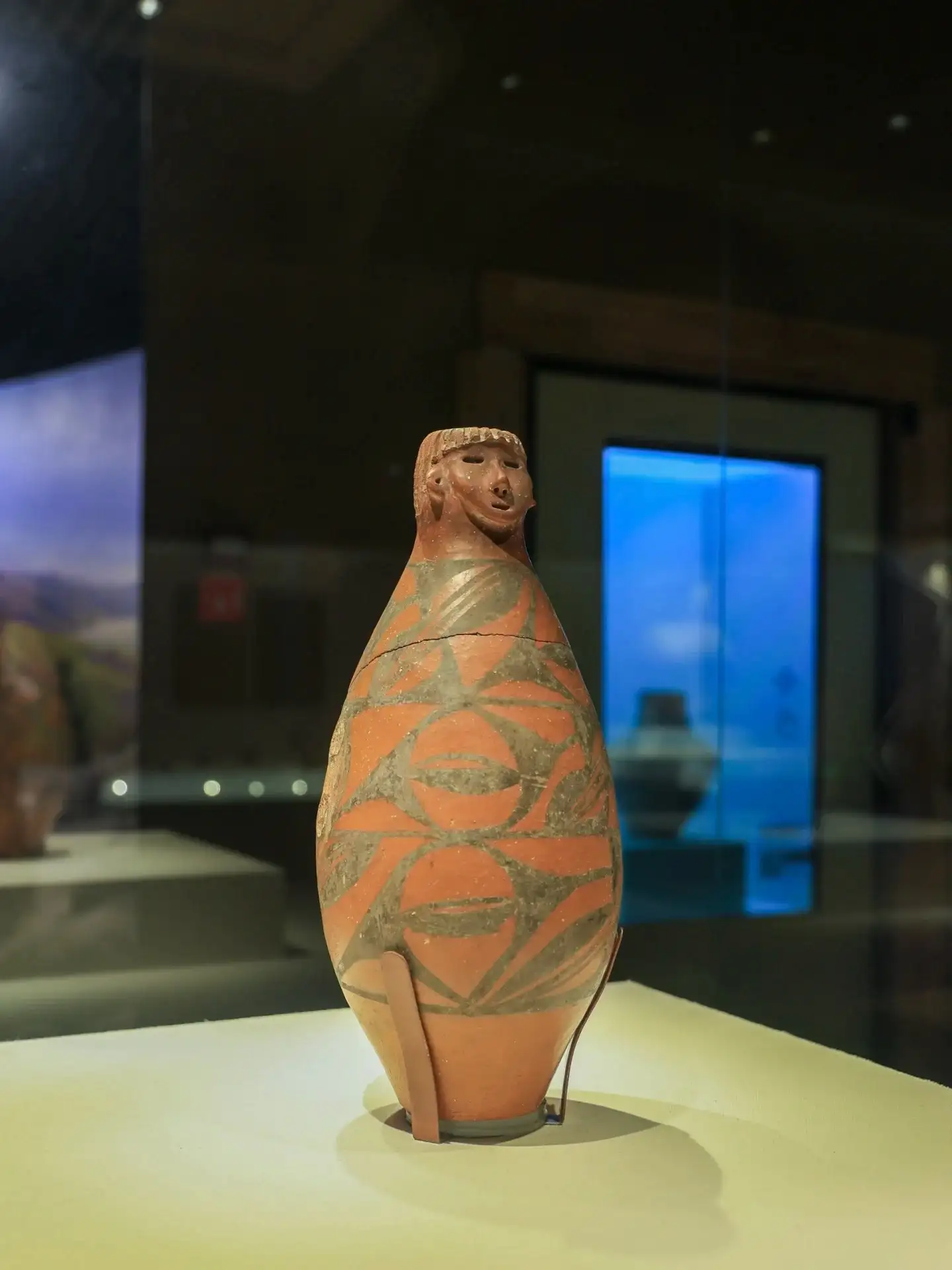
The painted pottery bottle with salamander motifs, as described on the Gansu Provincial Museum’s official website, features a small mouth, a long neck, two handles, and black patterns on the body. This example is ideal for practicing observation from form to pattern: first identify the container’s outline, then observe how the patterns unfold across the body. The pattern is not an independent, two-dimensional design; together with the curved body of the vessel, it determines the proportions and rhythm we perceive.
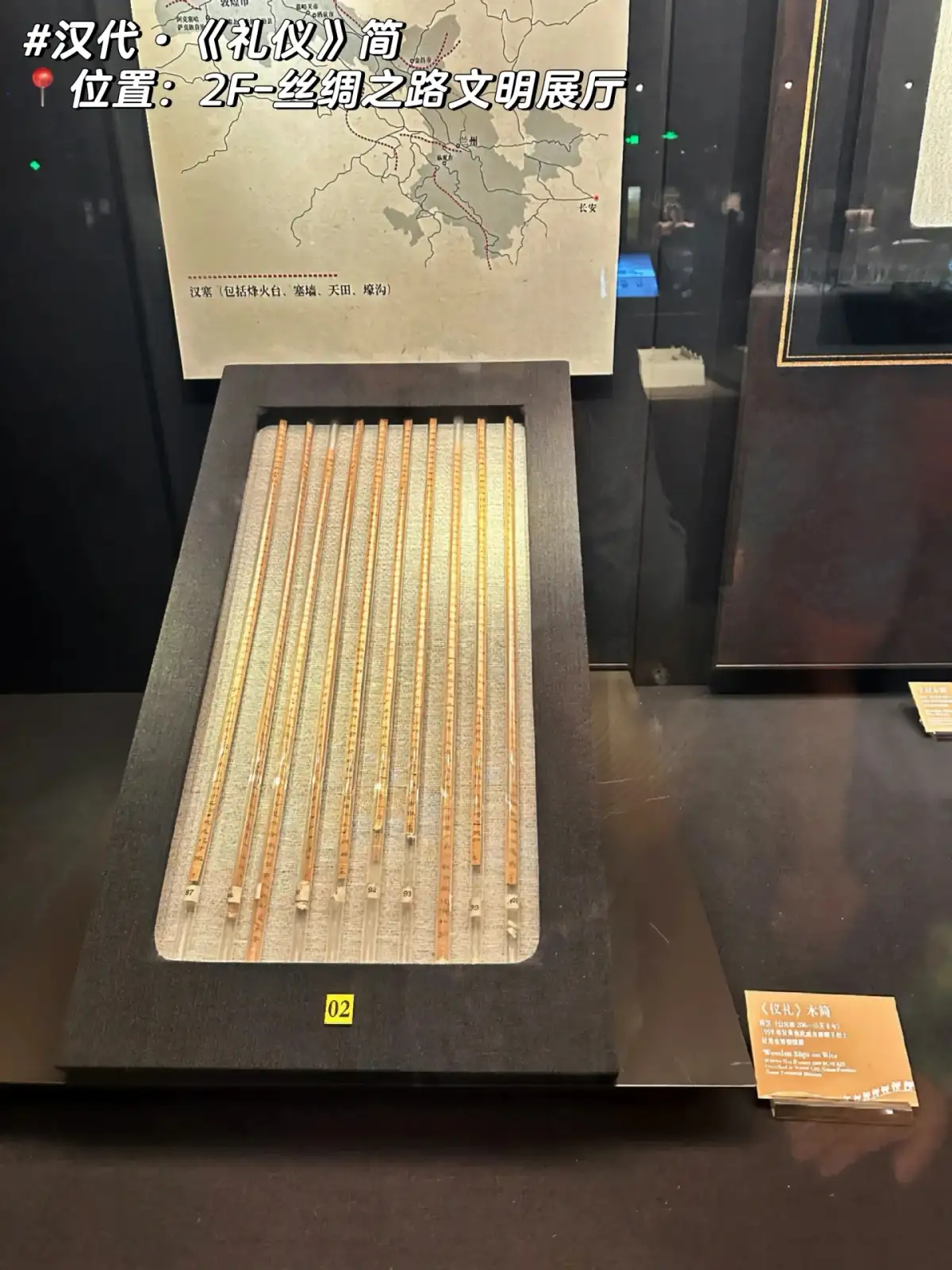
Ritual bamboo slips on display at the Gansu Provincial Museum. Photo:_2 Yaya~ · Original Post.
. From a permitted vantage point, slightly adjust your viewing angle to observe how the rounded body affects the patterns. The front highlights the imagery, the side reveals the curved surfaces, and the overall silhouette explains why the decorative patterns were placed in that specific location. When taking photos, be sure to capture both the vessel’s shape and close-ups of specific details; this will help you reconstruct these relationships when reviewing the images later. If you only photograph a close-up of a pattern, you often lose sight of the object on which it originally appeared.
Children can try describing the lines they see: which parts are thin, which are dense, and where they curve. Their descriptions do not need to immediately assign symbolic meaning to the patterns. Let their language stay close to the visible facts first; adults can then supplement the cultural and historical context based on the exhibit labels. This approach preserves the children’s own discoveries while preventing them from interpreting unexplained patterns as fixed myths.
If your companions are interested in design, this section also offers an opportunity to discuss the interplay between two-dimensional graphics and three-dimensional surfaces. Modern packaging, clothing, and pottery all face this same challenge: patterns must be folded, bent, or rotated to be fully visible. Using familiar everyday experiences to interpret artifacts can bridge the gap to ancient materials, though we need not assume that the creative motivations of ancient people were exactly the same as ours today.
Second Stop: How Writing Transforms the Distant Past into Concrete Daily Life
Collaborative materials from the China Silk Museum list Han Dynasty bamboo slips as one of the highlights of the Gansu collection; the Gansu Museum also continues to conduct research on bamboo slips and silk manuscripts unearthed in Northwest China. The textual materials ground the broad concept of geography in how people recorded, transmitted, and processed events. After observing the curves of the painted pottery, move on to the texts; the tour will shift from the surface of the objects to the information they convey.
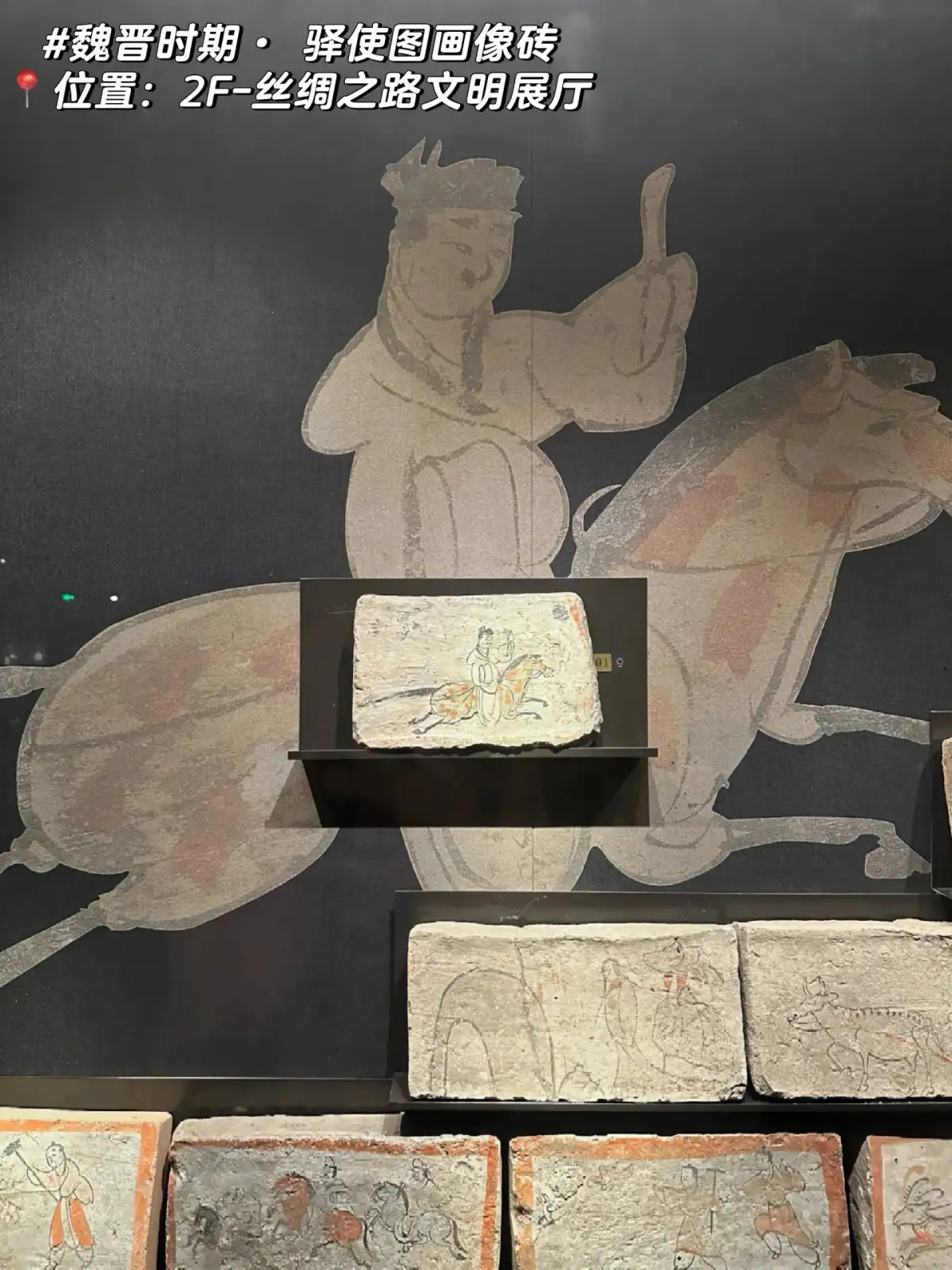
Display case for the “Messenger” pictorial bricks at the Gansu Provincial Museum. Image:_2 Yaya~ · Original Post.
. Ask yourself three simple questions: What material is it written on? How is it arranged? And what interpretation or explanation does the exhibition provide? These questions are particularly suitable for visitors with limited Chinese reading ability, as they do not require direct recognition of ancient characters. The shapes of the bamboo and wood materials and the direction of the text can first establish a visual impression, with the explanations then filling in the specific details; only by viewing both types of information together can we avoid treating the textual materials merely as examples of beautiful calligraphy.
If you encounter exhibits related to letters, administrative documents, or daily life records, start by thinking about the most ordinary aspects: how people conveyed messages after leaving home, how matters were recorded, and why these records were preserved. Don’t automatically categorize every bamboo slip under the same purpose; instead, follow the instructions on its own exhibit label. It is precisely these differences among the materials that allow the past to be seen not only through the lens of emperors and major historical events, but also through the lens of everyday life.
For international visitors, foreign-language commentary is particularly important at this stage. While the shapes of the artifacts can be observed, the textual content requires interpretation. You can ask the docent to select one item with a clear interpretation in advance to help translate the core meaning, rather than translating the entire long panel word for word on the spot. Engaging in a discussion centered on a single, understandable passage is more rewarding than rushing through many difficult-to-read texts.
Place the two artifacts side by side and reflect on them together.
Painted pottery and bamboo slips do not offer consecutive snapshots of daily life from the same era, nor should their comparison be forced into a single narrative of historical development. They provide two distinct types of material for understanding history: the forms and decorations of artifacts prompt reflection on their creation and use, while written texts allow us to delve into the recorded content. As you leave, consider them side by side, and you’ll come to appreciate why museums need a variety of materials to collectively interpret a region’s history.
This has also changed my expectations for traveling along the Silk Road. Along the way, there are not only routes that cross mountains and rivers, but also diverse themes such as craftsmanship, documentation, exchange, and faith. On the next leg of the journey, whether visiting archaeological sites or grottoes, you can carry with you a question sparked by the museum, rather than treating every city as just another spot to check off on your list. The museum provides clues for further exploration that you can take with you.
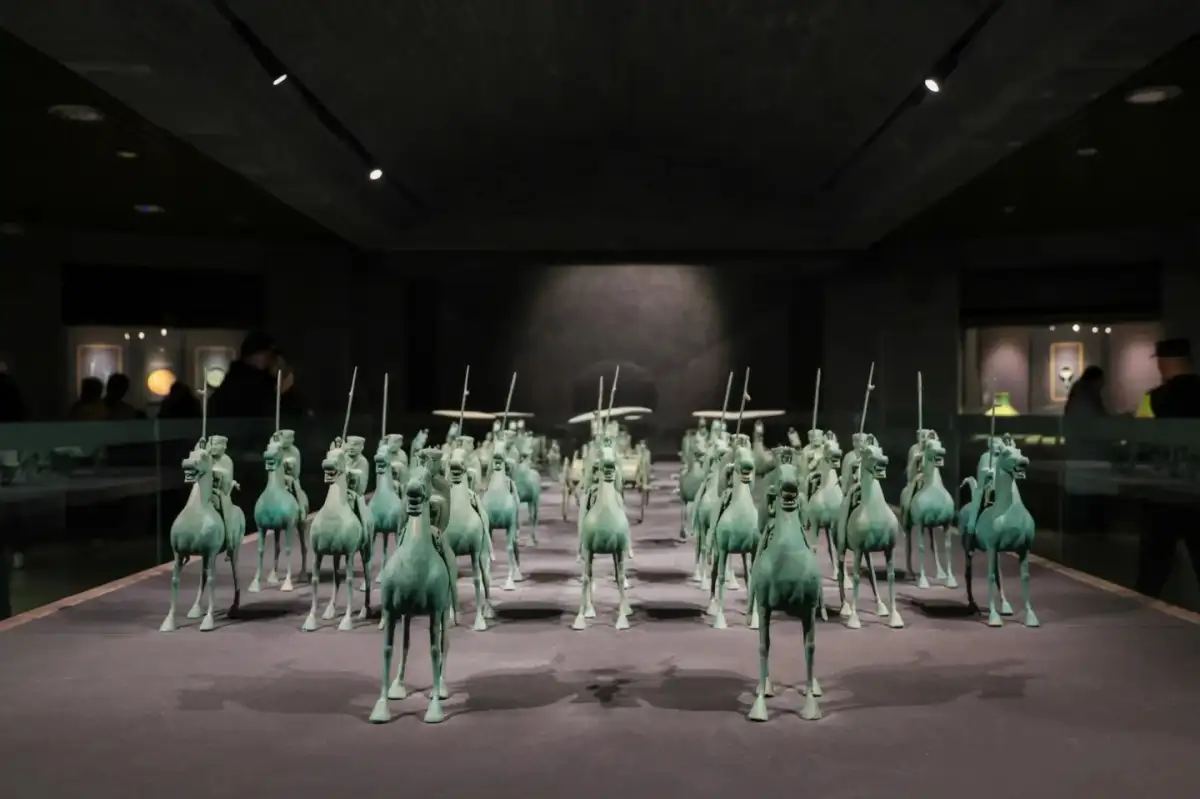
Display case for the Bronze Chariot and Horse Ceremonial Figurines at the Gansu Provincial Museum. Photo:Just Traveling · Original Post.
to adapt the steps to your actual companions.
Families with members of different ages can explore the painted pottery section together, then assign the written materials section to the person most interested, while the others take a break. Agree on a meeting spot and a time frame; if someone is watching over children or elders who need companionship, there’s no need for everyone to move around in sync just to prove this is a shared journey. Afterward, share your discoveries with one another; even the brief segments spent apart can be woven back into the same conversation.
Reservations, identification, and transportation to the museum should be handled before your visit. Passport holders should confirm the specific identity verification procedures through official channels; if you require a foreign-language tour, arrange this in advance—do not assume that the procedures outlined in your Chinese notes apply to you. Once these logistical matters are settled, you can focus your attention on the artifacts once inside the museum, rather than constantly checking your phone to resolve admission issues.
Your travel journal entry can consist of just two paragraphs: one describing the outline of a painted pottery piece and a single line, and another noting a daily-life issue from the textual materials. Such notes may not be grand, but they are very concrete. In the future, when I see the Hexi Corridor on a map, I’ll think not only of city names, but also of an artifact and a passage from the records. These two artifacts thus become the starting point for my continued understanding of Gansu.
Source and Editorial Notes
This article is an original travel interpretation compiled by the Dongxing Travel editorial department based on cited sources; it is not a firsthand account by the author. The full text of the original post has not been reproduced; accompanying images are used within the scope of authorization and are credited to the author and source of the original post. They do not serve as proof of actual travel experiences or services provided by Dongxing Travel.
_2 Yaya~ · Gansu Provincial Museum📍Easily check off 16 must-see signature pieces✅ · Travel Notes; Verified/Organized on: October 3, 2026.
I’m on a trip right now · 😭 Gansu Provincial Museum! You really can’t see it all without a guide! · Travel Notes; Verified/Organized on: October 3, 2026.
Gansu Provincial Museum · Digital Gansu Museum Collections and Research Information · Official materials; Verified/Organized on: October 3, 2026.
China National Silk Museum IIDOS · Gansu Museum Collections and Permanent Exhibits · Official materials; Verified/Organized on: October 3, 2026.