Before entering Zhi Jin Cave, many people have already seen photos of the “Silver Rain Tree” or massive stone pillars, expecting to find a natural sculpture within a dark space. Once inside the cave, however, the most intriguing relationships unfold beyond the sculptures themselves: why is the hall so wide? Why do stalactites hang from the ceiling? Why do stalagmites rise from the floor? And how was the water once channeled through these passages, whose elevation rises and falls as you walk?
小红书作者Ven把注意力分配给洞内景观与峡谷的光线;文煖Xuan则在笔记里列出南天门、银雨树等自己喜欢的地点,并提醒沿路有上下与窄段。两篇个人游览都提供了景观名称与感受,若把它们继续向前推进,织金洞可以成为一场关于水如何创造空间的自然阅读。
First, there must be a space you can walk into
An introduction to the formation and evolution of the Zhi Jin Cave World Geopark links the movement of groundwater along fissures, the development of underground waterways, and subsequent uplift. Caves are not formed by first placing stalagmites one by one and then carving out passageways for people; rather, water flow initially carved out the passages, and after changes in the regional environment, parts of these river channels became the cave spaces we can see today, within which sedimentary landscapes subsequently developed.
This sequence explains an intuitive experience: the coexistence of the large and the small. Visitors are greeted by a vast hall, yet when they look closer, they see slender stalagmites, rows of stalactites, and localized textures. The scale of the hall and the scale of the details stem from related but distinct processes; once this is understood, there is no need to generalize the entire cave by saying, “Everything is formed by dripping water.”
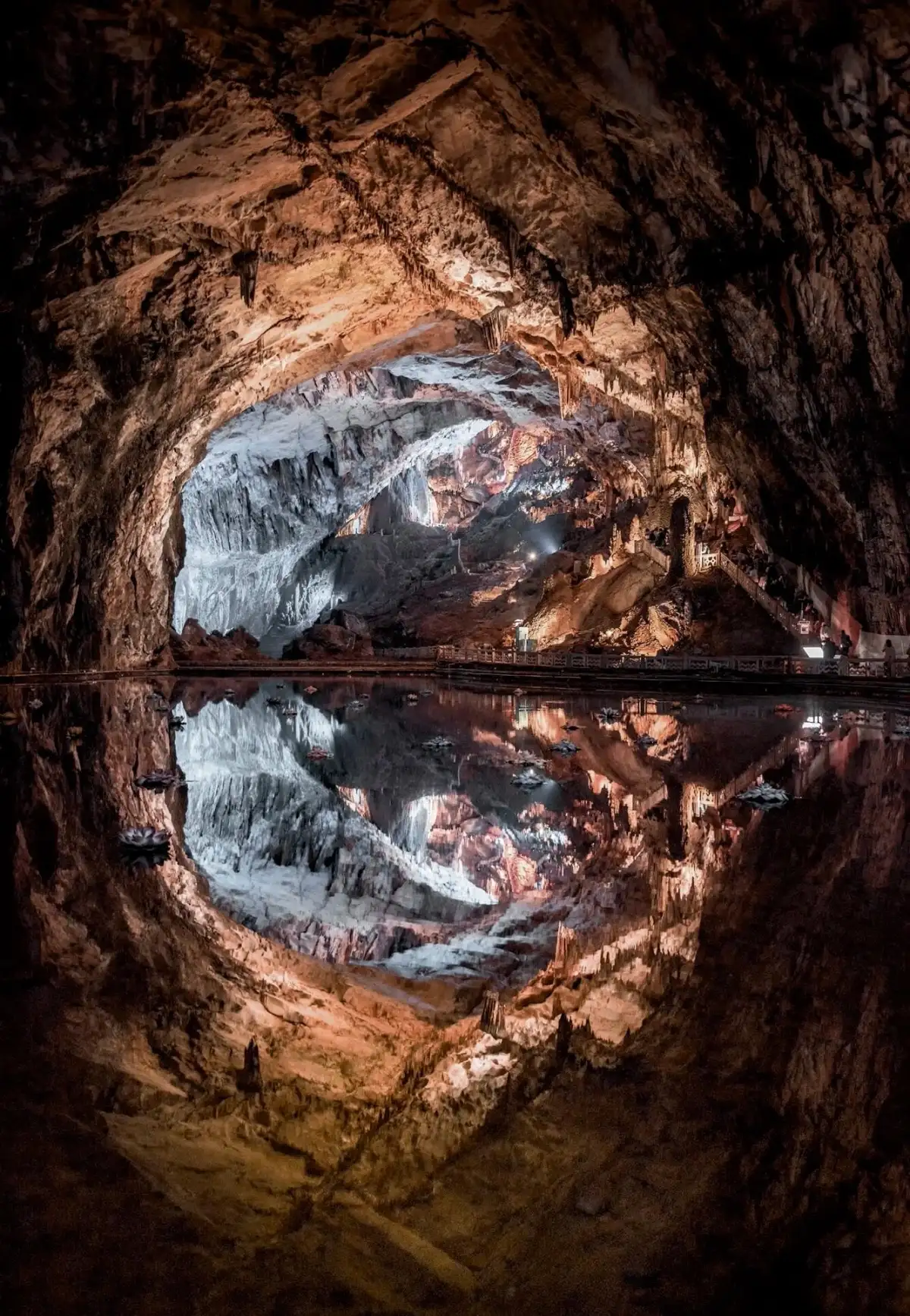
Arched caves and their symmetrical reflections in calm water. Photo:Ven · Original Post.”
Official geological descriptions also characterize Zhijin Cave as a multi-level, hall-and-labyrinth-style cave system. Geological levels do not correspond to a flat visitor map, nor do they imply that visitors can access every level. As you walk along the day’s designated route, observe how the passages twist and turn and where they suddenly widen, then connect these spatial changes to the past activity of groundwater. The walkway beneath your feet is a visitor facility; the larger rock formations alongside it are the true protagonists of this history.
For children, “Was there water here in the past?” is a good place to start. Parents can first explain the formation of underground rivers, then have their children observe the moisture and dripping water visible today. The scale of past water flow differs from today’s dripping water; water has performed different functions at different stages. This explanation is more insightful than simply memorizing which animal a particular rock resembles.
the same drop of water—why do some formations grow upward while others grow downward?”
According to the popular science explanation of stalagmites at the Yifu Museum of China University of Geosciences, water containing dissolved substances enters the cave and precipitates calcium carbonate as environmental conditions change. Stalactites, which form from the ceiling downward, and stalagmites, which form from the ground upward, can grow relative to one another; when they connect, they form a stalactite-stalagmite column. Visitors don’t need to memorize chemical equations on the spot; by first understanding location and direction, they can distinguish between these three terms that are often confused.
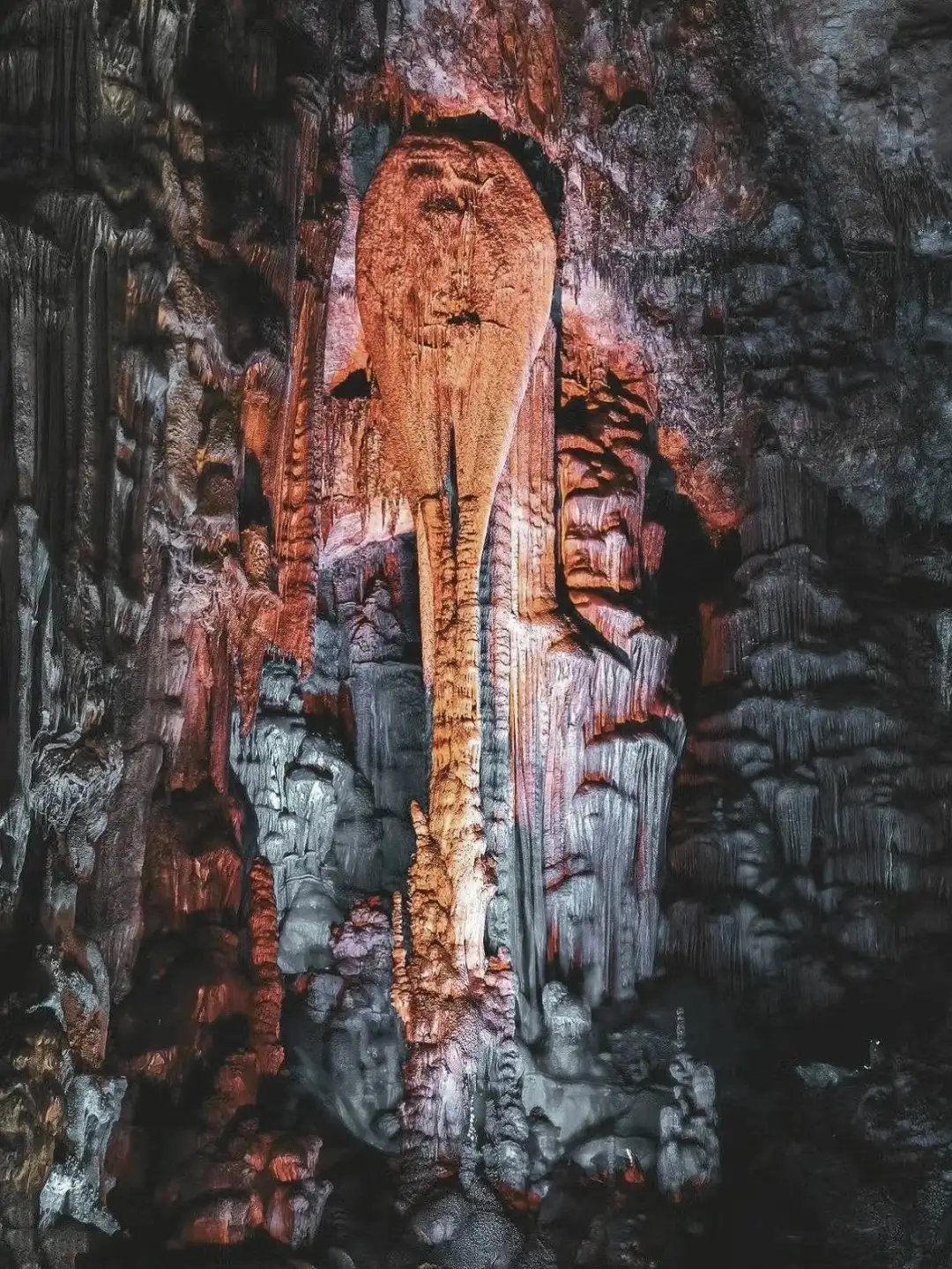
Curtain-like cave deposits hanging under orange lighting. Photo:Ven · Original Post.”
Some visitors may ask: Since both the ceiling and the floor appear pointed, why distinguish between them? Because the names indicate how they relate to the position of the water flow. Hanging downward, accumulating upward, and connecting between the two are three spatial relationships worth comparing. Standing on the designated walkway, one can—without touching anything—match a large stone pillar with the separate forms beside it.
The official description of Zhi Jin Cave further lists stalactite forms such as flag-shaped, curtain-shaped, shield-shaped, and tongue-shaped. These terms help people move from recognizing “differences in size” to recognizing “differences in shape.” For example, a broad hanging formation and a slender conical formation present the relationship between water and rock in distinctly different visual ways; if on-site explanations provide specific names, visitors can match those names to the corresponding outlines.
The anthropomorphic or pictorial names of these landscapes also serve a purpose. They are easy to remember and spark the imagination, but they cannot explain the formation process on their own. One can first appreciate the charm of a particular name, then observe where it hangs, whether it stands alone, and how its surface curves. Imagination and science need not cancel each other out; the former helps us pause, while the latter gives substance to that pause.
Regarding growth rates, it is also inadvisable to use a single number to explain all the landscapes within the cave. A popular science article by the Chinese Academy of Sciences discusses the relationship between dripstone formation and sedimentary conditions, illustrating how different environments influence the formation process. If a visitor asks, “How long will it take to grow to this size?” the most accurate starting point is to recognize that these forms have evolved through the accumulation of long-term, specific conditions—rather than directly guessing a stone’s age based on its appearance.
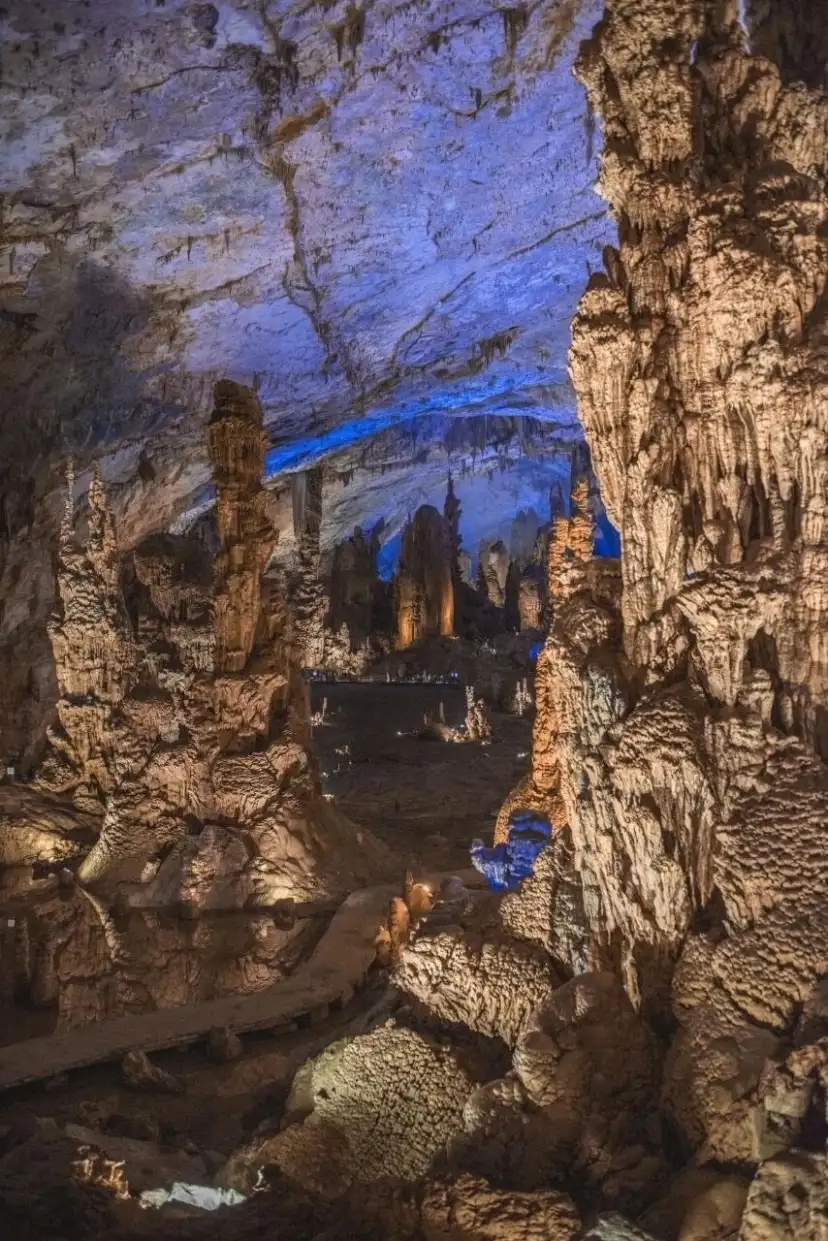
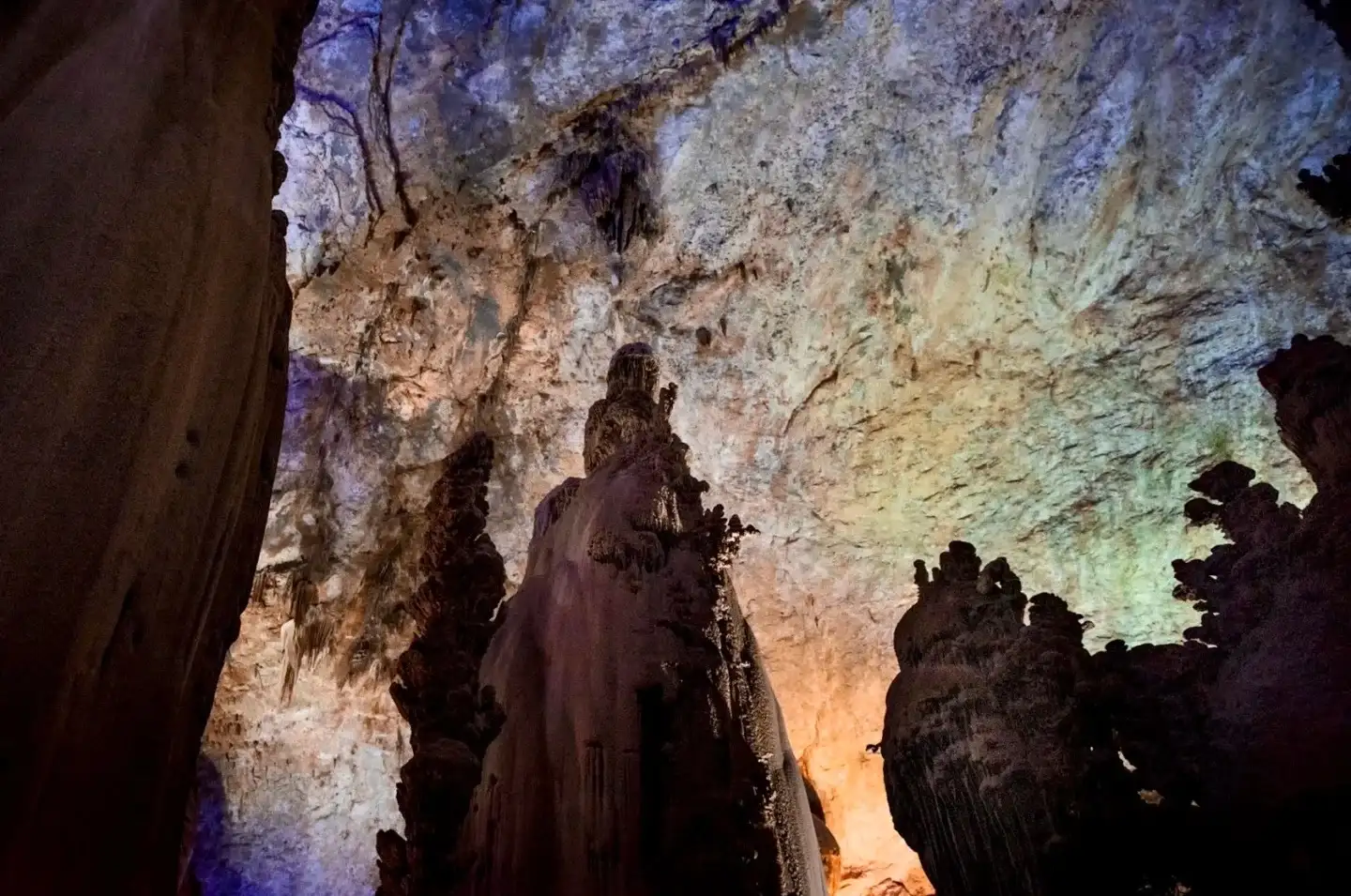
Blue cave ceiling lighting and dense cave deposits in the foreground. Photo:Ven · Original Post.”
Keep the curiosity alive during a cave tour
A nature education trail does not need to assign an activity for every corner. Three sets of contrasts can be selected: the hall and the narrow passage, the hanging formations and the ground, and individual formations and clusters. At each suitable stopping point, comparing just one of these sets allows the eyes to gradually adjust to the scale of the cave. Children enjoy listening to pictographic stories, while adults seek to understand geology by reading explanatory texts—the same tour can accommodate diverse interests.
Foreign visitors should confirm the language of the guided tour before their visit. If the on-site content is primarily in Chinese, prepare a few brief bilingual term cards featuring “stalactites, stalagmites, stone pillars, underground rivers, and fissures” to help families connect the commentary with what they see. The text on the cards should be brief so visitors don’t have to keep looking down to translate while touring; longer information on formation and evolution can be read before the trip.
Photography can also revolve around contrasts. A wide-angle shot illustrates the scale of the hall; a medium shot captures clustered formations; and a close-up captures the contours that truly interest you. The lighting inside the cave affects colors; the vivid hues in the images do not represent the rocks’ full natural palette. When selecting photos, you can note that the scenes were captured under cave lighting and avoid treating the lighting effects as evidence of another type of mineral.
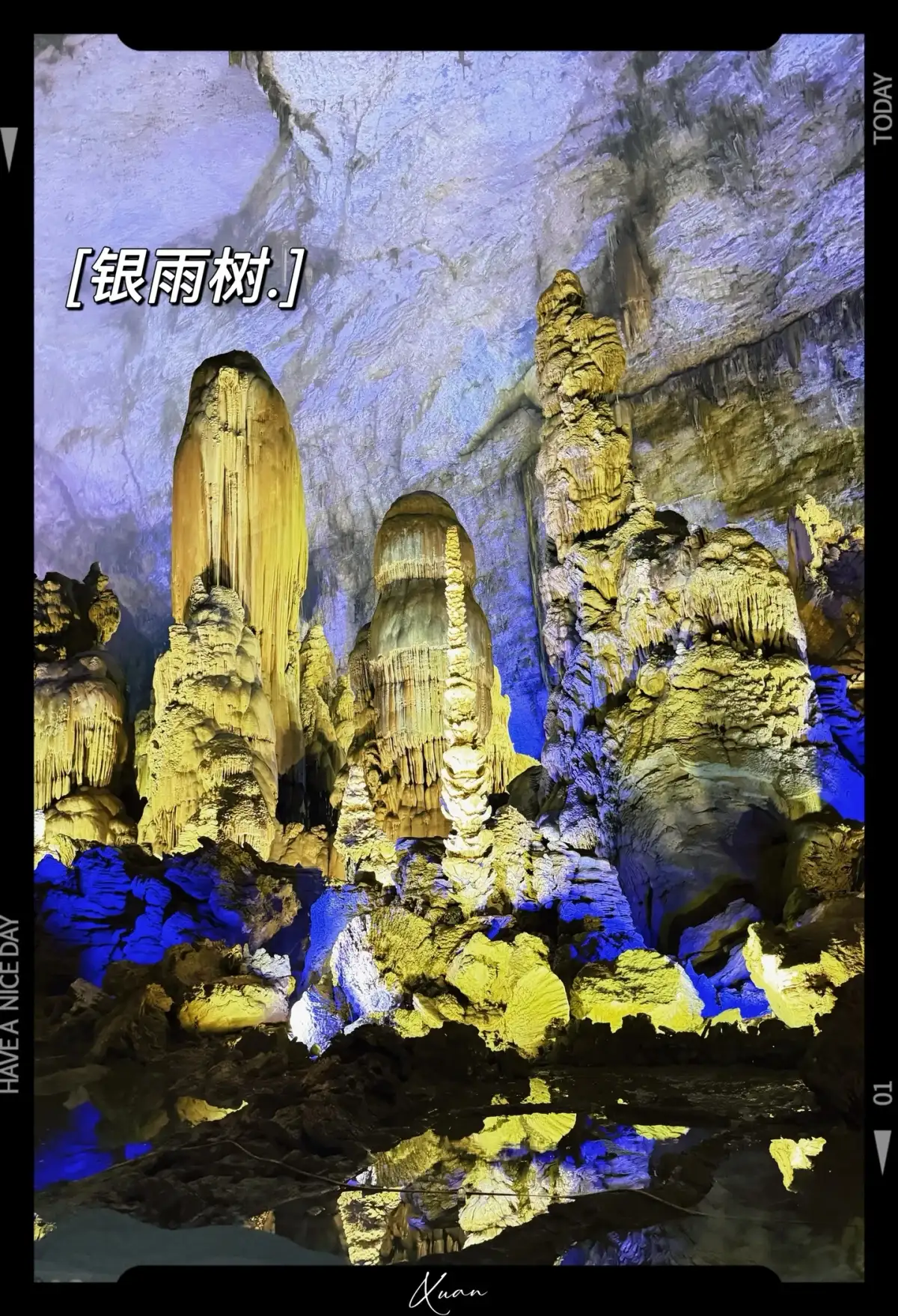
Clusters of slender sedimentary formations under cave lighting; the image features text by Yin Yushu. Photo:Wen Nuan Xuan · Original Post.”
When taking photos, prioritize safety underfoot and unobstructed passage, and keep your equipment as minimal as possible. Continuously adjusting your camera in narrow sections disrupts the rhythm of fellow visitors and affects those behind you. If you need to stay for an extended period, choose a spacious spot permitted on-site and treat other areas as part of a continuous viewing experience. Follow venue guidelines regarding the use of flashlights, flashes, or other equipment; the value of your visit isn’t determined by how many photos you take.
Whether to continue on to the Grand Canyon brings us back to the main theme of the day. Families specifically interested in understanding caves can devote their full attention to the cave itself, then eat and rest after exiting before discussing the spaces they’ve just seen; those wishing to compare the surface world with the underground world should save the canyon for the next part of their itinerary. The combined itinerary proposed by Wen Xuan and Ven involves experiencing each location individually; they cannot decide for you that you must visit both sites.
After the visit, each person can choose one clearly identifiable feature to explain—rather than memorizing a list of landscape terms: a connected stone pillar, a curtain-like stalactite formation, or a passageway leading from a narrow section into the hall. The gift that Zhijin Cave offers travelers is the journey from simply thinking, “The natural sculptures are truly beautiful,” to asking, “How did water shape it this way?” Once the question takes on a tangible form, the underground space will continue to unfold in one’s memory.
Source and Editorial Notes
This article is an original travel analysis compiled by the Dongxing Travel editorial department based on cited materials; it is not a firsthand account by the author. The full text of the original post has not been reproduced; accompanying images are used within the scope of authorization and are credited to the author and the source of the original post. They do not serve as proof of actual travel experiences or services provided by Dongxing Travel.
Ven · The Most Comprehensive “Lazy Traveler’s Guide” to Zhijin Cave and the Grand Canyon in Bijie, Guizhou: Stunning Beauty · Travel Notes; Verified/Organized on: October 3, 2026.
Wen Nuan Xuan · October 6: Zhijin Cave Quick Tour Guide (Time-Saving & Effort-Saving Edition) · Travel Notes; Verified/Organized on: October 3, 2026.
Zhijin Cave World Geopark · Formation and Evolution Model of Zhijin Cave · Official source; Verified/compiled on: October 3, 2026.
Zhijin Cave World Geopark · Introduction to the Geology of Zhijin Cave · Official source; Verified/compiled on: October 3, 2026.
Zhijin Cave World Geopark · Zhijin Cave Stalactite and Stalagmite Features · Official source; Verified/compiled on: October 3, 2026.
Yifu Museum, China University of Geosciences · Stalagmites · Official source; Verified/compiled on: October 3, 2026.
Institute of Earth Environment, Chinese Academy of Sciences · Cave Secondary Carbonate Climatology · Official source; Verified/compiled on: October 3, 2026.