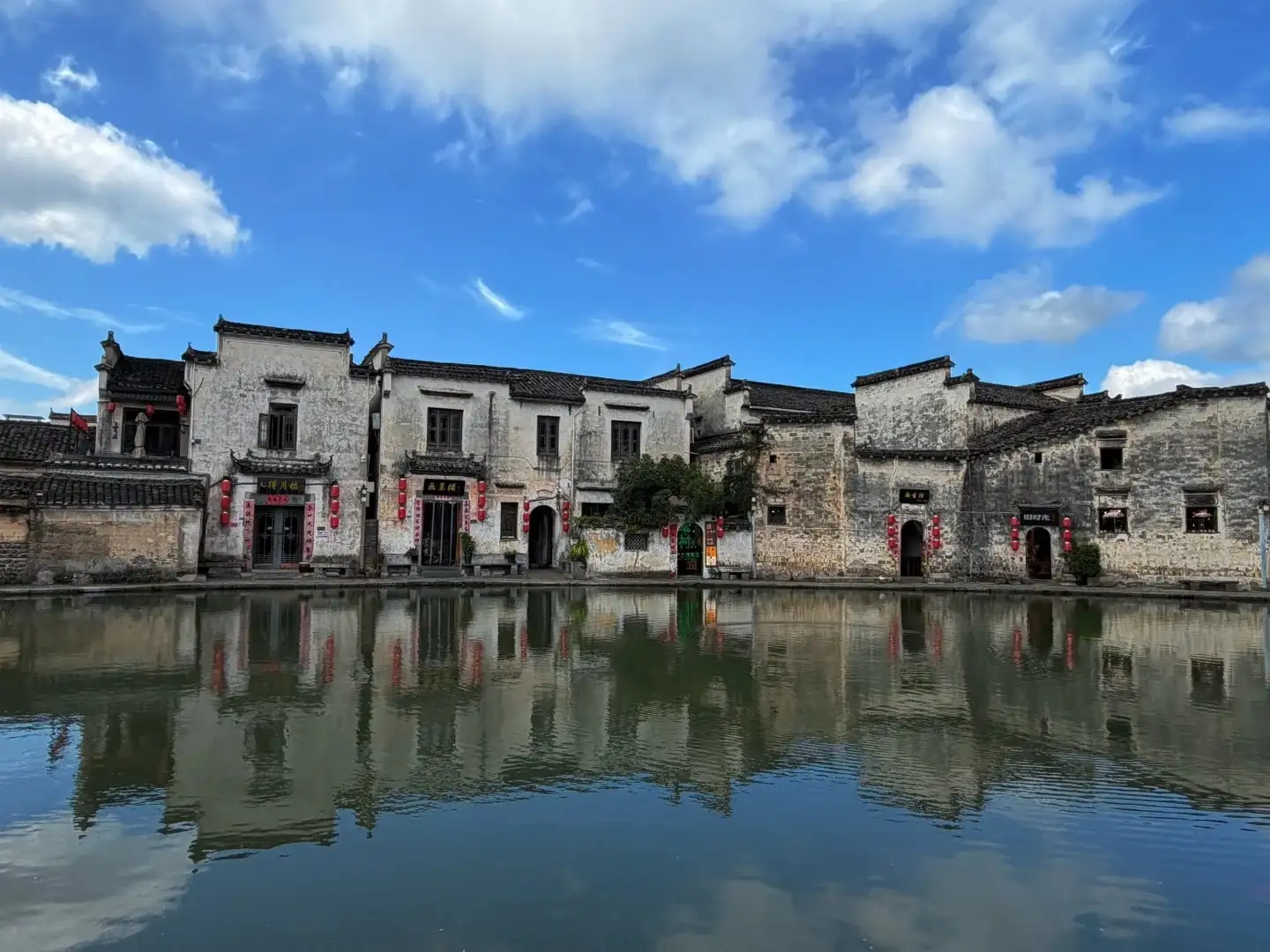
What most easily draws visitors to a stop in Hongcun are the white walls and rooftops reflected on the water’s surface. Once your gaze shifts away from the reflections, you’ll discover another point of entry: a modest water channel winding through the village, connecting the pond before you to the water beyond. The water features of this ancient village are not merely for viewing; they also require ongoing maintenance. Exploring the village through the lens of water adds a layer of daily life and maintenance to the experience—far more than simply seeking out a photo opportunity by Moon Pond Pond.
小红书作者蛋卷蛋挞开心哇把宏村水景与西递建筑作为个人比较,woshidahaoren记录带母亲走访多个村子的高步数经历。本文只采用宏村水系兴趣和家庭移动负担这些线索,具体票务、讲解与活动不沿用。水系走向和清淤背景依据黄山市政府公开资料,现场路线按实际开放安排。
From large bodies of water back to small waterways
According to the Huangshan Municipal Government, the ancestors of Hongcun utilized natural elevation changes to channel water into the village. The water flows through irrigation canals, Yuezhao Pond, Nanhu Lake, and other features, connecting to irrigation systems and downstream streams. This is a man-made water system that cannot be understood merely as a collection of isolated decorative ponds. Travelers can first familiarize themselves with the main points of interest through maps or public guides, then find a section of the irrigation channel to observe, connecting the descriptions with the actual features.
There’s no need to venture into every alley just to fully trace the water’s path. Choose areas that are publicly accessible and where you’re allowed to linger. Observing the spatial relationships between the waterways, roads, and courtyards will naturally raise many questions: What is the water level? How do the roads cross over it? How much space is left between the houses and the water? Specific answers depend on this particular site and the relevant descriptions; you cannot assume that every waterway in the village has the same structure.
Moon Pond and Nanhu; it’s best to start by looking at an overview map and then experience the on-site scale individually. One body of water is situated within a denser village setting, while the other has different connections to the landscape outside the village; your own walking perspective will reveal these differences. When imagining how the water connects them, you should refer to official explanations—do not assume there is no flow simply because the water’s surface appears calm, nor estimate water depth or flow velocity based on photographs.
The “ox” metaphor is a gateway to understanding—not the complete answer.
Introductions to Hongcun often use the metaphor of an ox to describe the water system and the village, referring to the water channels as “ox intestines” and incorporating places like Yuezhao and Nanhu into a unified, vivid framework for interpretation. Metaphors aid memory, but once the names are understood, further questions can be asked: How are these parts actually connected? How does the water flow through different areas? Who manages and cleans them? By considering both the figurative descriptions and the operational processes together, the cultural interpretation becomes more complete.
Children visiting for the first time may really enjoy this analogy. They can start by locating a few points on a public map, then choose a section of the actual waterway to observe. Asking children to describe the direction they’re facing and the surrounding objects is easier than requiring them to remember all the technical terms. If there isn’t enough information on-site to explain a particular spot, feel free to jot down the questions. A tour of an ancient village can embrace curiosity and unanswered questions; there’s no need to take a knowledge quiz at every step.
Photographers can also use this to break away from the typical reflection-based composition. Irrigation canals provide a linear perspective; bridges or other crossing structures indicate movement; and the entrances to houses relative to the road surface convey a sense of scale. Selecting one shot to capture the overall scene and another to document the intersection of the waterway and the road will convey more about the village than many similar photographs of water surfaces. Clearly label every location you photograph, and do not use the same terms interchangeably for irrigation canals and ponds.
water feature requires dredging
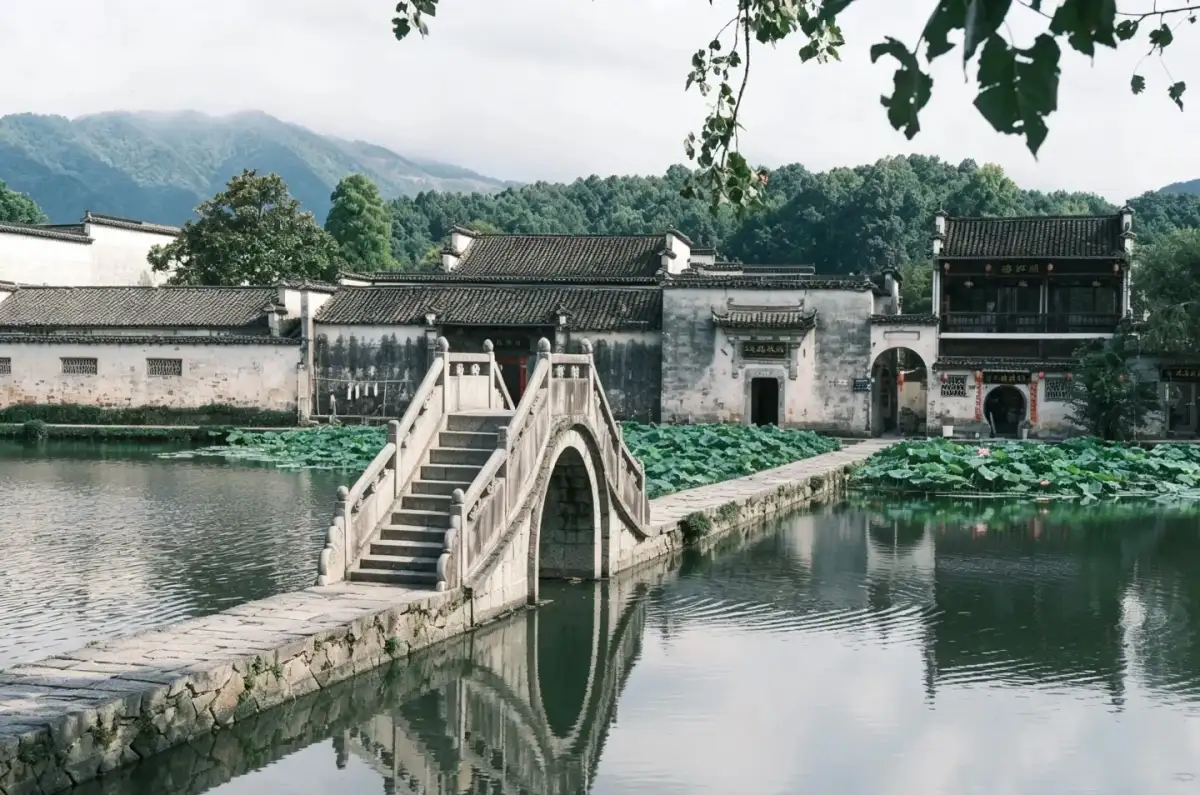
The Stone Bridge over South Lake in Hongcun and Huizhou-style dwellings. Photo:woshidahaoren · Original Post.
In 2025, the Huangshan Municipal Government reported on a dredging operation for Hongcun’s water channels, demonstrating that this ancient water system still requires ongoing maintenance. Dredging is not an irrelevant task confined to photographs; it is essential for ensuring that water can continue to flow through the village. Through this example, visitors can come to understand that heritage preservation occurs not only when restoring an old house, but also in the day-to-day management of waterways and the surrounding environment.
When viewing related exhibits, look for explanations regarding the maintenance, management, or historical use of the water system to see how its operation is described. If you happen to see staff at work, observe from a distance within permitted limits; do not enter construction or cleanup zones. The 2025 report is a record of work that has already taken place; it does not imply that the same activities will be visible every day. The value of understanding the process does not depend on encountering a live demonstration on any given day.
The name of this historic water system can easily lead people to overlook its ongoing connection to residents’ daily lives. Access to the water’s edge and the use of the houses constitute real-world spaces; visitors must not climb over railings, move protective coverings, or place objects in the water solely for the sake of taking photographs. To illustrate how the system functions, one can rely on diagrams, text, and observations made in public areas. Preserving the site’s normal state of use actually helps reveal the continuity of this heritage.
When traveling with elders or children, you can condense the Hongcun itinerary into two segments: view the village as a whole from a major body of water, and then follow a confirmed, accessible alley to locate the irrigation channels. Add a break in between, and you’ll have a clear thematic focus. Exploring the water system doesn’t require visiting multiple villages in a single day. As woshidahaoren’s high step count experience reminds us, even short distances on a map can add up to make for a very long day.
If your companions are in good physical condition, you can add a visit to an actual open residence or public building to observe interior spaces beyond the waterway theme. This way, with each addition, you’ll know exactly what it contributes to the tour; if you simply want to visit every well-known address, the main waterway route will easily be interrupted by constant searches for entrances. The clearer the route’s objectives, the easier it is to make reasonable adjustments when encountering crowds or rain. Is the guided tour worthwhile? For those unfamiliar with the water system and architecture, an explanation that clarifies the specific relationships can be very helpful. When selecting a tour, understand the services offered, the language used, and the cost, and determine whether it can address your specific questions. The free admission conditions and prices listed in my personal notes may only apply to specific services at specific locations at that time; this article does not treat them as universal rules. Guided tours aid understanding, but actual evidence still comes from on-site observations and reliable sources.
Observing water offers different insights depending on the light and whether it’s a rainy day.
—which depends on the day’s wind, light, and viewing angle; waterways at the village’s edge may offer different textures and lines. If you can’t capture the reflections you’re looking for, focus instead on the positioning of walls relative to the water, the structures crossing it, and the land use surrounding the waterway—there’s no need to consider the entire outing a failure. While your photographic focus has shifted, the theme of the water system can still be explored.
During rain, first narrow your scope based on actual walking conditions and management restrictions to avoid combining slippery roads with vantage points near the water. To explore water routes, you can stop at suitable public locations to read materials, or link a tour of an indoor building to the context of the water system. Do not venture into areas where passage cannot be confirmed just to track the flow. Understanding man-made water systems often relies on accurate maps and a clear observation.
When leaving Hongcun, bringing back a photo of a large body of water, a photo showing the location of a water channel, and a maintenance log will allow you to tell a story that goes beyond simply taking photos of reflections. How water enters the village, how it flows past ponds and roads, and how it continues to function through management are a set of interconnected questions. The white walls and black-tiled roofs thus gain a dynamic backdrop, and Hongcun’s beauty becomes easier to understand as an environment that remains in continuous use.
Sources and Editorial Notes
This article is an original travel interpretation compiled by the Dongxing Travel editorial team based on cited materials; it is not a firsthand account by the author. The full text of the original post has not been reproduced; accompanying images are used within the scope of authorization and are credited to the author and the source of the original post. They do not serve as proof of actual travel experiences or services provided by Dongxing Travel.
Egg Rolls, Egg Tarts, and Happiness! · Xi Di, Hongcun, and Chengkan: How to Choose? · Travel Notes; Verified/Organized on: October 3, 2026.
woshidahaoren · Hongcun-Xidi-Chengkan · Travel Notes; Verified/Organized on: October 3, 2026.
Huangshan Municipal People’s Government · Hongcun Town: Dredging the “Ox Intestine” Canal to Welcome the Lunar New Year · Official sources; Verified/compiled on: October 3, 2026.
Huangshan Municipal People’s Government · Hongcun Online Tour Introduction · Official sources; Verified/compiled on: October 3, 2026.