East Travel Editorial Department · Travel Diaries and Pre-Trip Reading
Jinci is best explored by following the water as your guide
Jinci is located on the outskirts of Taiyuan, so it’s best not to treat it as a brief stop you can squeeze into your downtown itinerary. Travel time, finding the actual entrance, and touring the structures all take time; setting aside a dedicated visit makes it easier to appreciate the interplay between the wooden architecture, ancient trees, and spring water. Upon arrival, first identify the Water Mirror Terrace, the Hall of Offering, the Fish Pond Flying Bridge, and the Hall of the Holy Mother using the day’s guide, then arrange them along a structured viewing route.
This pre-visit guide begins with water, as it creates a tangible connection between the various structures. When you see a body of water, don’t rush to photograph the reflections; instead, observe whether it lies beneath a bridge, in front of a hall, or beside a tree, and note how the shoreline connects with the paths. The buildings at Jinci do not all date from the same era; when visiting, identify them based on specific descriptions to avoid lumping all structures—and the later conservation efforts—under the blanket term “millennia-old architecture.” Choosing a clear main route within the grounds will also help you avoid the wasted energy of turning back whenever you encounter a fork in the path.
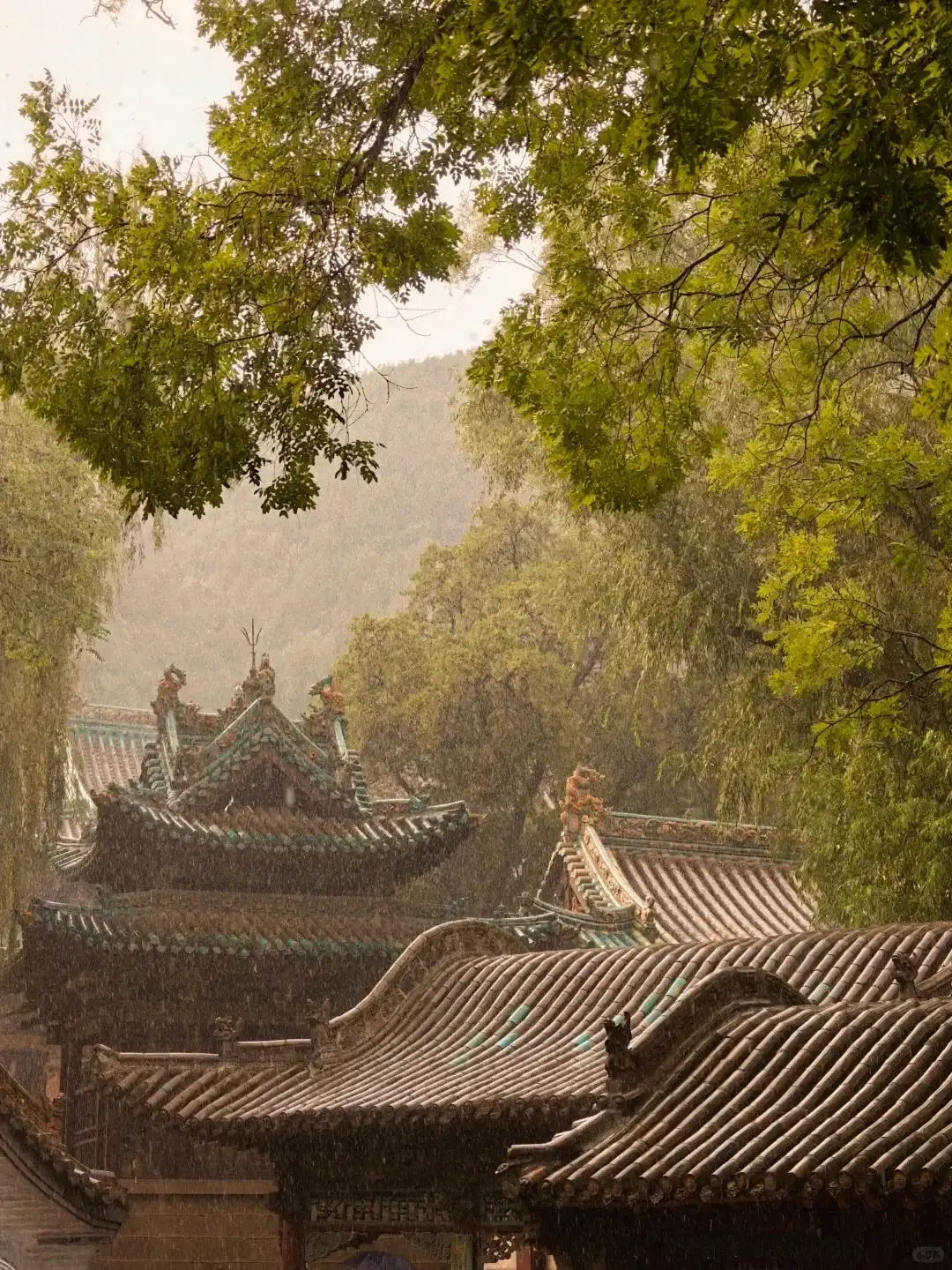
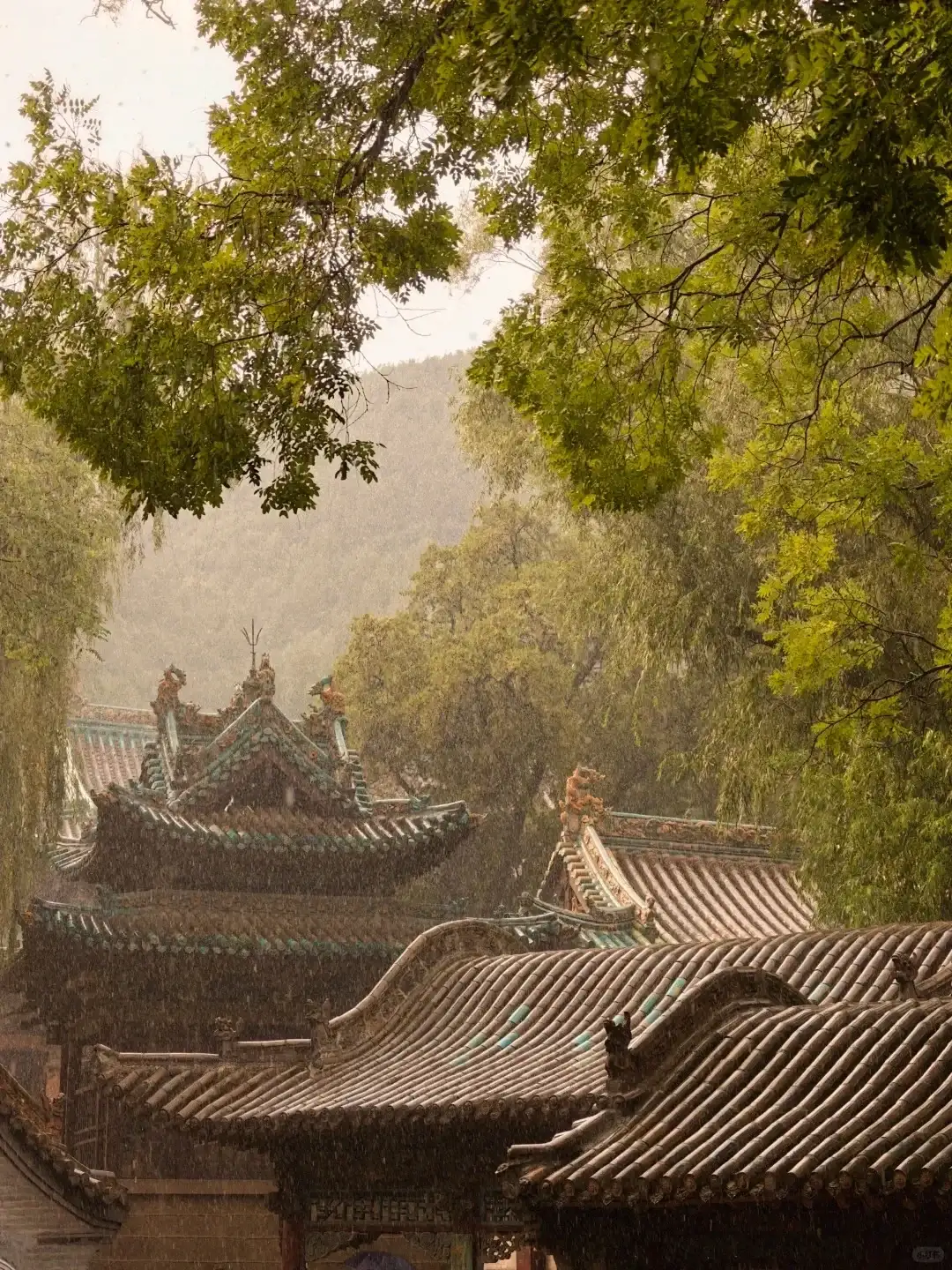
The overlapping roofs and trees of Jinci Temple in the rain. Image source: Xiaohongshu · Shanxi Provincial Department of Culture and Tourism
in front of the Water Mirror Terrace to get your bearings first
When entering the main viewing sequence from the Shuijingtai area, there’s no need to rush straight to the Hall of the Holy Mother. First, stand on a courtyard path that doesn’t obstruct traffic and observe whether the buildings ahead rise gradually or are divided into sections by plinths and gates; then look back to identify the entrance—this will help you internalize the direction of the main route. You can examine the decorations and inscriptions on the Water Mirror Terrace up close, but understanding its specific purpose and historical period requires reference to the on-site explanations; the character for “water” in its name should not be interpreted as the sole origin of the entire landscape before you.
After walking a short distance forward, look back at the same spot—the depth of the courtyard will become clearer than at first glance. This before-and-after comparison requires no additional attractions but transforms the buildings from a collection of unrelated names into a coherent sequence. As a result, you can take your time exploring Jinci, and the historical context will more easily align with the specific locations.
in front of the Hall of the Holy Mother, where the colonnade brings the roof right before your eyes
Viewing the Hall of the Holy Mother can be divided into two steps. First, view the overall structure from the courtyard—the width of the roof, the eaves, and the pedestal together form a stable silhouette; then, within the open viewing area, step closer to observe the layering between the columns and beams. The wooden carvings of coiling dragons in front of the hall are ideal for observing the curves and shadows: as the dragon’s body winds around the columns, its eyes reveal the continuity of the carving as you move up and down. For specific dates and restoration information, refer to official or on-site sources; do not judge authenticity based on color alone.
It’s more interesting to observe where a single column fits within the entire row than to simply take a photo of it. While individual carvings catch your eye, the repeating colonnade draws your attention back to the architecture as a whole. These two perspectives complement each other, helping you avoid the limitation of remembering only a single dragon. Rainy or overcast days don’t necessarily obscure details—the soft light may even make the shadows and highlights on the wood more even—but slippery steps and crowded entrances should be your top priority. When it’s darker under the eaves, pause for a moment to let your eyes adjust.
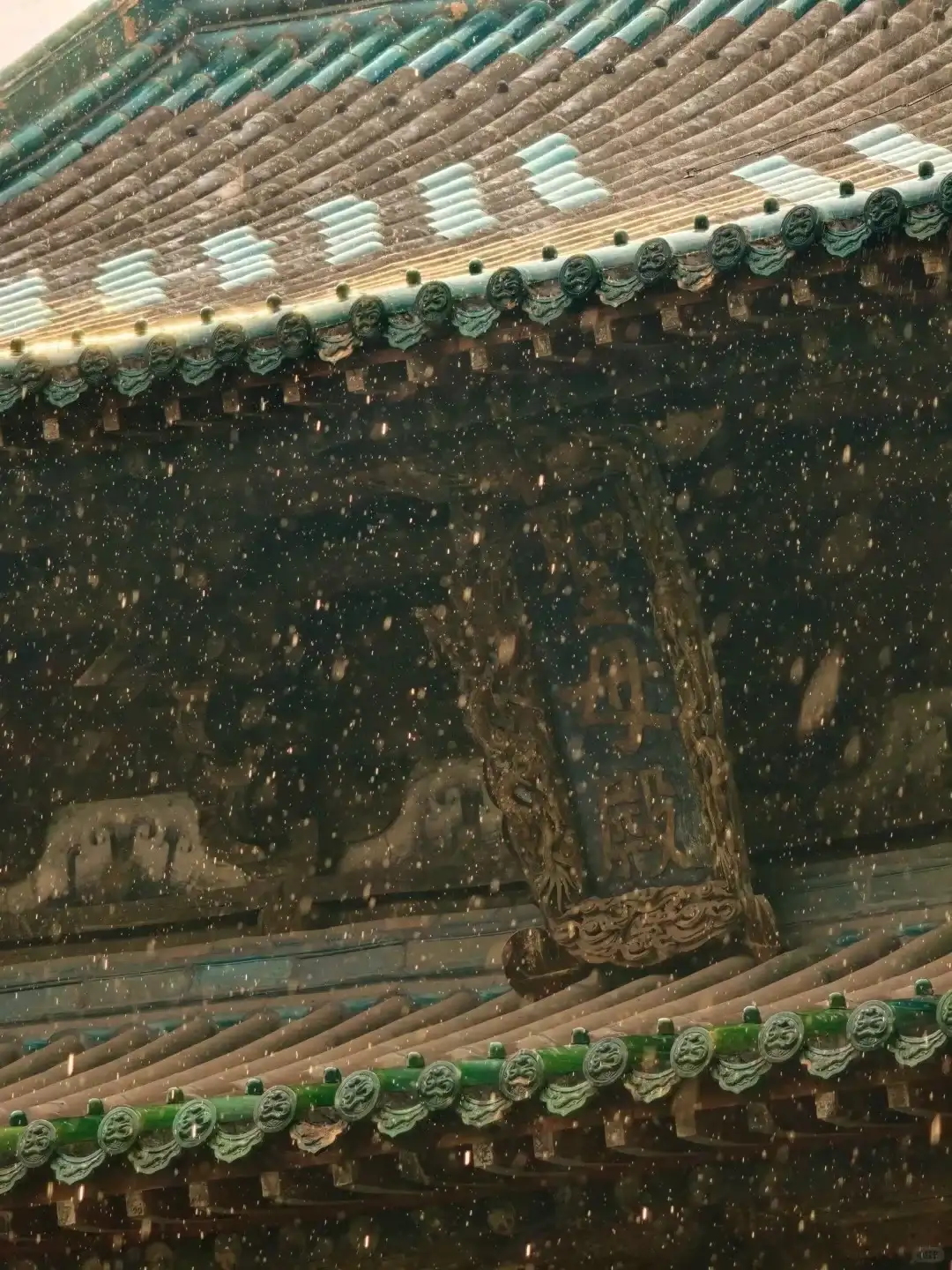
The plaque of the Hall of the Holy Mother and the eaves in the rain. Image source: Xiaohongshu · Shanxi Provincial Department of Culture and Tourism
Yuzhao Feiliang Bridge—the bridge itself serves as a waypoint for choosing your direction
The design of the Yuzhao Flying Bridge ensures it does more than simply carry people to the opposite shore. Its cross-shaped layout allows visitors to enter the space from the front, back, left, and right simultaneously, making the bridge and the pond integral parts of the viewing experience in front of the hall. Standing at a designated viewing spot, first take in the orientation of the bridge deck, then observe how it relates to the Hall of Sacrifice, the Hall of the Holy Mother, and the paths on either side. While the bridge’s name is evocative, viewing should still begin with its actual structure, situating each direction within the architectural relationships before your eyes.
You don’t need to explore every visible turn to understand the bridge. Conservation restrictions may limit access, and you should leave room for others on the bridge deck. You can compare the heights of the pond’s edge, the supports, and the bridge deck from the side, noting which parts are in shadow. This kind of observation transforms the structure’s peculiar shape into a clear impression: the water remains level below, while the bridge deck connects several pathways running in different directions, thereby creating an open forecourt for the wooden structure.
the Xian Hall and the open space in front of it to slow down your viewing pace
from the larger halls toward the Xian Hall, shifting your focus to the sense of openness and the surrounding spaces. How the architecture guides visitors toward the rear, what kind of openings are left between columns and walls, and whether the light under the eaves differs from that in the courtyard—these are all details that can be observed without specialized knowledge. Pausing at a single spot to observe the flow of movement—both incoming and outgoing—allows for a deeper understanding of the site’s layout than simply keeping your head down and following the directional arrows.
The charm of Jinci lies in the seamless transition between different scales, not just in its most famous structure. Take a look at each location separately first, then return to view them together; you’ll find that their relative positions convey the scene more effectively than a single photograph. When documenting your observations, note specific locations and materials; don’t rush to apply broad adjectives like “solemn” or “exquisite.” Eaves, steps, bridges, and water each serve distinct functions, and your descriptions should reflect these distinctions. Focus on examining just a few specific spots along the way; the remaining structures will then serve as the backdrop for understanding the whole.
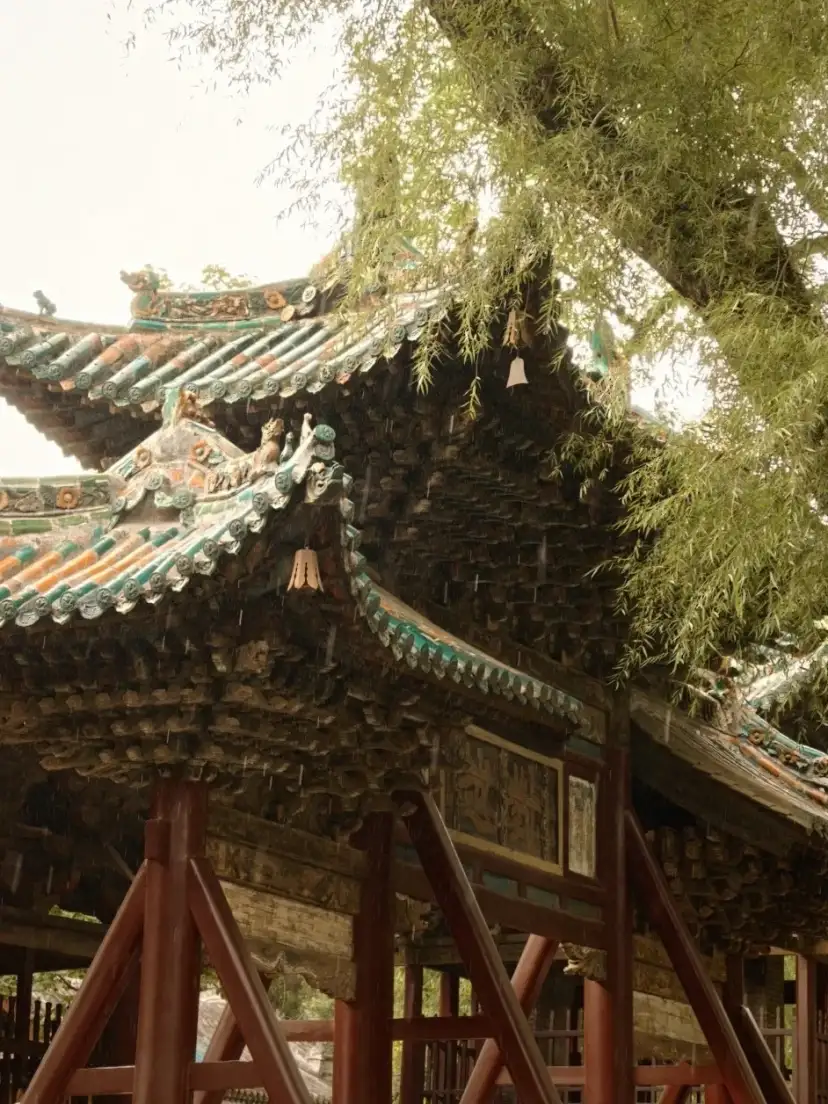
The layered composition formed by the eaves of Jinci’s wooden structures and the trees. Image source: Xiaohongshu · Shanxi Provincial Department of Culture and Tourism
The spring and ancient trees—this is the time to take a closer look
the Nanlao Spring area, where you can shift your focus from the architecture to the sounds and the flow of water. As the water flows past the rocks, the play of light and shadow and the ripples change with your perspective; pavilions, channels, and trees organize the area around the spring into smaller, intimate spaces. You can learn about the spring’s name and legends from the information signs, but do not treat the water quality, constant temperature, or purported health benefits as unverified claims. The spring’s scenery is worth seeing, but that does not mean you should touch the water, collect it, or drink it.
Ancient trees, however, reveal a different kind of time on their surface: the furrows in the bark, the slanted trunks, and the outstretched branches remind us that growth is not always neat and symmetrical. Tree age, names, and historical connections should be determined by on-site signage; do not guess a tree’s age based solely on its appearance. By staying outside the barriers and viewing the scene from varying distances, the relationship between the trees and the halls will become apparent. Branches partially obscuring the roof are not a hindrance to photography; they are, in fact, an integral part of the Jinci landscape. Changing your perspective reveals new layers of depth.
Read the rain from the rooftops, and read the light from beneath the trees
the spot featured in your chosen rain scene photo—where leaves partially obscure the sky, rooftops layer upon layer, and raindrops soften the sense of depth. This composition offers an entry point distinct from standard frontal architectural shots: first observe the edge where the leaves meet the eaves, then trace the direction in which the roof tiles extend. Colors appear deeper in a damp environment, and the light is uneven; while the photograph can suggest a way to view the scene, it cannot guarantee that the same effect will be replicated during your visit.
a safe, open path in the garden—this is often more rewarding than rushing to secure a specific vantage point. As you pass beneath the trees, observe the leaves up close, then look up at the distant roofs; this allows your body to move between different perspectives. Rainy weather also presents practical limitations: stone surfaces, steps, and fallen leaves can be slippery, and outdoor resting areas may not be suitable for prolonged sitting. By preparing waterproof gear and appropriate footwear to minimize the distance you need to cover, you can still fully appreciate the theme created by the interplay of wooden structures and vegetation.
The colored sculptures should be approached through their poses rather than their narratives
If the Holy Mother Hall is open to the public that day and allows viewing of the colored sculptures inside, start by selecting a statue with a clearly defined posture. Observe how the direction of the head, the drapery of the robes, and the hand gestures work together to form the body’s silhouette, then compare it with other nearby statues. It is important to distinguish between visual form and historical interpretation: a smile or a leaning posture cannot prove the figure’s actual emotions or experiences at the time. The era, role, and context of creation should be supplemented by the exhibition displays and reliable commentary.
the shade to let your eyes adjust; avoid using flash and do not lean over the railings to get a brighter shot. Since fellow travelers may have varying levels of interest in the colored sculptures, agree on a set departure time—this allows those who wish to examine the details closely to have the space they need, while giving others a chance to rest briefly on the open courtyard paths. For international visitors, it’s especially helpful to determine in advance whether you’ll need a guided tour in your language—an overabundance of technical terms can obscure the actual details right before your eyes. If a particular area is closed that day, simply appreciate what you can see from the outside; don’t substitute online photos of the interior for an actual visit.
Suburban transportation: Be sure to plan your return trip in advance
Confirm transportation options between Jinci Temple and downtown Taiyuan before departure, especially for the final leg to the entrance and the return trip after your visit. Arrangements vary for public transportation, driving, and pre-booked vehicles; it’s unwise to assume fixed schedules or travel times based on a single online account. Save the Chinese name of the entrance and your return destination on your phone, and agree on a meeting point with your companions—this way, you won’t need to figure out your route on unfamiliar roads once the tour is over.
Official channels should be consulted for reservation and access information; verify ID requirements, last entry times, and any temporary maintenance closures. If you plan to visit other sites in Taiyuan that day, first assess how much energy you’ve already expended on round-trip travel and exploring the architecture; reserving just one additional stop for the afternoon typically creates a clearer memory than cramming in multiple distant attractions. The spring foliage, summer shade, autumn colors, and winter branches of Jinci Temple each offer their own unique perspectives; flowering seasons and snow cover need not be prerequisites for your visit. As you leave, reflect on the connections—how the water supports the bridge, the bridge leads to the hall, and the columns support the roof—and this path will reveal its own narrative.
Further Reading and References
Compiled and organized by the Dongxing Travel Editorial Department based on publicly available travel notes and listed information. Intended for pre-trip reading; this is not a personal account of a visit. Please verify opening hours, transportation, reservations, and service arrangements according to your actual travel dates.
Shanxi Provincial Department of Culture and Tourism · When You Encounter an Autumn Rain at Jinci
Hebei Provincial Market Supervision Administration: The Ancient Charm of Jinci
What can you read without architectural vocabulary?
Start a Jinci Temple visit with Saint Mother Hall details: from a permitted stopping point, see how the columns support the eaves, then compare the distances between timber structure, courtyard and water. Select one dragon-carved column and one labelled sculpture rather than naming every component. Recording position and posture gives you specific clues to revisit.
Making water part of the route
The Fish Pond Flying Bridge is both an object to observe and a way to understand how paths cross water. Read its form from outside before using permitted routes, then slow down around springs and old trees. In rain or cold weather, pay attention to footing. Allow separate time for the journey back towards Taiyuan rather than compressing the visit into the last moments before departure.
Planning references
Planning reference: Jinci Temple visit 1