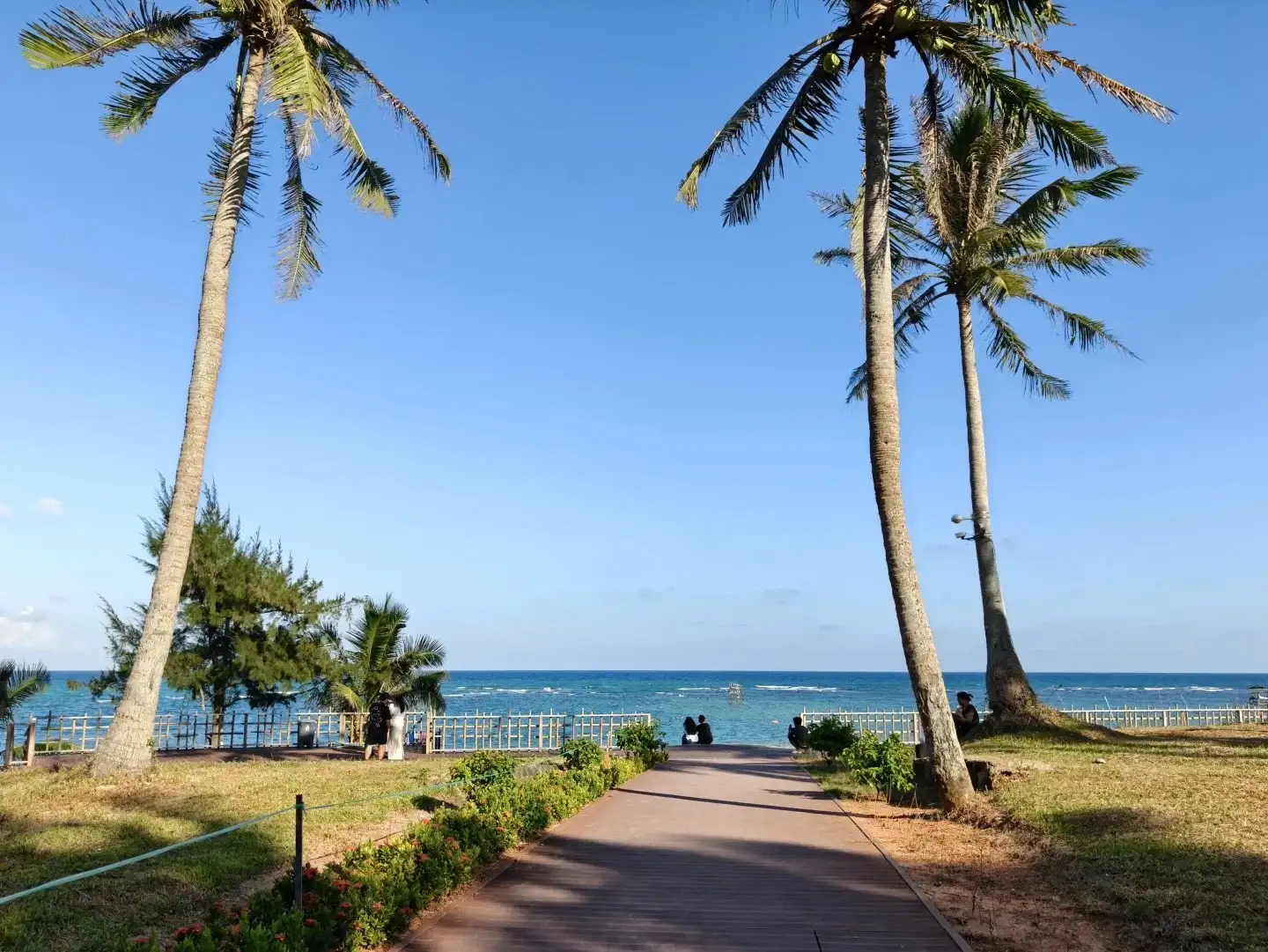
When viewing coconut groves in Wenchang, the eye naturally rests first on the interplay between the coconut trees and the sea. But if you shift your perspective to ask different questions, the landscape reveals much more: how is the land beneath the trees used? Where does a coconut go once it falls from the tree? How do the roads cutting through the grove connect residential and productive areas? Coconut palms provide the iconic shapes found in travel photos, but they are also integral to local agriculture and processing. Recognizing this layer transforms a brief drive-by into a meaningful observation.
小红书作者爪爪记录东郊椰林沿途的景色,认为部分路上停留比导航终点更吸引自己。这个个人偏好提醒旅客看见连续景观,但不能理解为每一处路边都能停车或进入。海南省农业农村厅二〇二六年介绍文昌椰子产业,将东郊等镇的连片椰林、加工与林下利用联系起来,为阅读这片景色提供了现实背景。
The first layer of a coconut grove consists of the arrangement of the trees and the light.
When viewing a coconut grove from a public road or accessible walking area, start by noting the spacing between trees, their height, and the direction of their canopies. A continuous row of trunks creates a sense of depth, while the road surface, buildings, or the distant sea alter the composition’s layers. When you see a curved trunk, simply describe its shape; there’s no need to judge its age or the reasons for its growth based on a single photo. Refer to the educational materials available on-site to correlate the tree’s morphology with the accompanying descriptions.
When taking photos, you can also observe from three different distances. From a distance, look at the grove and its surrounding environment; from a medium distance, observe how the tree trunks and paths intersect; and up close, examine the identifiable materials and botanical details in the open areas. Each distance addresses different questions; only a close-up may fail to reveal the scale of the coconut grove, while only a distant view may lead one to mistake it for a uniform expanse of green. By changing your viewing angle along the same accessible path, you can capture a wealth of details.
Coconut palms by the sea and those lining the roadside serve different visual functions. The former naturally form the foreground of the shoreline, while the latter emphasize the sense of continuity as one walks into the grove. Documenting both separately helps illustrate the changes experienced during a short journey. Whether a scene is worth stopping at depends on both the physical space and transportation conditions; a pleasing view does not necessarily have an accessible entrance for parking and walking.
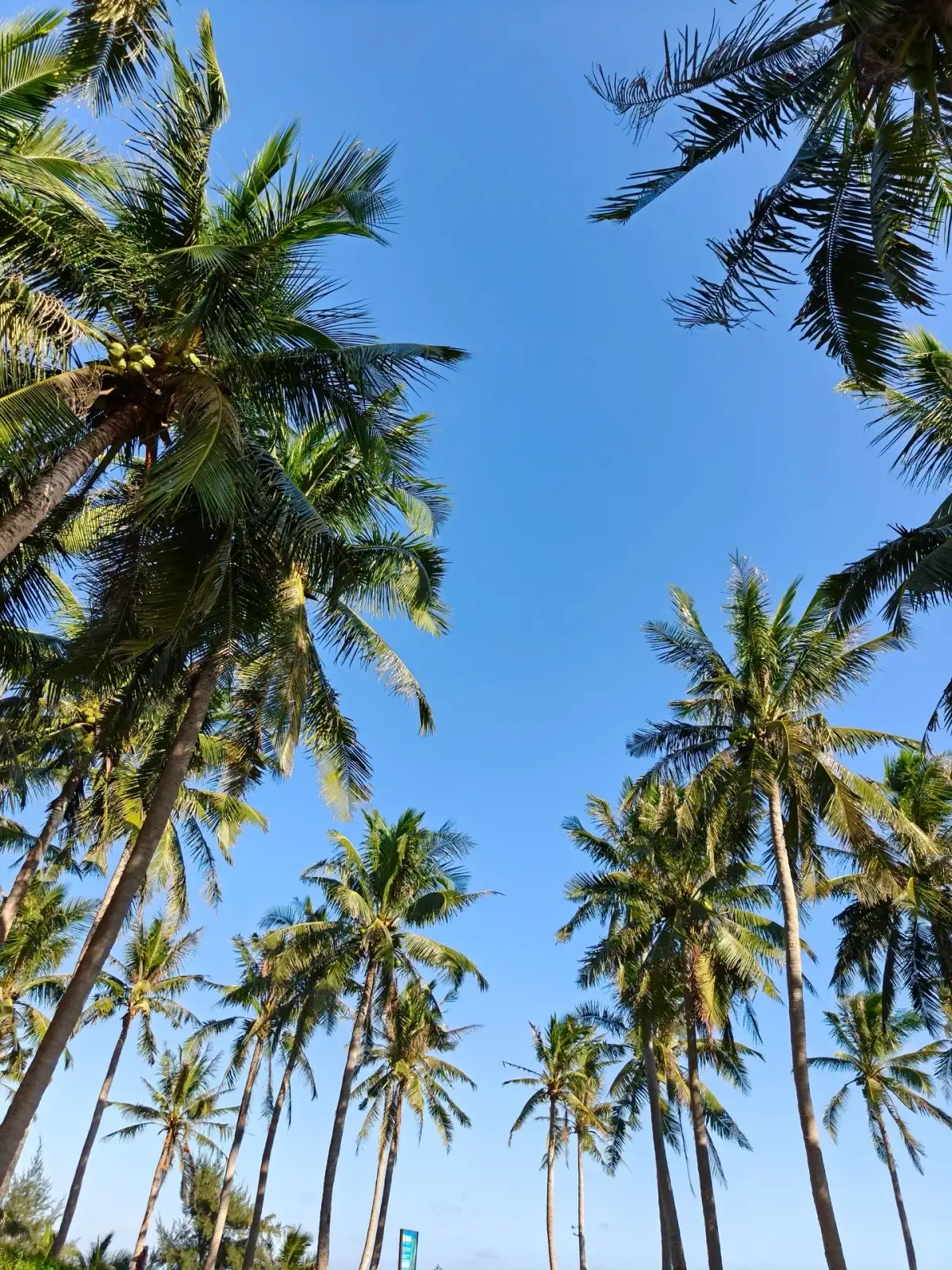
Looking up at the canopy of the Wenchang coconut grove. Photo:Zhuozhuo · Original Post.
Second Level: Work Conducted Under the Canopy
Reports from Hainan’s agricultural authorities mention that Wenchang is exploring ways to utilize coconut groves, such as raising chickens under the trees and intercropping fruits and vegetables. This gives the space beneath the trees a purpose beyond that of a purely ornamental green space. Travelers observing from designated viewing points may come to realize that agricultural landscapes are composed of multiple layers: the tree canopy above, the land between the trunks, and the adjacent roads all function in tandem. The specific management practices employed in a given grove still depend on on-site information or explanations from the operators.
If you spot chicken coops, farm tools, or signs of cultivation, these primarily indicate agricultural activities. To understand their purpose, feel free to ask when it’s convenient for the owner; when entering, stay within the designated areas. Moving farm tools to a more photogenic spot or stepping into cultivated areas in search of a better composition can disrupt the workspace. The charm of agricultural landscapes lies precisely in their authentic use; observation should not require the site to be rearranged for visitors.
Parents can use this prompt to guide their children’s exploration of the coconut grove: “Besides the trees, what else do you notice?” A ditch, a section of fencing, or a cleared patch of land might lead to questions about water, management, and access. Answers should be based on actual observations and explanations. Encouraging children to identify different levels of land use is easier to implement than promising they’ll definitely pick coconuts or touch animals—and it shows greater respect for the work of local residents.
Part Three: How Coconuts Make Their Way from the Farm to the Table
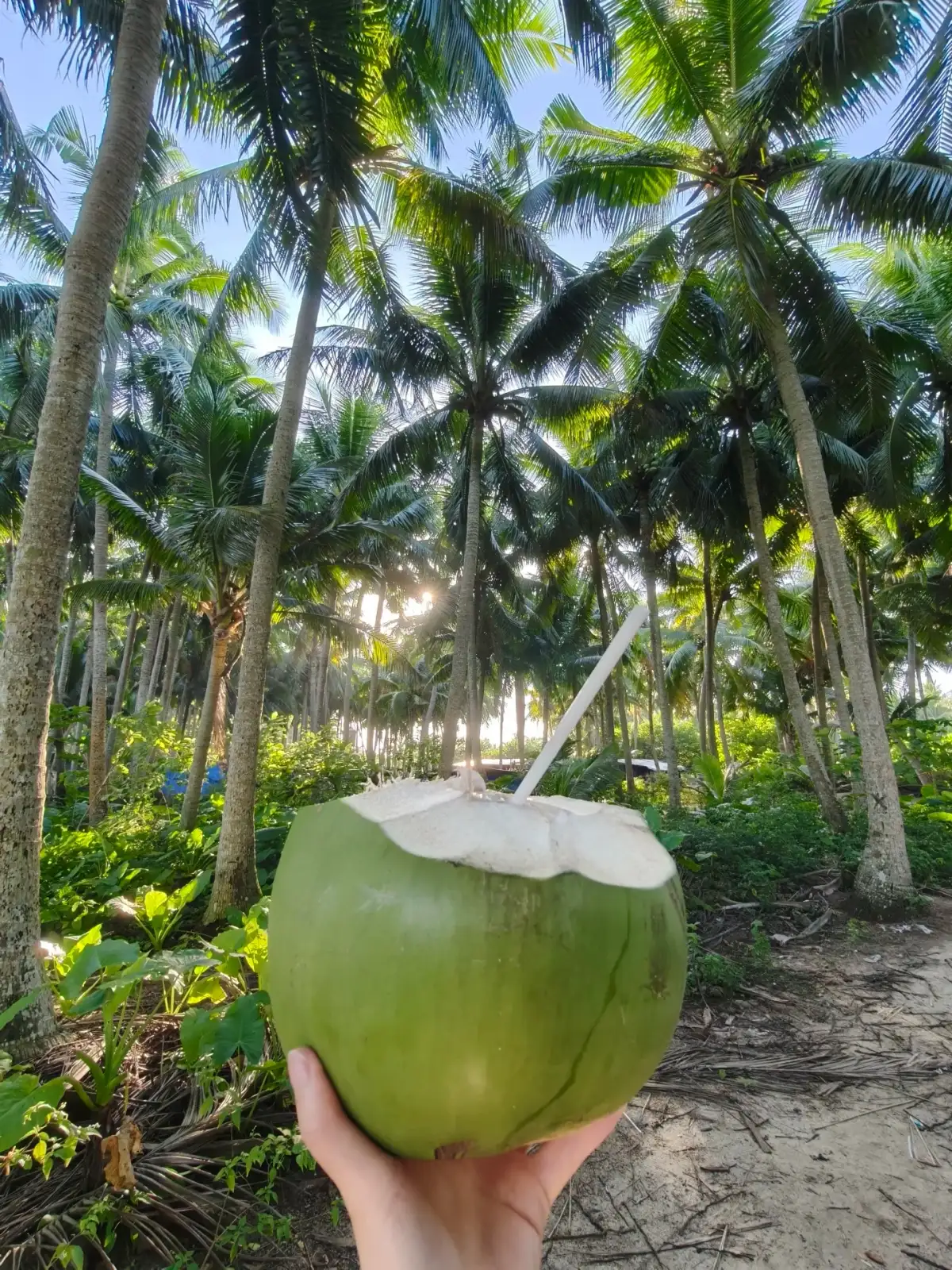
A fresh coconut held in front of the Wenchang coconut grove. Photo:Zhuozhuo · Original Post.
Official reports present Wenchang’s coconut raw materials, corporate processing, and industrial development as an integrated whole. Visitors can gain insight into this process over a meal: note which parts of the coconut are used in the coconut-based dishes on the menu; determine whether beverages are prepared on-site or are pre-packaged; and check the origin labels on packaging. The more specific the questions, the less the coconut becomes merely a symbol of tropical charm—and the more it connects ingredients, production, and sales.
When purchasing, you can learn the product name, specifications, and processing methods to decide whether to consume it on the spot or take it with you. Fresh foods and packaged products have different storage and transportation requirements, so they should not be handled the same way. International travelers should also consider departure and destination entry requirements when deciding what to bring; you cannot assume an item is suitable for cross-border transport simply because a store is willing to sell it. Choosing to enjoy the experience on the spot often makes packing much simpler. When asking about coconut dishes at a restaurant, you can also mention your personal dietary preferences. Just because a dish’s name includes “coconut” doesn’t mean it contains no other ingredients—soup, meat, or seasonings may all be part of the same dish. Those who enjoy exploring flavors can first ask about the preparation method, then pay attention to the tastes and aromas they can recognize. Shops share information about their own products; there’s no need to assume that one establishment’s preparation method represents Wenchang’s sole traditional practice.
The East Suburb Coconut Grove is well-suited for combining with other activities in Wenchang, but the itinerary should be planned based on that day’s transportation arrangements. If your lodging is far away, first determine the round-trip route and meal locations, then decide how much time to allocate to the coconut grove; if you’re already nearby, choose a main stop you’re certain you can reach and add a short observation segment. The goal of this article is to explore the agricultural landscape; there is no need to visit every attraction in the city at once.
Does the fact that there are sights worth seeing beyond the navigation destination mean you can get out of the car at any time? The “spontaneous stops” mentioned in Zhaozhao’s notes are based on personal experience; in practice, you should find a location where parking is permitted before walking into accessible areas. The official introduction to Hainan’s Island-Circling Tourist Highway lists amenities such as viewing platforms and parking facilities; travelers can use this information to find official service details. The presence of such amenities does not mean that every section of the shoulder is a parking area, nor does it guarantee that every facility is currently providing the same services.
When choosing a walking route, it’s more practical to consider the ground conditions, shade, and return path than to simply count the number of coconut trees on a map. Those accompanying elders can shorten the drive to the stopping point, allowing observations to begin from a comfortable vantage point; photographers, meanwhile, can circle the same group of trees to compare angles and distances. Even a small area can offer a rich experience; the depth of a journey doesn’t have to be measured by how far you walk.
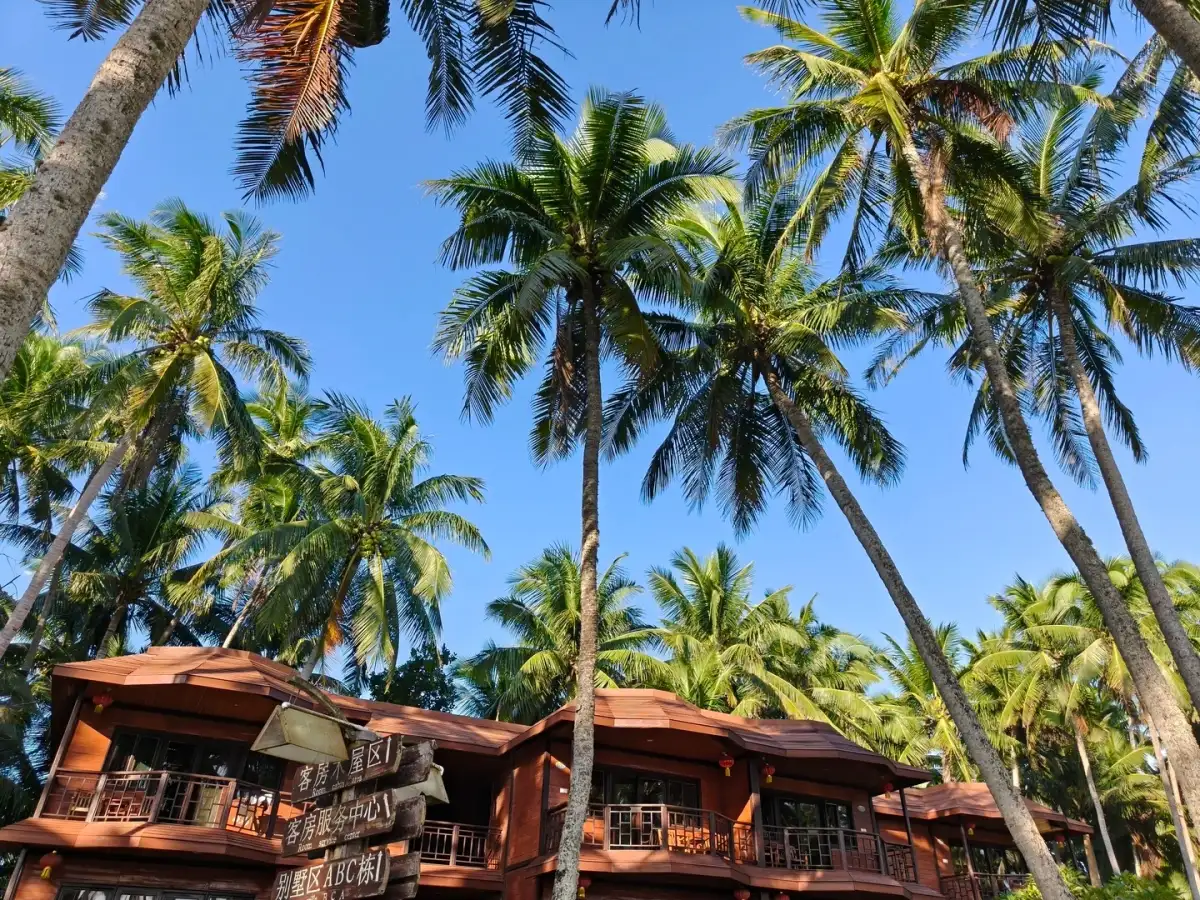
the wooden house in the Wenchang coconut grove. Photo:Zhuozhuo · Original Post.
Weather conditions also alter how this landscape is perceived. On sunny days, tree shadows are distinct, while on cloudy days, the layers may appear softer; rain or strong winds can affect your ability to stay, so please base your specific plans on local weather and management information. Don’t treat the sunlight and ocean colors seen in others’ photos as a mandatory outcome for your own shots. Consider setting aside a confirmed plan for indoor dining or a short stop so that the day still includes content related to the coconut industry.
Before leaving, describe the scenery more accurately.
When sharing photos, it’s clearer to specify whether you’re viewing a roadside coconut grove, a publicly accessible area, or a commercial space open with permission, rather than simply labeling them all as “hidden gems.” If you’re simply looking at a production site from a distance, don’t describe it as a tourist attraction open to the public. Accurate descriptions of the location and how it’s used make it easier for future visitors to determine whether this route is suitable for them, preventing them from mistaking the photos for a service promise.
A single observation of the Wenchang coconut grove can ultimately reveal three things: how the trees form layers, what practical uses the land beneath the canopy serves, and how coconuts become a product or a meal. Official industry materials provide context, authentic travel notes remind us of what to look for along the way, and the site itself determines what we actually see. The landscape thus comes alive with labor and people, and holds a story that lasts longer than a single tropical photograph.
Source and Editorial Notes
This article is an original travel interpretation compiled by the Dongxing Travel editorial department based on cited materials; it is not a firsthand account by the author. The full text of the original post has not been reproduced; accompanying images are used within the scope of authorization and are credited to the author and the source of the original post. They do not serve as proof of actual travel experiences or services provided by Dongxing Travel.
Zhuozhuo · East Suburb Coconut Grove🌴 Beautiful scenery is right by the roadside · Travel Notes; Verified/Organized on: October 3, 2026.
Hainan Provincial Department of Agriculture and Rural Affairs · From a Single Small Coconut to Full-Chain Industrial Upgrading: Wenchang’s Coconut Economy Unlocks New Momentum for Rural Revitalization · Official source; Verified/Compiled on: October 3, 2026.
People’s Government of Hainan Province · Hainan Coastal Scenic Highway: The road that makes you roll down your windows forever · Official source; Verified/Compiled on: October 3, 2026.