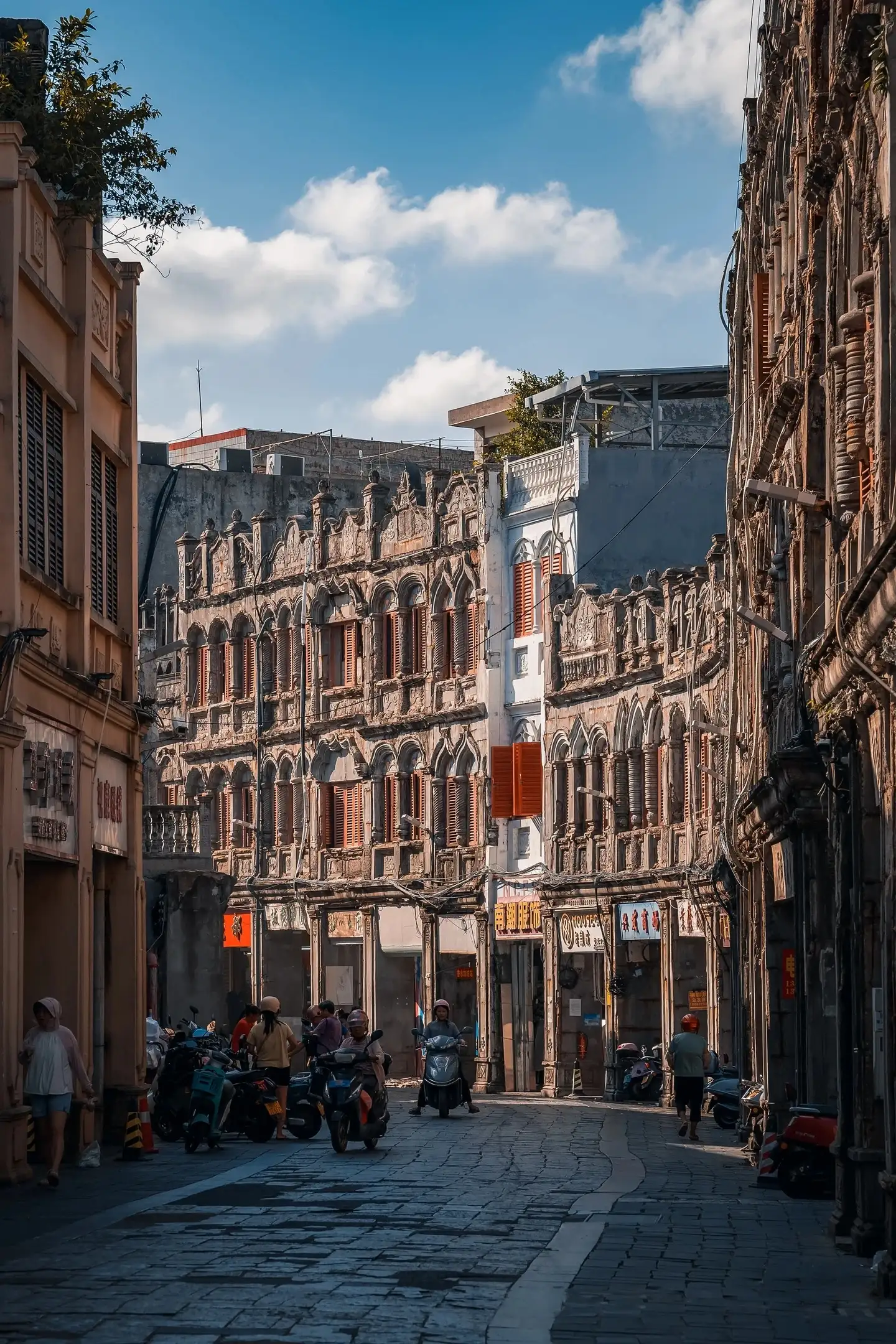
Upon seeing colonnades, arched windows, and ornate walls, travelers often describe modern architecture in southern China with the phrase “it looks just like Europe.” Both Wenchang’s Wannan Old Street and Guangzhou’s Shamian evoke this association, yet they should not be lumped together on the same list of “exotic” styles. The former can be understood through the lens of an overseas Chinese hometown and its arcaded commercial streets, while the latter must be viewed within the context of Guangzhou’s modern history of foreign relations and the concession era. Similar appearances are merely a starting point for understanding; it is the formation and use of the streets that reveal each city’s unique character.
Look at the street first, then at a single building
It’s best to begin studying architecture by examining public spaces. On Wannan Old Street, observe the relationship between the upper and lower levels of the street-facing arcades and how the arcades connect storefronts with pedestrians; on Shamian Island, observe the spacing between roads, trees, and buildings. Start by taking a photo or sketching a wide-angle view that includes the street, then examine the decorative details—this will help you grasp the overall context more easily than focusing directly on a single colorful window. Determine which areas are accessible and open to the public based on current usage; both locations may contain commercial, office, residential, or historic spaces.
Introduction to the Shamian Conservation and Utilization Plan released by the Guangzhou Municipal GovernmentConsider the central green axis, the grid-patterned blocks, and the waterfront environment. This provides a concrete framework for viewing Shamian: buildings not only have facades but also form part of a planned urban grid. By observing the orientation of intersections and building setbacks along public roads, individual structures can be contextualized within the street fabric. This article uses the fact of this stable layout as a guide for observation, while the actual arrangement of roads and buildings is determined by the on-site conditions.
Wenchang: Returning the Arcades to the Overseas Chinese Hometown
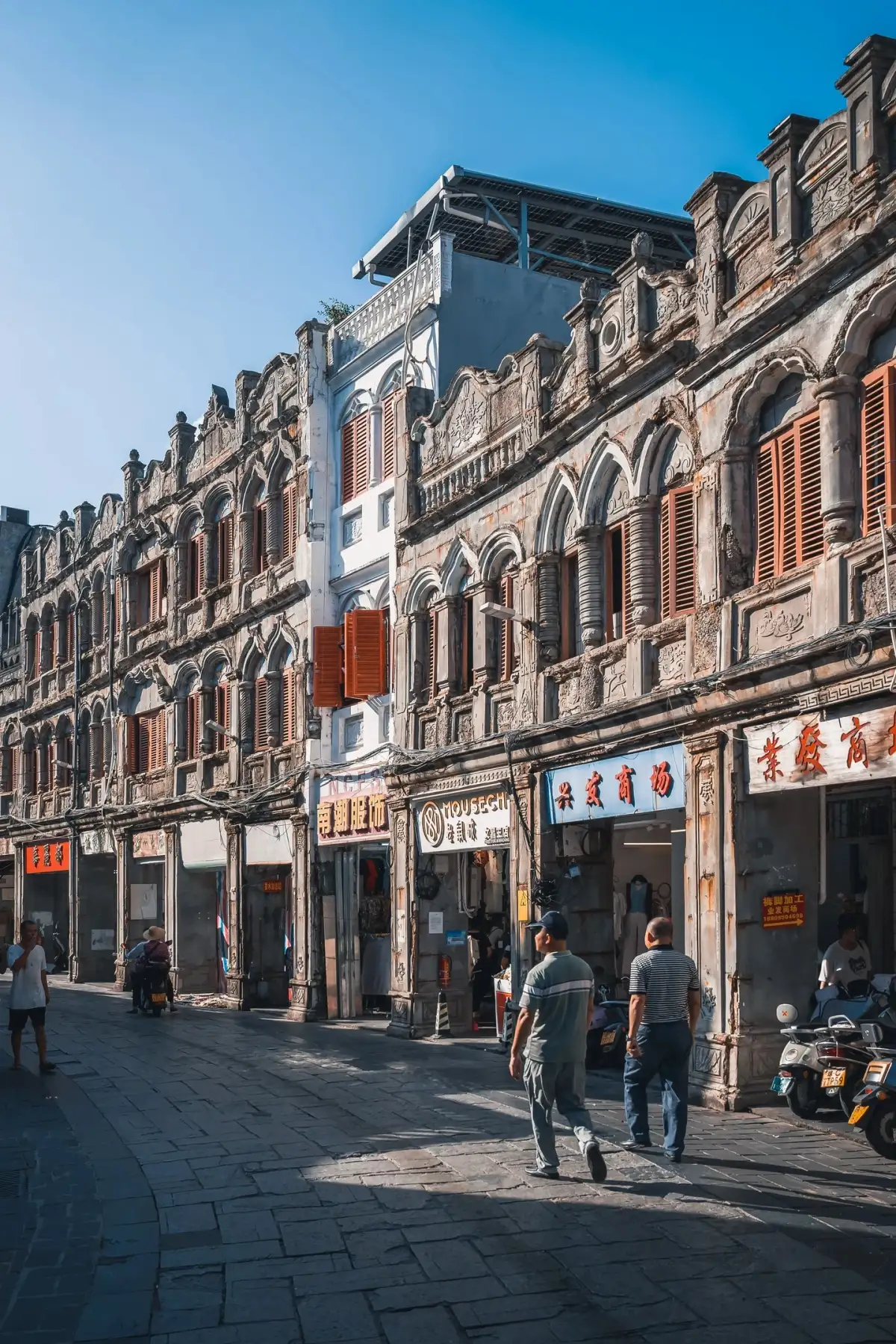
A continuous row of arcades, windows, and shop signs lines the street, with one section of the facade painted light blue. Photo:Snapshots in the Blink of an Eye · Original Post.
Ministry of Culture and TourismIntroduction to the Wenchang Rural Cultural RouteIt is noted that Wenchang is a hometown of overseas Chinese, featuring Nanyang-style arcades and former residences of overseas Chinese. According to the website of the Overseas Chinese Affairs Office of the State Council,Report on Wannan Old StreetThis also connects the neighborhood to the history of the overseas Chinese community. This article uses these contextual elements sparingly, avoiding the creation of a single narrative that encompasses all arcade builders, construction dates, and funding sources. Individual buildings should still be researched using their own reliable records.
The term “hometown of overseas Chinese” helps travelers understand the ongoing exchange between people and places. When people leave their hometowns to live elsewhere and then bring back capital, customs, construction expertise, or aesthetic sensibilities, the city’s appearance may change as a result. While this is a general framework for explaining cultural exchange, it is insufficient to prove the specific origin of a particular window decoration. Only when the description of a building includes information about its builders and the history of its inhabitants should one connect the people to the architecture; for buildings without such records, one can begin by documenting the visible relationships between the veranda, doors, windows, and the street.
How do arcades influence pedestrian movement? Viewed from the street, the lower-level arcades bring storefronts into direct proximity with pedestrian space, while the upper level features a separate facade and residential or functional spaces. Observe the continuity of a colonnade section, noting where it turns, is currently in commercial use, or requires pedestrians to detour. Understanding the relationship between shade and commerce provides a more complete perspective than simply viewing the colonnade as a photographic frame. Whether continuous passage is possible during rain or intense sunlight depends on specific road conditions; one architectural type cannot be regarded as a guarantee of shelter from the elements for the entire street at all times.
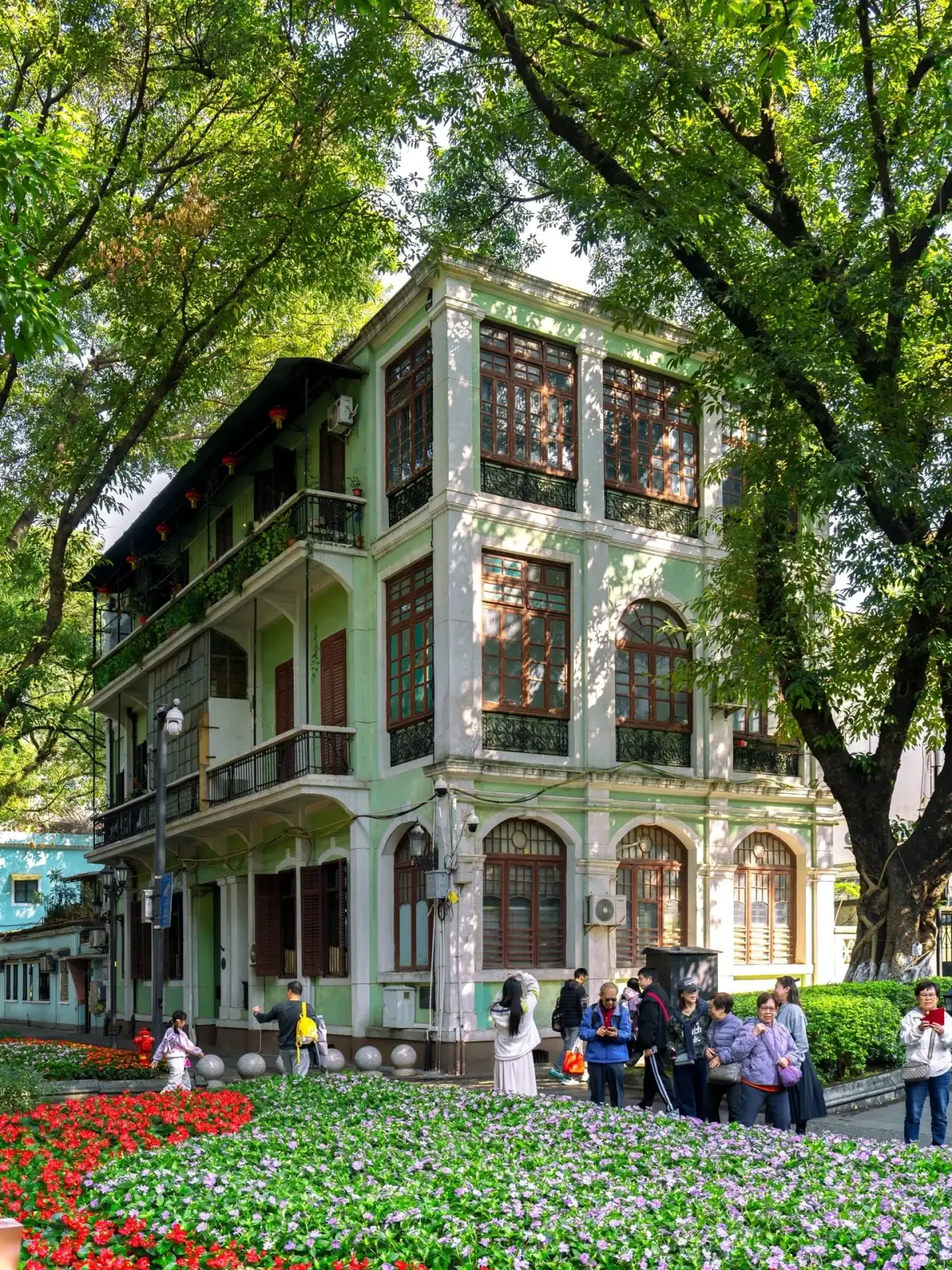
A large tree grows beside the corner of a green-decorated facade, with the flower bed in the foreground and tourists in the distance composing the street scene. Photo:Li Wan’yi · Original Post.
小红书作者弹指间行摄的Wenchang Arcades NotesFocus on colonnades, lintels, shutters, and street life. This draft draws inspiration from the idea of “viewing the upper and lower levels separately”; the historical context shifts to official sources, and does not include the original post’s scale rankings, complete architectural chronologies, or references to film locations. When strolling through the streets, you might first raise your gaze to the upper floors, then return your eyes to the storefronts, comparing how decorative elements and contemporary businesses coexist within the same building.
Shamian: Beyond Beautiful Facades Lie Modern Urban Relationships
Guangzhou Municipal Water Affairs BureauA Brief History of the Shamian EmbankmentThe discussion covered historical clues such as the formation of the Shamian concession and the artificial canals. Understanding this context helps avoid reducing the neighborhood to a European town transplanted to Guangzhou. The positioning of buildings along the waterfront embodies specific power dynamics and urban transformations; when observing them, one can not only appreciate the craftsmanship but also ask how these spaces were organized at the time and who was able to use them.
Does the history of the concessions make architectural sightseeing feel heavy? You can juxtapose facts with aesthetics. When examining a bay window, pay attention to proportions and materials; when you come across an official historical explanation, pause to understand its function and the era. Architectural exteriors are worth observing, and history needs to be explained accurately—both can be part of the same tour. For foreign visitors in particular, it’s especially helpful to clearly identify place names, dates, and institutional contexts, rather than letting vague notions of “colonial charm” overshadow the entire story. Specific events are based on official historical records; this article does not add any personal anecdotes.
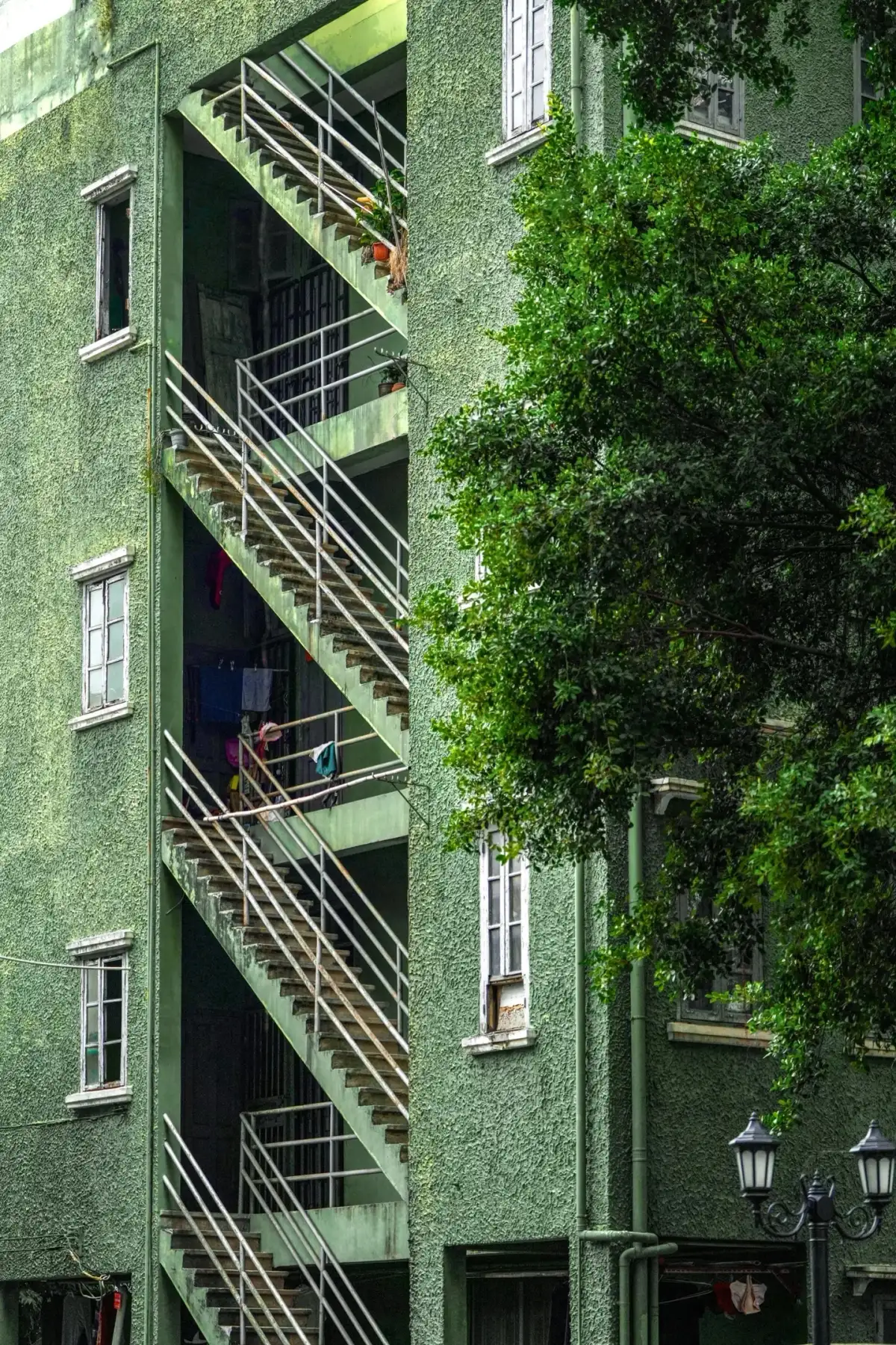
A metal spiral staircase is situated next to the green building’s exterior wall, with tree branches extending into the frame from the edge. Photo:Li Wan’yi · Original Post.
小红书作者李万一的Architectural Record of ShamenObserving both architecture and everyday life by the river serves as a reminder that the lens can capture both types of content. This article does not adopt the author’s evaluations of other photographers but instead transforms this observation into a choice: when photographing architectural details, also include a shot that illustrates the street’s context. Contemporary uses of legally designated public spaces ensure that historic districts remain places where people live; consent should still be obtained before photographing recognizable people.
When comparing, use questions instead of stylistic labels
If you’re unfamiliar with architectural styles, how can you tell them apart? Ask yourself four easy-to-observe questions: How does the building connect to the street? Where do pedestrians walk? How are the doors and windows arranged? What other uses are present in the surrounding area? When answering these questions, first describe the specific shapes and relationships, then look up the technical terms. The presence of columns does not automatically indicate a specific European architectural style, and arched windows and stained glass may have different historical contexts in different regions. Keep a photo of the complete facade along with your notes; when reviewing later, cross-reference the names to reduce misidentification.
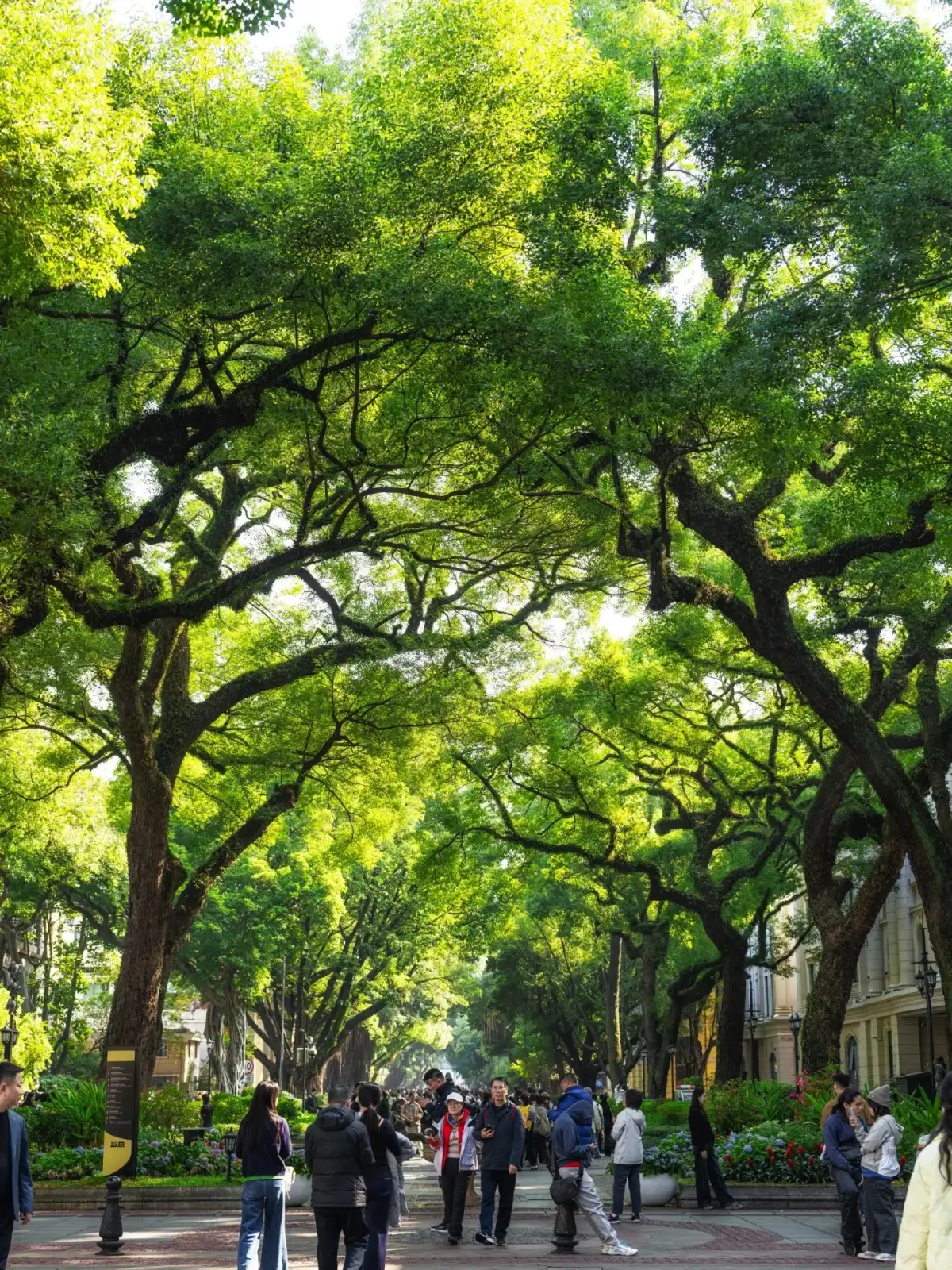
Dense tree canopies shade the walkway, while tourists in the distance stroll along the tree-lined path. Photo:Li Wan’yi · Original Post.
With only half a day, which location is best suited for this trip? If you’re already in Wenchang, explore a stretch of arcaded street to understand the heritage of the overseas Chinese community and commercial life; if in Guangzhou, explore the open streets of Shamian to observe modern architecture and the waterfront layout. The distance between the two places is considerable; the comparisons in this article are intended to foster cultural understanding, not to promote a combined tour on the same day. When making your choice, prioritize local transportation, your existing itinerary, and personal interests—don’t add an unnecessary inter-regional trip just to complete a stylistic comparison.
Photographers can set themselves a series of comparative tasks: one shot capturing the relationship between people and the street, one of the building’s facade, and one of a detail you’ve truly deciphered. Record the materials and their use as they appear in the frame; do not claim that the architecture “has remained unchanged” by artificially creating a sense of age through post-processing. Leave questions open regarding elements that contradict official descriptions, especially restored decorations or new signage. When staff are giving a tour, ask specifically which parts are original and which have been restored; the answers will be far more revealing than imagining a scene that has “remained unchanged for a century.”
If you’re planning a stop in Hainan after Wenchang, check out this site for guidance.Sanya Destination GuideGain insight from another perspective; for a cultural tour of Guangzhou, you may refer toGuangzhou Destination Guide. The table of contents does not yet have a separate page for Wenchang, and internal transportation in Hainan requires separate verification. After studying the architecture of these two locations, what is worth remembering is not which foreign city they resemble, but how people, commerce, waterfronts, and streets have, within their respective histories, formed a space that can be observed today.
Source and Editorial Notes
This article is an original travel interpretation compiled by the Dongxing Travel editorial department based on cited materials; it is not a firsthand account by the author. The full text of the original post has not been reproduced; accompanying images are used within the scope of authorization and are credited to the author and the source of the original post. They do not serve as proof of actual travel experiences or services provided by Dongxing Travel.
Snapshots on the Go · Wenchang, Hainan: The Old Arcade Street—The Old Dreams of Nanyang in a Century-Old Hometown of Overseas Chinese · Travel Notes; Verified/Compiled on: October 3, 2026.
Li Wan-yi · Guangzhou’s Shamian: A Living Museum of Historic Architecture 🏛️ · Travel Notes; Verified/Compiled on: October 3, 2026.
Ministry of Culture and Tourism · Hainan: Leisurely Tour of Wenchang—Hometowns of Famous Figures · Official Sources; Verified/Compiled on: October 3, 2026.
Website of the Overseas Chinese Affairs Office of the State Council · Wenchang, Hainan: Overseas Chinese Culture Attracts Tourists to Capture Moments of Nanyang Life Guangzhou Municipal People’s Government · Protection and Utilization Plan for the Shamian Historical and Cultural District Announced Guangzhou Water Affairs B · Official Sources; Verified/Compiled on: October 3, 2026.
Guangzhou Municipal People’s Government · Protection and Utilization Plan for the Shamian Historic and Cultural District Announced · Official Sources; Verified/Compiled on: October 3, 2026.
Guangzhou Municipal Water Affairs Bureau · Exploring Water Heritage | Historical Traces Along the Shamian Embankment · Official Sources; Verified/Compiled on: October 3, 2026.