East Travel Editorial Department · Travel Diaries and Pre-Trip Reading
First, give both the stone and the characters a little time
A visit to the Xi’an Stele Forest is perfect for a day when you need to slow down during a city trip. Upon entering the museum, your focus shifts from the architectural silhouettes on the street to the characters, stone surfaces, and carvings before your eyes. It doesn’t require every visitor to understand Chinese calligraphy, but it does demand more sustained attention than a typical “check-in” experience. Start by reading the current guide to distinguish between the original Stele Forest, the Stone Carving Art Exhibition, and the new wing’s displays. Then, choose a main theme centered on the steles and inscriptions to avoid trying to see all the famous steles right from the start.
For visitors from overseas, the first step might even be to set aside reading the content for the moment: how tall is the stele, how densely is the main text arranged, and how is the title separated from the text below? Start by taking in the form, then use the exhibition labels to fill in the details about the calligrapher, the era, and the stele’s purpose—this provides a concrete entry point for viewing unfamiliar characters. Spending ample time on just two or three exhibits makes it easier to understand why calligraphy can also be a spatial art form than spending ten seconds in front of each of dozens of stone steles.
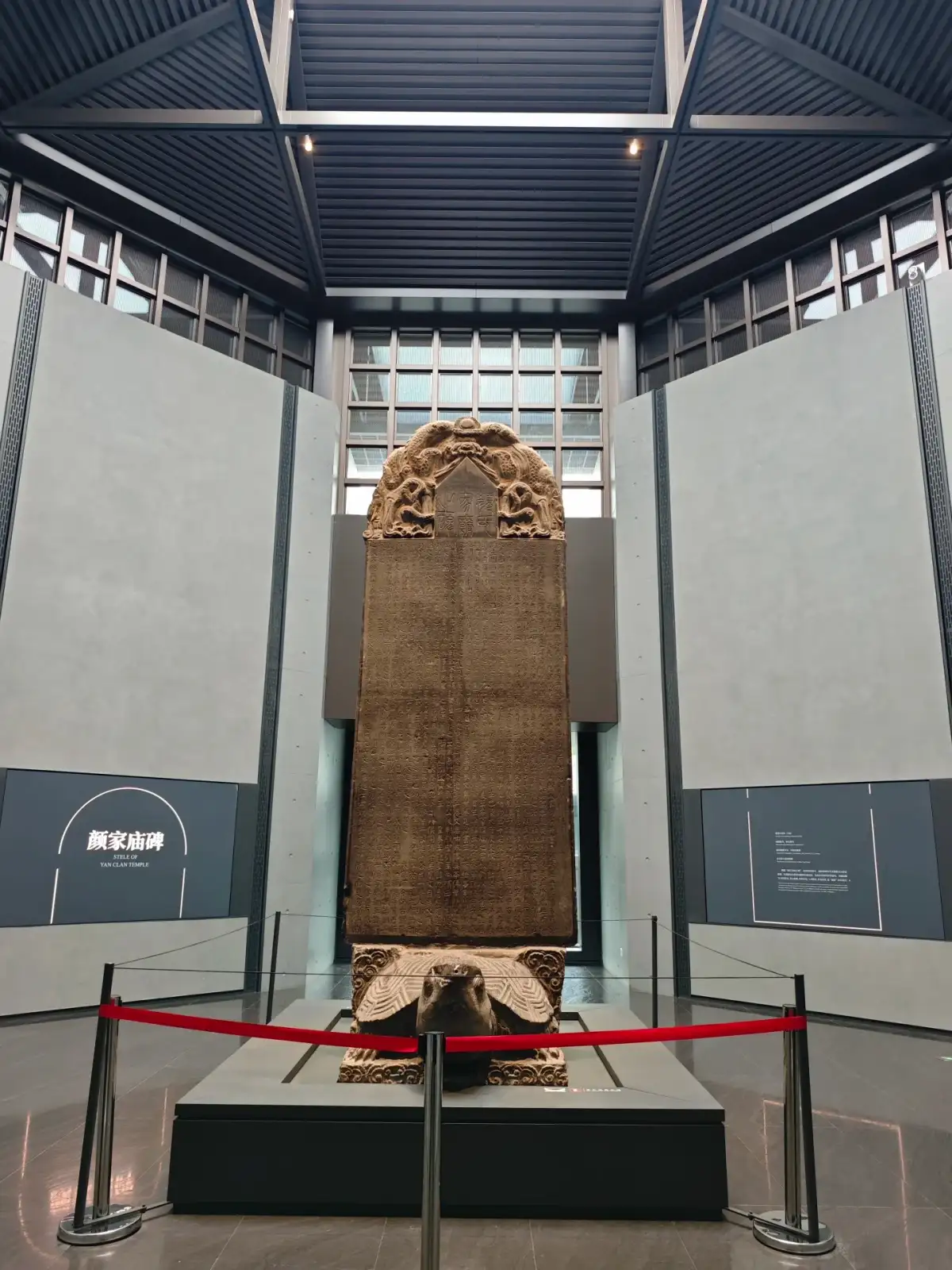
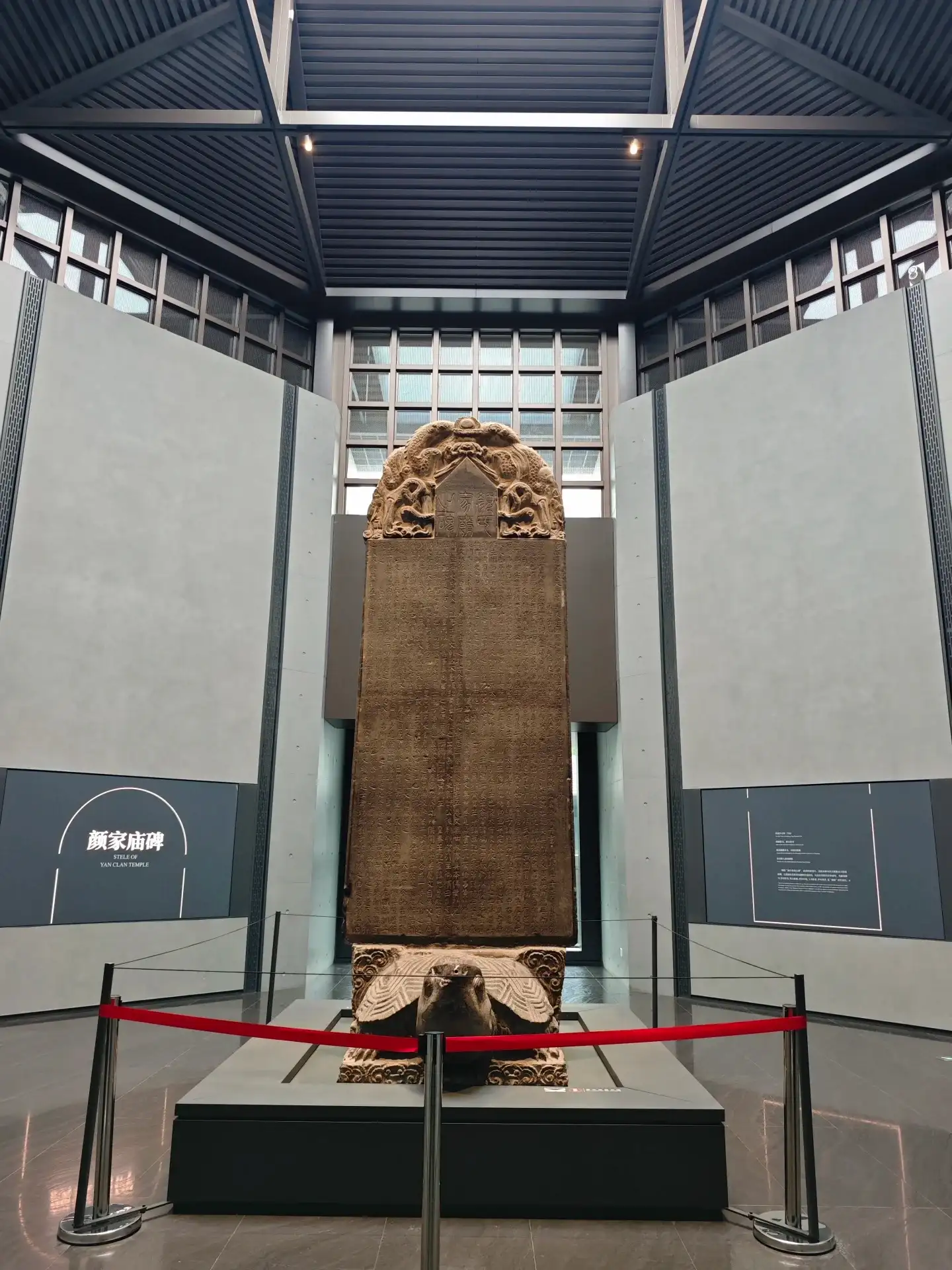
The Yan Family Temple Stele and the exhibition space at the New Xi’an Stele Forest Museum.
The Yan Family Temple Stele: First, Observe How a Stele Stands
When facing the Yan Family Temple Stele, you can first step back to the standard viewing position to take in the stele’s overall outline. The decorative capstone, the dense body of text, and the stone base below each carry different visual weights; the upper section is more intricate, the lower section is stable, and the characters in the middle form a continuous, unfolding surface. The exhibition space allows visitors to compare how these parts connect and to see why both large-scale forms and fine brushstrokes coexist. The first impression of the entire stele often better captures its purpose as a memorial than a single character viewed in isolation.
Then select a short passage to examine up close, observing the horizontal spacing, vertical alignment, and stroke thickness. Yan Zhenqing’s name can serve as a starting point for further exploration of calligraphy, but there’s no need to memorize his entire biography right away. First, compare the stele before you with the accompanying explanation to understand why it was erected and who wrote it, then return your attention to the form of the characters. Since you cannot gauge the weight of the exhibit by touch, maintain a safe viewing distance and shift your gaze between the entire stele and its details—this alone will provide a rich opportunity for comparison.
Start with a single character to find the physical rhythm of calligraphy
If you’re unfamiliar with Chinese characters, start with easily recognizable recurring shapes. A square frame, a relatively long “pai” stroke, or a prominent vertical stroke may be arranged differently across various characters. Choose a line of text, compare where it appears dense and where there’s more white space, and then see if the next line maintains a similar rhythm. Viewing calligraphy in this way no longer relies entirely on translation; the relationships between characters and the direction of the strokes themselves reveal order, strength, and variation.
For travelers learning Chinese, try to find a character you recognize—there’s no need to read the entire inscription right away. Ancient character forms, calligraphic styles, and wear on the stone surface may make familiar strokes seem unfamiliar, so you’ll need the exhibition labels or guided explanations to help identify them. Separating character recognition from appreciation reduces frustration: even in parts you don’t understand, you can still appreciate the lines, while recognizing a character creates a clear connection. This approach also makes it easier for companions to engage in conversation—each can choose a detail and discuss why they were drawn to it in the first place.
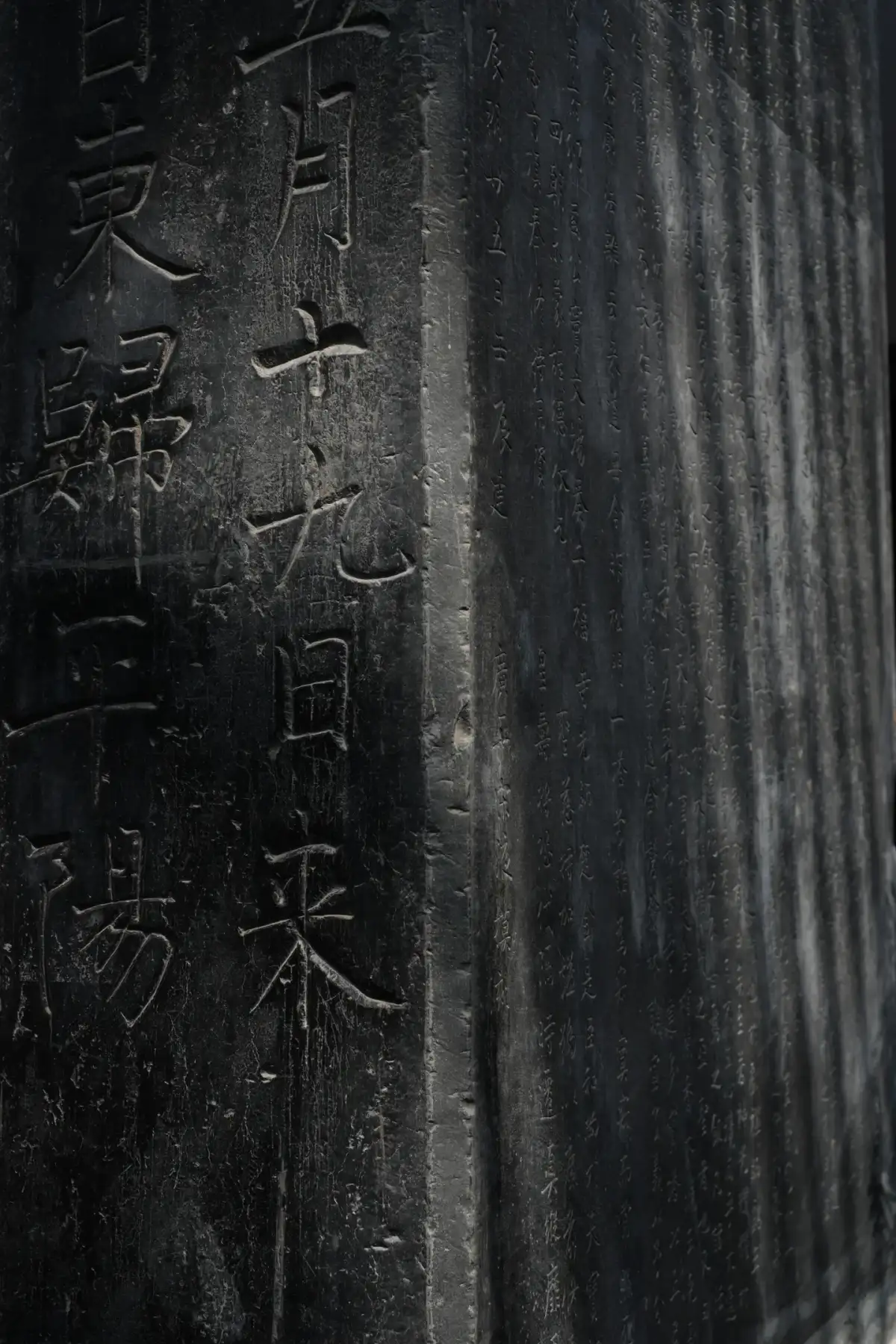
carved indentations on the stone surface and the strokes of varying sizes.
When strokes become carved marks, the material itself becomes an integral part of the text
text on the stone is not a direct replica of ink on paper. The written forms have been carved into the stone; when light falls from one side, shadows form in the recesses of the strokes, while cracks and wear on the stone’s surface leave another layer of time imprinted upon it. When examining a section of clearly carved text, first identify the edges of the characters, then observe the direction of the natural grain alongside them. These two types of lines may appear close to one another but originate from different processes; this distinction shifts the viewer’s focus from simply recognizing characters to the material itself.
Don’t trace the engraved lines with your fingers, and don’t use a flash to try to capture every indentation clearly. The on-site lighting and designated viewing areas already provide the optimal conditions for appreciation; adjusting your body angle often reveals different shades of light and shadow. After taking photos, you should return to observing with the naked eye: while cameras may emphasize contrast, the actual setting preserves more subtle shades of gray. Only by viewing the text alongside the stone itself can you understand why a stele is simultaneously a historical document, a calligraphic work, and a physical artifact in need of preservation.
The Kai Cheng Stone Classics: Giving the Pages a Different Dimension
The Kai Cheng Stone Classics are well-suited for a comparison with a single famous stele. While famous steles tend to focus attention on the calligrapher or a specific event, the continuous script of the classics directs the gaze toward how the text has been preserved over the long term and publicly displayed. When viewing, start by reading the exhibition label to understand the classical background it represents, then choose a spot that doesn’t obstruct traffic to appreciate how the dense text unfolds across the stone surface. Such a large number of characters does not require visitors to read every sentence; the overall arrangement alone suffices to illustrate that this was a calligraphic and carving project of a different scale.
If you spot a familiar phrase, you can pause to read a short passage; even if you don’t, you can compare the size of the characters, the arrangement of the lines, and the boundaries between the text and the stone surface. Since the steles in the exhibition hall vary in age and original purpose, it’s not appropriate to lump all the exhibits together under the single phrase “ancient library.” Once you understand how a set of stone scriptures unfolds, walk over to another standalone stele—the distinction between methods of preserving information and forms of commemoration will then become concrete and fascinating.
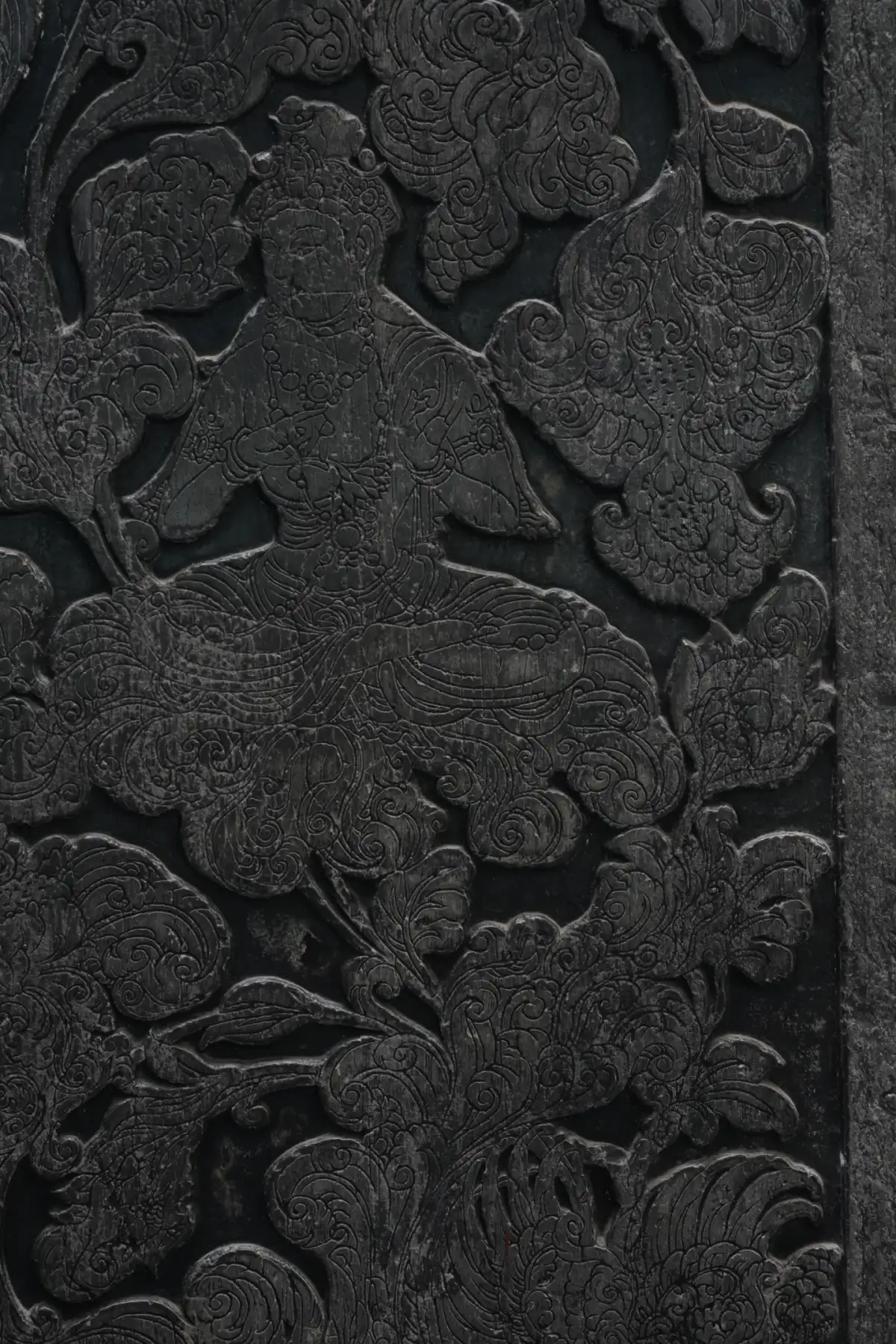
detailed carvings of the figures, the drapery, and the scroll-like ornamentation.
stone carvings, allowing you to discover meaning beyond the characters themselves
Viewing the stele forest isn’t limited to following the rows of text. The stele’s head, stone base, and carved decorations will also catch your eye: curving patterns take a turn, the outlines of mythical beasts merge with the borders, and line-engraved figures or plants divide the hard stone surface into intricate layers. Choose a carving with a clear description; first compare the shadows created by shallow carvings and deeper recesses, then understand its subject matter—without forcing every decorative element into the same auspicious narrative.
If you continue your tour of the stone carving art exhibition, you should set aside a separate block of time for the religious sculptures. Inscriptions and religious sculptures have different contextual backgrounds; they cannot be treated as the same type of artwork simply because they are both carved from stone. Focus on the drapery, postures, and spatial arrangement, shifting your observation from individual strokes to the overall form. For foreign visitors entering a Chinese museum for the first time, this shift—where the material remains the same but the viewing approach changes—is very helpful: stone is no longer merely heavy; it can also convey delicate, fluid, and complex expressions.
The Old Courtyard and the New Museum: Arranging a Shift in Viewing Perspectives
The courtyard-style space of the Stele Forest and the layout of the New Hall offer visitors two distinct environments. In the courtyard, gates, trees, and eaves come into view, maintaining a close relationship between the exhibits and the architecture; the more compact exhibition halls of the New Hall, on the other hand, use lighting and exhibition routes to facilitate understanding of the themes. Depending on the actual order of exhibits open that day, you can either explore a courtyard first before entering the exhibition hall, or start by learning about the historical background in the new wing before returning to the old space for a closer look—both approaches have their merits.
It’s a good idea to take a short break between exhibits to let your eyes rest from the dense text. Look at a section of the eaves or the plants in the courtyard, then recall the arrangement of the stele you just viewed—this will help refocus your attention. Exhibit locations, temporary exhibitions, and visitor entrances are subject to change. Check the official guide before your visit and follow the on-site directions. Don’t rely solely on exhibition room numbers from outdated guides to locate a specific artifact; a clear theme with a flexible sequence often works better for an actual visit than a fixed list of famous steles.
Guided tours and reservations ensure a viewing experience of appropriate length
Guided tours at the Stele Forest don’t necessarily need to be the longest. You can first decide whether your interest lies in calligraphy, the historical records in the inscriptions, or the stone carvings and statues, and then familiarize yourself with the language, scope, and duration of the official tour. After listening to the explanation for a particular exhibit, allow yourself a brief interval to observe it on your own; this will help you connect the terms used in the commentary to the actual stone surface. If your companions have different interests, it’s less stressful to agree on a period of free exploration and a meeting point than to require everyone to read through all the exhibit labels at the same pace.
Use official channels for ticket purchases and reservations. Foreign visitors should verify that their passport registration, admission credentials, and selected time slot match. Factor in security checks, walking time inside the museum, and rest breaks when planning your day; avoid scheduling a long-distance bus trip with a strict departure time immediately after your visit. Also confirm the entrance and exit points based on the current tour guide; especially when planning to explore the surrounding neighborhoods, make sure to clarify which gate you’ll exit through. Having some extra time allows you to linger a few extra minutes in front of a stele, resulting in a more focused and enjoyable viewing experience than when you’re rushing.
Walking back onto the streets of Xi’an, bringing the dense text into the city
After visiting the Stele Forest, plan a short walk through the city. First, have a meal and drink some water to let the dim lighting and dense strokes of the exhibition hall fade from your eyes, then take a stroll along the streets leading back to your lodging. When you see the signs of today’s shops or road signs, you may pay closer attention to the size, arrangement, and typeface of the characters; this brings the museum viewing experience back to everyday life, rather than confining it to photographs of artifacts. As for the nearby shops and shopping options, simply choose based on your actual interests.
On hot or rainy days, a visit to the Stele Forest can be structured as an alternating journey between indoor and outdoor courtyards, though you should adjust how long you stay in each courtyard based on the actual weather; during the cold season, be sure to dress warmly for outdoor walks. If, before leaving the museum, you can recall the overall outline of a stele, the light and shadow of an engraved passage, and the rhythm of its lines, you’ve already gained a clear insight. Xi’an’s history thus exists not only in the imagination of grand city walls and palaces, but is also hidden in the individual strokes, lines, and stone surfaces that one can discover with patience.
Further Reading and References
Original compilation by the Dongxing Travel Editorial Department based on publicly available travel notes and listed information, intended for pre-trip reading and not as a personal account of the experience; opening hours, transportation, reservations, and service arrangements should be verified according to the actual travel date.
Xi’an Stele Forest Museum: Visitor Guide
Xi’an Stele Forest Museum: Historical Development
Is the museum meaningful without reading Chinese?
A Xi'an Beilin Museum visit can start with one clearly interpreted stele: examine its outline, then choose a character to compare stroke thickness and spacing. Beilin calligraphy viewing does not require understanding the entire inscription. Observe arrangement, turns and carved marks first, then ask an interpreter about function rather than collecting unexplained names.
Comparing stone books with an individual stele
Kaicheng Stone Classics observation treats the stone surface as a page, drawing attention to continuous text. An individual stele offers a different relationship between border, heading and body. Choose one of each for a focused comparison of material and writing. Connect galleries and accessible courtyards using the day's visitor map; keen readers should reduce other stops and rest in the nearby streets afterwards.
Planning references
Planning reference: Xi'an Beilin Museum visit 1