The most frustrating mobile issues in an unfamiliar city sometimes occur even when the signal appears strong: you can open a map app, but you can’t make a call to your hotel; you receive messages from family, but the SMS required for a booking page is slow to arrive. These issues relate to data connectivity, phone number services, and specific app rules, respectively. By understanding them separately, you can purchase a communication plan that better suits your itinerary before departure.
Xiaohongshu’s “ExploreChinaNow” feature compares roaming, travel e-cards, and local SIM cards side by side, while another author, “International Expert,” documented their personal experience purchasing a short-term SIM card in Shanghai. These notes address the questions travelers actually ask, though prices and counter experiences reflect only the circumstances at the time. This article outlines the application process based on Shanghai’s official mobile service guide and uses a comparison of devices and intended uses as a pre-trip decision-making tool.
Assign Tasks to Your Phone First
The first category of needs—viewing maps, sending and receiving messages, and checking orders—relies on an active data connection. The second category involves keeping your original phone number so that banks or existing accounts can still reach you. The third category involves contacting local hotels, drivers, or other service providers and meeting the phone number requirements for certain services. All three needs can be met by a single plan, or they may require two SIM cards working together; whether this is supported depends on the phone model, carrier, and service plan.
If your trip lasts only a few days and your main activities are already planned, maintaining a stable data connection and continuing to receive messages on your original number may be more urgent than getting a new number. However, if you plan to travel between cities frequently, make impromptu phone calls, or use a service that requires a local number, a local number will be more valuable. Your decision should be based on what you actually need to do, rather than on which SIM card is marketed as the most convenient or cheapest.
Do travel data cards always come with a phone number? The answer depends on the product you purchase. When reviewing the product description, check the four categories separately: data, voice, text messages, and phone number. A product labeled as “usable in China” does not necessarily include a mainland China phone number; having a phone number does not guarantee you’ll be able to receive verification codes from all platforms. Save the customer service response—it will help you determine upon arrival whether the issue is a setup problem or if the plan simply doesn’t include that feature.
The advantage of roaming is that you can keep your original phone number.
For those already familiar with their home country’s carriers, roaming is typically easy to consider alongside managing their existing number. Before departure, you should ask about the destination area, how data and calls are billed, which days the plan covers, and what happens when you run out of data. Since plans vary by provider, you cannot estimate your own costs based on amounts listed on someone else’s bill. You should also familiarize yourself with payment methods and auto-renewal settings before departure.
Your original number may still be needed during your trip for account recovery or bank verification. Before switching data sources, check how your phone selects the default data and voice lines. If your phone supports dual SIM cards, label both lines clearly to avoid selecting the wrong one when making calls on the fly. Device support varies, particularly regarding SIM card slots, eSIM support, and carrier lock status; it’s best to contact your service provider directly with your device model.
The appeal of travel e-cards often lies in advance preparation, eliminating the need to search for sales outlets upon arrival. However, successful installation and actual internet connectivity are two separate stages. Be sure to read the activation conditions, effective date, coverage areas, and validity period listed in the purchase instructions together. If the timer starts after installation, the outcome will differ from plans that begin upon arrival—it’s especially important to check this detail before departing on long-haul flights.
Local SIM cards: Be clear about what you need when you go to the counter
The Shanghai Municipal Government’s mobile service guide lists official stores for China Mobile, China Unicom, and China Telecom. The in-person process involves selecting a plan, presenting your passport, confirming the SIM card size, and completing the registration. For those unfamiliar with Chinese, bringing your device and writing down your length of stay, data needs, and intended use for calls will make your consultation much more specific than simply saying, “I want a SIM card.”
A straightforward example: “I’ll be staying in China for X days and want to use maps and messaging. I may or may not need local calls. I’d like to know the total cost and how the plan will be handled upon expiration.” Have your original passport and phone ready, and let the counter staff explain the specific plans available to you. Although official channels provide application portals, specific inventory, business hours, and device compatibility should still be confirmed at the store.

A traveler carrying luggage stands beneath a sign pointing toward the “suburban rail,” with a luggage cart visible nearby. Photo:Vv. · Original Post.
After completing the registration, it’s a good idea to perform three different actions on the spot: open a new web page to confirm data connectivity; make a test call or send a text message according to your plan; and note down the phone number and customer service contact information. If you only open a map while connected to the store’s Wi-Fi, you may not have truly tested the new SIM card’s data connection. The test does not need to involve sensitive accounts; the purpose is simply to have the service staff help identify basic setup issues while they are present.
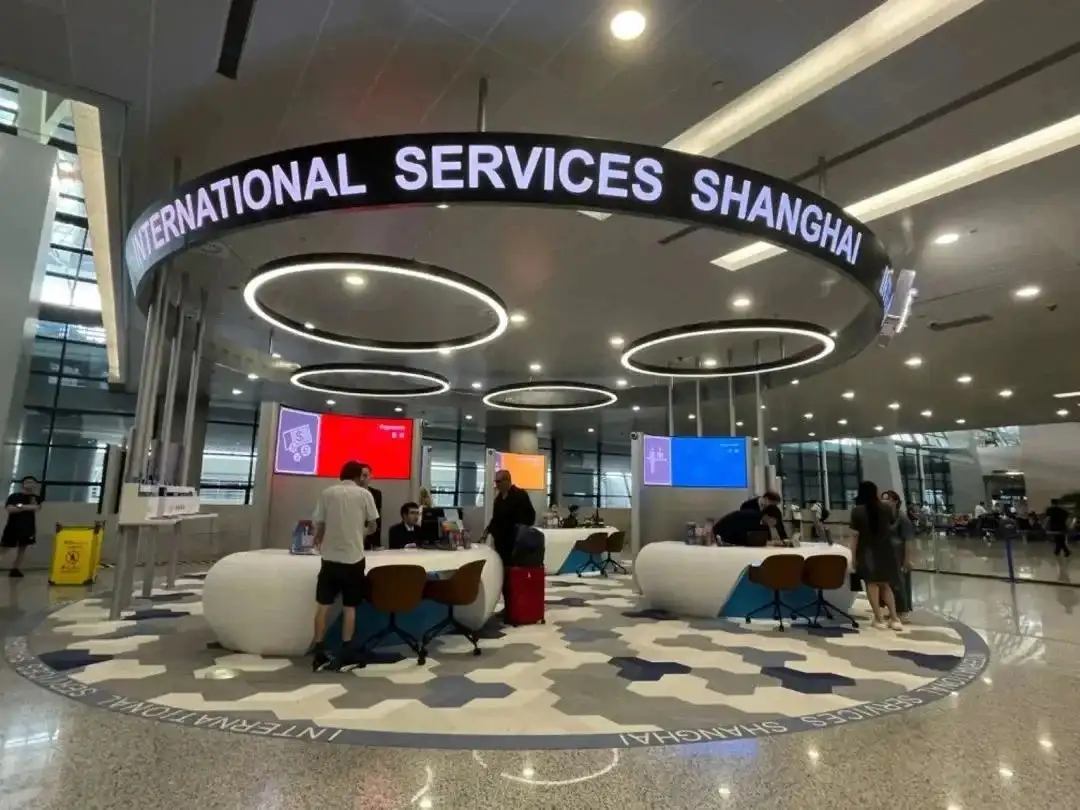
Should you buy a SIM card at the airport or after arriving in the city? This depends on your first move after arrival. According to official Shanghai sources, the Pudong International Airport arrival area offers assistance with communication services, making it a good option for those who need immediate access upon arrival. Those who have already arranged for roaming or travel data services can wait until they’ve settled in to compare local options. Both approaches are valid; the key is to ensure you have a valid address and contact information for the journey from the airport to your hotel.
When traveling with family, there’s no need to centralize all information on a single phone
On family trips, one person often handles all the bookings, so the mobile hotspot, payments, navigation, and order details are all concentrated on a single device. If that person goes to the ticket counter for assistance, runs out of battery, or steps away temporarily, the others might not know the meeting point. At the very least, have one other traveler save the hotel’s address in Chinese and the train ticket information, and agree on a meeting spot that doesn’t rely on ad-hoc text messages.
Sharing a mobile hotspot is suitable for traveling in close proximity, but you shouldn’t assume that everyone can leave the group at any time. When planning to split up in museums, shopping malls, or on the streets, independent internet access and clear meeting arrangements are more important. Whether children and elderly family members need their own data should be determined based on their actual ability to use it; those without smartphones can also be provided with printed addresses and contact information. The purpose of communication preparation is to ensure that everyone can figure out their next steps.
Multi-city itineraries can also lead to fluctuations in data usage. Video calls, uploading photos to the cloud, and continuous navigation have very different data requirements compared to simply sending and receiving text messages. You can monitor your phone’s usage history for the first couple of days before deciding whether to add more data. Photo backup and real-time sharing during your trip can also be handled separately, allowing you to reserve most of your data for transportation and communication needs as they arise.
After returning home, the number still has further uses
If you use a short-term local number to register for services, check before you leave which accounts rely on it for password recovery or receiving text messages. Inquire about plan expiration dates, renewal procedures, and deactivation processes, and update important accounts to contact information you’ll have long-term access to. For those on short trips, the number’s lifecycle is often overlooked more than the number itself; handling this properly can reduce communication difficulties after returning home.
If your phone is lost or malfunctions, it will be very helpful to know which service provider you purchased from, as well as your SIM card number and contact information. Save this information along with your hotel address in a separate location—this could be on a travel companion’s device or on a securely stored piece of paper. Passwords and complete payment details should not be included in public screenshots. The more thorough your offline preparations are, the easier it will be to contact your service provider and relevant account services step by step should a problem arise.
The communication plan can ultimately be quite simple: short-stay travelers should first ensure data access and that their original phone number remains active; those traveling independently across multiple cities can then assess the value of a local number; and families should share key contact information with multiple people. When purchasing, use these four criteria to assess your needs; upon arrival, test the actual functionality; and before returning home, manage any number bindings. This way, your mobile service will adapt to your journey, and your trip won’t be dictated by any single product name.
Sources and Editorial Notes
This article is an original travel analysis compiled by the Dongxing Travel editorial team based on the listed information; it is not a firsthand account by the author. The full text of the original post has not been reproduced; accompanying images are used within the scope of authorization and are credited to the author and the source of the original post. They do not serve as proof of actual travel experiences or services provided by Dongxing Travel.
ExploreChinaNow · Ultra-Detailed❗️China SIM Cards Guide · Travel Notes; Verified/Updated: October 3, 2026.
International Expert (Worker Edition · 2025) Guide for Foreigners Entering Shanghai to Purchase Short-Term SIM Cards · Travel Notes; Verified/Updated: October 3, 2026.
Shanghai Municipal People’s Government · A Guide to Setting Up Mobile Services · Official sources; Verified/Updated: October 3, 2026.
Shanghai Municipal People’s Government · Pudong Airport Upgrades Services for International Travelers · Official sources; Verified/Updated: October 3, 2026.
One cup, full sugar, no ice · You can even buy a [Chinese number] SIM card at Pudong Airport in the middle of the night! · Image source: This article does not treat the original post as a basis for current policies.
Vv. · 🇲🇾🇨🇳 A Beginner’s Guide to Riding China’s High-Speed Rail for the First Time · Image source: This article does not treat the original post as a basis for current policies.