The mountain path itself serves as a reading path
A mountain face on Mount Tai may first catch the eye with its color and outline, and only then do the characters become visible. As you approach, the size of the characters, the strokes, and the undulations of the rock face will alter your perception. Thus, two activities occur simultaneously on the mountain trail: the body moves upward, while the gaze rests upon a specific spot. Being interested in the inscriptions does not mean you must be familiar with every calligraphic style. Simply observing how the characters are situated within the mountain landscape already reveals much about the experience of travel.
Xiaohongshu’s “Classic Mount Tai Hiking Routes!” incorporates attractions such as Jingshiyu and cliff inscriptions into hiking itineraries, indicating that many travelers expect more than just the summit. The Mount Tai management authorities also document cultural landmarks along the route in their introduction to the Hongmen Trail; UNESCO’s World Heritage documentation discusses inscriptions, architecture, and the natural environment as an integrated whole. Drawing on these clues, this article proposes four approaches to interpreting the site on-site: examining location, distance, and arrangement, and then considering the connection between the inscriptions and the viewer—rather than reducing all the stone carvings to a mere test of character recognition.
Reading Approach 1: First, Ask Where It Is Located
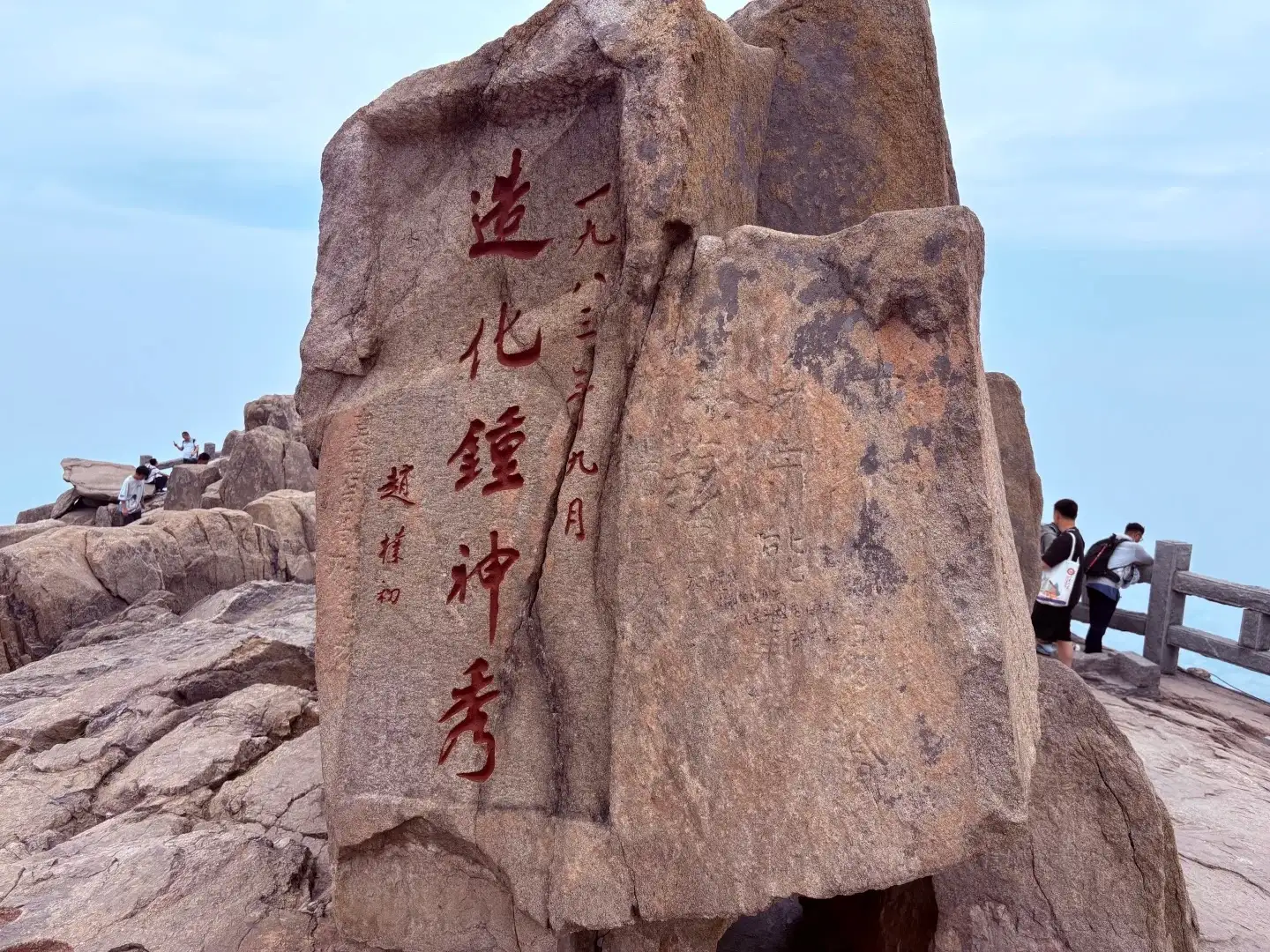
When you see an inscription, you can set aside reading the content for the moment and first examine the surface of the stone on which it is carved. Is it situated in an open area facing the distant landscape, or tucked away beside a nearby mountain path? Does the viewer need to look up, or can they view it at eye level? The location of the text influences whether a person passes by in a hurry, pauses to examine it closely, or stands at a distance, treating it as part of the overall landscape. The location itself is a condition of viewing; it is not merely a backdrop added after the text has been read.
Inscriptions on a cliff face differ from photographs of calligraphy in a gallery. Photographs can crop out the background, but on-site, there are slopes, rock textures, tree shadows, and adjacent inscriptions. Even a slight change in distance along the walking path can alter the relationship between the characters and the mountain. If you stand too close, only the details of the strokes remain visible; step back to the right spot, and the characters become part of the cliff face. This dynamic helps international visitors unfamiliar with Chinese characters to first grasp the landscape, rather than having to wait for a complete translation before engaging with the view.
choose an inscription you particularly like and describe its location in a single sentence—for example, “The characters appear after a bend” or “You have to stand a bit farther away to see the entire stone surface.” This approach links your memory to the actual mountain trail. When you look at the photos back home, it will be easier to recall where you were walking from at the time. Compared to simply noting the title, describing the location adds a sense of physical presence to the journey and provides a point of reference for the next section of your writing.
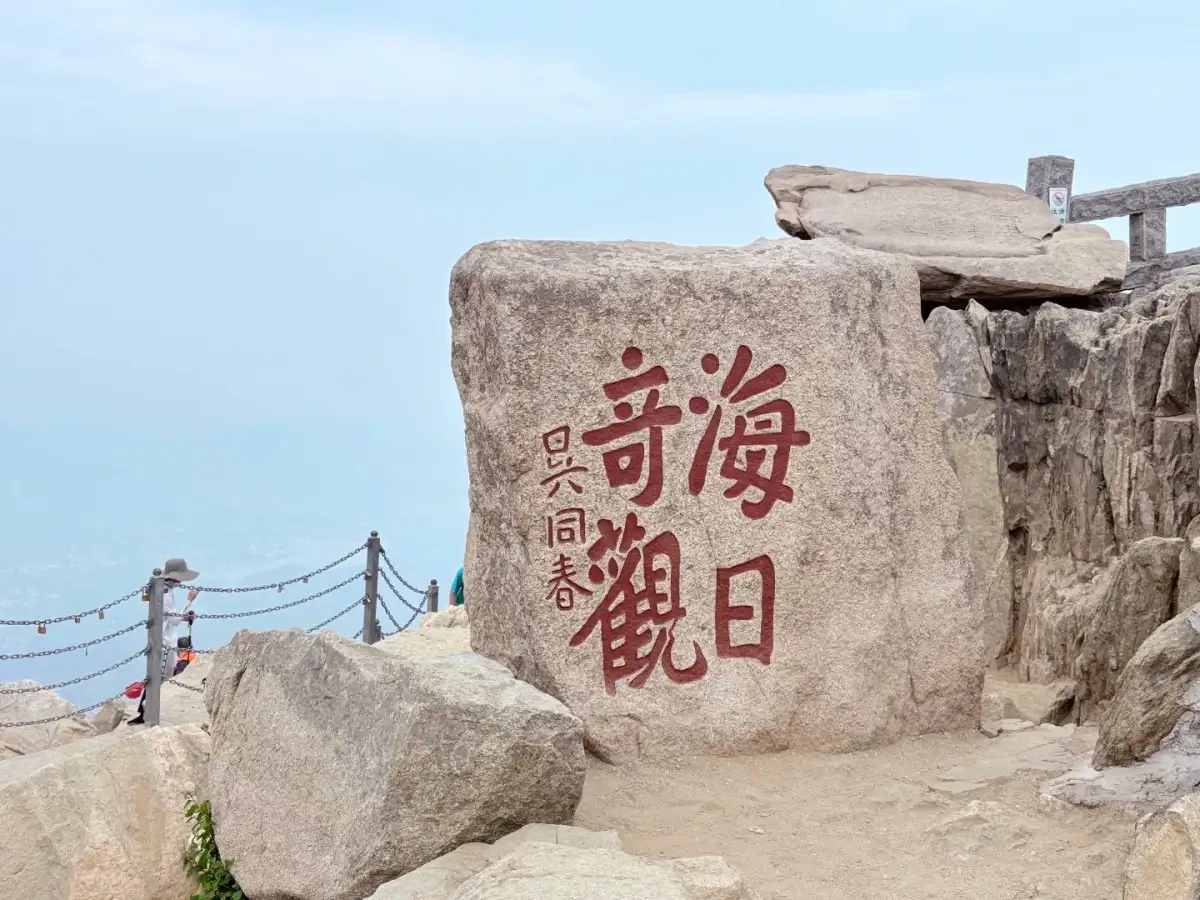
The “Marvel of the Sun Over the Sea” stone inscription and guardrail at the summit of Mount Tai. Photo:Click, click Zyzz · Original Post.
Second Approach: Compare the Differences Between Viewing Up Close and From a Distance
Large and small characters invite the viewer to adopt different viewing distances. From a distance, you might first notice the direction of the strokes, the negative space, and whether the text echoes the contours of the mountain; up close, the carvings and the stone’s texture more readily take center stage. These two ways of viewing do not compete for the “correct” answer; they respectively address “how this mountain face organizes the viewer’s gaze” and “how the characters become marks on the stone.” By separating these two questions, you won’t feel that lingering there is pointless simply because you can’t make out every single character.
You can make the same comparison when taking photographs. One wider shot captures the mountain path and the inscription’s location, while a closer shot focuses on the text and the stone’s texture. Combining these two photos conveys the travel scene more effectively than a single shot filled entirely with the characters. Photographs should be taken from areas open to the public; do not cross boundaries just to find a frontal angle. If there are other visitors nearby, position yourself carefully to avoid blocking the mountain path.
If children are accompanying you, have them look for shapes they can recognize: a character that resembles a split tree branch, or a stroke that curves alongside the stone’s natural texture. This approach does not involve making up arbitrary stories about the text but rather enters the viewing experience through visual perception. Next, read the words from a reliable description, allowing the shapes and meanings to gradually connect. Compared to immediately requiring children to memorize classical allusions, this sequence is more likely to sustain their interest in active observation.
Third Approach: Observing How a Single Stone Wall Accommodates Multiple Voices
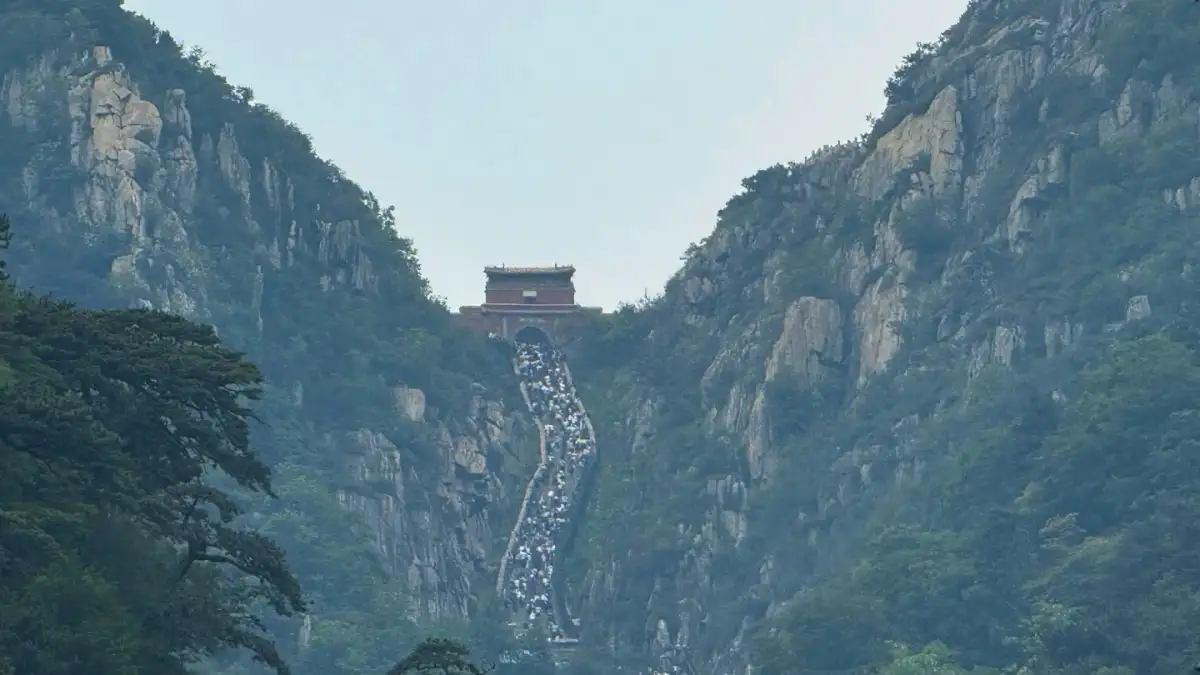
The long stone steps of Mount Tai’s “Eighteen Turns” and the South Heavenly Gate above. Photo:Click, click Zyzz · Original Post.
When different inscriptions appear within the same environment, what is most interesting is often not how beautiful each individual character is, but how they coexist. The size, arrangement, orientation, and negative space of the characters will guide the viewer’s gaze back and forth between different points. You might start by comparing two locations to see which one functions more as a marker facing the distant landscape and which is better suited for close-up reading. Here, we focus solely on the visible forms; specific authors and dates are based on on-site explanations and official records.
Inscriptions also alter our perception of time. While the mountain appears continuous and stable, the text makes us aware that different observers have left their expressions here over time. Today’s travelers stand on the same mountain path, equipped with new languages, visual tools, and life experiences. Thus, the stone inscriptions are not merely a relic of the past, devoid of the present; they continue to forge connections with how people today pause and interpret the mountains. This relationship transforms cultural observation from background knowledge into an on-site experience.
If your companions are interested in history, choose an inscription with relatively complete information and discuss the tone of the text: Is it praising the landscape, emphasizing a certain value, or identifying a specific location? Start by reading a short passage to clarify the content, then ask why it is suited to this location. Avoiding the temptation to interpret every phrase as a vague “praise of Mount Tai” allows for a more nuanced viewing experience. Each inscription has its own unique expression and need not be forced into a single grand conclusion.
Fourth Approach: Reframe the Text Within a Contemporary Context
When traveling and encountering words that express height, vastness, or resolve, people tend to treat them as slogans on a photograph. A more interesting approach is to look back at your surroundings: Is the view truly expansive? Does the mountain path take a turn here? Do the words align with your own feelings? If they do, you can articulate the specific reasons; if not, you can note the differences. Stone inscriptions do not require everyone to feel the same way; readers’ responses can naturally vary in depth.
For fellow travelers who struggle with reading Chinese characters, you can first provide a brief explanation of the text, then clarify its relationship to its location. The purpose of the explanation is to help others engage with the view, not to showcase a lengthy lecture. For example, start by describing the direction indicated by the characters, then point out the visible terrain. This way, the words, the mountain scenery, and the hike won’t become three unrelated activities, and the explanation won’t be so long that it disrupts the others’ rhythm as they continue their tour.
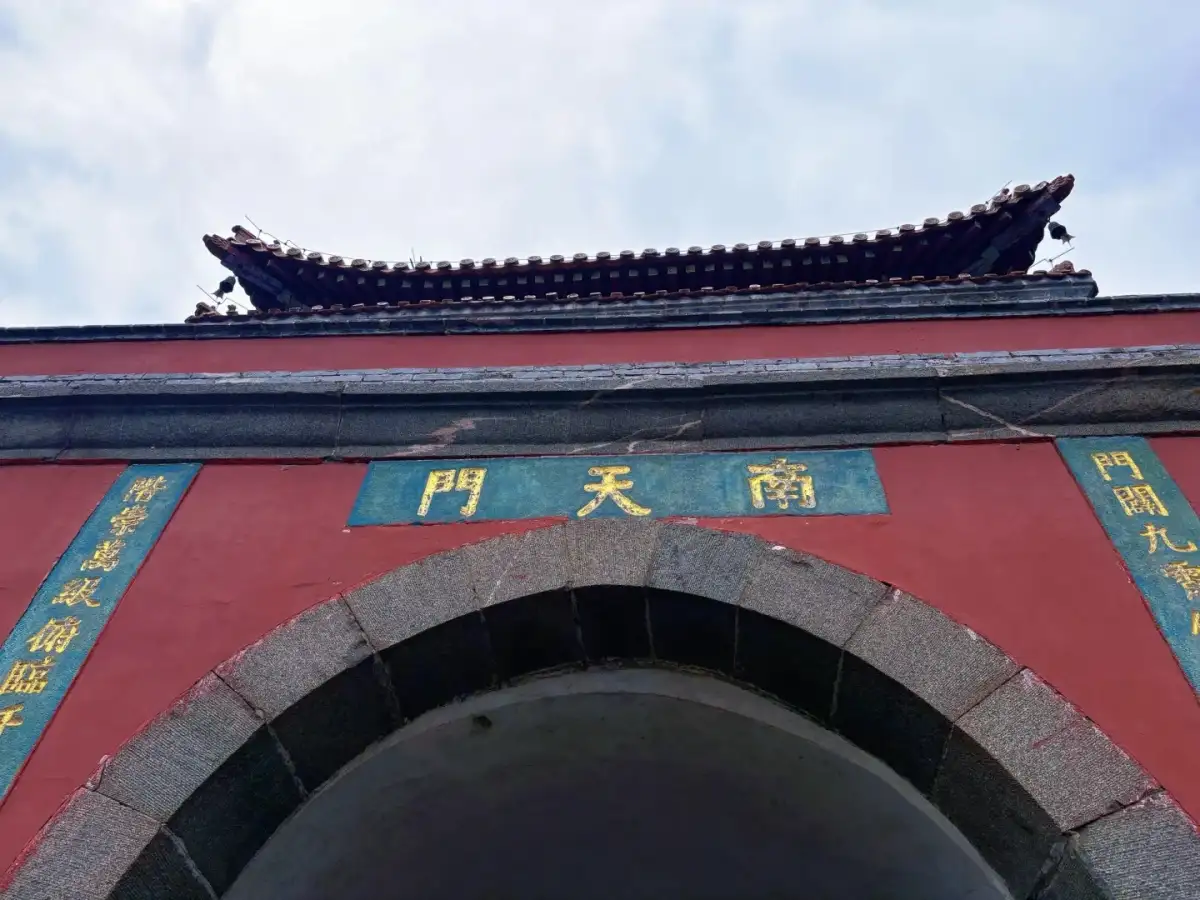
The South Heavenly Gate archway, plaque, and red walls of Mount Tai. Photo:Click, click Zyzz · Original Post.
calligraphy enthusiasts may refine their questions further: how does a particular stroke turn on the stone surface? How does the spacing between characters create rhythm? Does the irregular edge of the stone affect the overall impression? On-site observation and tracing on paper involve different conditions; acknowledging this difference makes the discussion more concrete. When focusing solely on form, it is not necessarily necessary to immediately judge its merit; simply describing what you see is often more persuasive than relying on a few evaluative terms.
skip a few passages to preserve the integrity of the viewing experience
When there are many inscriptions, you can choose one to view from a distance, one to read up close, and another to discuss with your companions. If there are differences in location and form among these three, they can form a small theme for exploration. This approach ensures that the hike isn’t fragmented by constant commentary, nor does it reduce all the text to mere roadside scenery. By viewing fewer inscriptions, it becomes easier afterward to clearly explain why you stopped at each one and how those stops altered your impression of Mount Tai.
This SiteIntroduction to Mount Tai Destinationshelp you situate your reading of the inscription within the broader context of your hike. Specifically on a mountain trail, the most practical preparation isn’t memorizing a list of names, but rather bringing along a few questions you can answer on the spot. Where are the characters located? From what distance should they be viewed? How do they differ from the text beside them? And how do you respond to them today? These questions make cultural interest tangible and allow a walk to develop its own rhythm of discovery.
Source and Editorial Notes
This article is an original travel interpretation compiled by the Dongxing Travel editorial department based on listed materials; it is not a firsthand account by the author. The full text of the original post has not been reproduced; accompanying images are used within the scope of authorization and are credited to the author and the source of the original post. They do not serve as proof of actual travel experiences or services provided by Dongxing Travel.
Click, click—Zyzz · Classic Mount Tai Hiking Routes! · Travel Notes; Verified/Organized on: October 3, 2026.
Mount Tai Scenic Area Management Committee · Mount Tai Hongmen Tourist Route · Official source; Verified/Compiled on: October 3, 2026.
Mount Tai Scenic Area Management Committee · Tianwai Village Tourist Route · Official source; Verified/Compiled on: October 3, 2026.
UNESCO World Heritage Centre · Mount Taishan · Official source; Verified/Compiled on: October 3, 2026.